Charts & Markets – 11 Jun, 2018


Ibovespa Brasil Sao Paulo Stock Exchange Index

It has been a rough few weeks for Brazilian capital markets. In the short-term, the sell-off should be getting close to being done. We would not be surprised to see a rally soon.

IBOV Index (Ibovespa Brasil Sao 2018-06-11 10-51-06

Straits Times Index

Singapore’s equity market is attempting to break out of its 9 year trading range.
STI Index (Straits Times Index S 2018-06-11 10-38-28
Singapore Airlines

Like the broader market, Singapore Airlines has been sideways for many years and is now near the high-end of its trading range.

SIA SP Equity (Singapore Airline 2018-06-11 10-37-00

Tadawul All Share Index

Saudi Arabia’s stock market is at three-year highs with investors fully expecting MSCI to upgrade the Saudi market to emerging market status on 20 June.

SASEIDX Index (Tadawul All Share 2018-06-11 10-42-06

SABIC

The largest company in the Saudi market by market cap is making a run for 10 year highs.

SABIC AB Equity (Saudi Basic Ind 2018-06-11 10-43-14

Al Rajhi Bank

The largest bank and second largest company in the Saudi market recently recorded 10 year highs.

RJHI AB Equity (Al Rajhi Bank) U 2018-06-11 10-46-34

Uranium 

After a prolonged bear market, is uranium making an inverse head-and-shoulders bottoming pattern?

UXA1 Comdty (Generic 1st 'UXA' F 2018-06-11 10-28-28

Uranium Participation Company

A pure play on uranium, is also carving out a similar pattern.

URPTF US Equity (Uranium Partici 2018-06-11 10-31-35


Fast Retailing Co

The largest constituent of Japan’s Nikkei 225 Index is trying to make a run for the 2015 highs.

9983 JT Equity (Fast Retailing C 2018-06-11 10-55-16

SoftBank Group

On the other hand, the second largest constituent of Japan’s Nikkei 225 Index looks in bad shape.

9984 JT Equity (SoftBank Group C 2018-06-11 10-54-59

Chipotle Mexican Grill

Is the worst over for Chipotle? It looks it wants to go higher.
CMG US Equity (Chipotle Mexican 2018-06-11 12-29-10

Starbucks

The stock has gone nowhere since mid-2015. Is the next leg lower and through the three-year trading range? We would not bet against it happening.

SBUX US Equity (Starbucks Corp) 2018-06-11 11-23-51

Darden Restaurants

A much more difficult call to make but we think this might be heading much lower eventually as well.

DRI US Equity (Darden Restaurant 2018-06-11 12-30-54

TripAdvisor

Another stock coming back from the dead. Looks like it could go much higher.
TRIP US Equity (TripAdvisor Inc) 2018-06-11 14-46-11

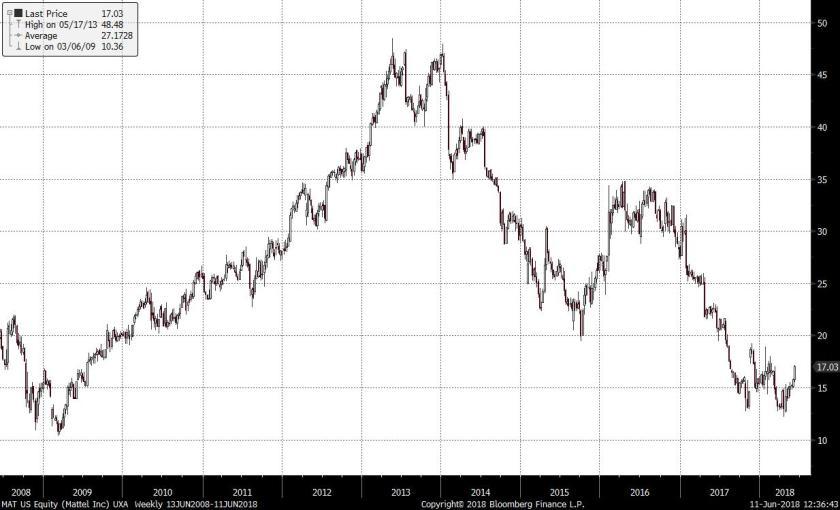
Mattel Inc

A little less obvious but toy maker Mattel may not be the worst contrarian long out there. 
MAT US Equity (Mattel Inc) UXA 2018-06-11 12-36-41
This post should not be considered as investment advice or a recommendation to purchase any particular security, strategy or investment product. References to specific securities and issuers are not intended to be, and should not be interpreted as, recommendations to purchase or sell such securities. Information contained herein has been obtained from sources believed to be reliable, but not guaranteed. 

The Vollgeld Initiative


“Money is a public good; as such, it lends itself to private exploitation.”  ― Manias, Panics, and Crashes: A History of Financial Crises by Charles P. Kindleberger


This weekend the people of Switzerland vote on the Swiss sovereign-money referendum – a radical bank reform plan otherwise known as the Vollgeld proposal. The proposal for the referendum was initiated by Hansruedi Weber, a former schoolteacher turned financial reformer who founded the Monetary Modernisation Association (MMA) – a Swiss, not-for-profit, non-governmental, non-politically affiliated organization. Mr Weber and other proponents of the reforms argue that the reforms within the Vollgeld proposal will make the financial system safer while the Swiss National Bank dismisses them as a “dangerous experiment”.


So which is it? The short answer, it is a bit of both.


Taking a step back, the Vollgeld proposal consists of two key elements:


  1. Imposing a 100 per cent reserve requirement on demand deposits i.e. putting an end to the long-standing system of fractional reserve banking; and


  1. Transferring the right to “create” money to the central bank (without the need to finance debt).


By requiring banks to back demand deposits fully with reserves, the Vollgeld proposal effectively necessitates the conversion of Swiss banks from lenders to depository institutions. In simple terms, under the terms of the Vollgeld proposal, Swiss banks will not be permitted to use demand deposits to extend financing. Thus making hundred per cent of demand deposits available on demand and in turn fully mitigating the risk of a bank run.


Since money is created by commercial banks by extending financing, commercial banks would, as a consequence, no longer be able to create money. Banks wishing to continue their lending activities would instead have to obtain funds through alternative sources and in all likelihood offer higher interest rates to attract time deposits. From this perspective, if the reforms were to pass it would be a victory for savers. And given that capital is fungible, capital would flow from the negative and zero interest rate regimes across the developed world into Switzerland.


The losers from the reforms passing, we think, would be Swiss banks and banks across the Eurozone. While we suspect the Swiss banks shares would be the first to be hit, the forward earnings expectations of European banks operating under zero and negative interest regimes would be most severely impacted. European banks we think would suffer from marginal capital fleeing from the environment interest repression in Europe to benefit from interest rate liberalisation in Switzerland.


For the Swiss economy at large, a hundred per cent reserve requirement may well turn out to be positive. There would no longer be the waxing and waning in the demand for, or supply of, credit that could cause wild swings in money supply. A stable money supply in turn would reduce both the risk of credit led excesses building up in the economy and the volatility in business cycles.


Unfortunately the Vollgeld proposal is not limited to simply ending fractional reserve banking.


For all its soundness with respect to putting an end to fractional reserve banking, the proposal is equally flawed as the current system by allowing the central bank to continue to lend directly to the banking system. The provisions within the proposal allow the Swiss National Bank: (1) to support any banks suffering from declining net interest margins or shrinking loans and (2) to control interest rates by offering funds to banks at low interest rates.


Moreover, the Vollgeld proposal enables the central bank to create money and inject it into the system simply by giving it away. In contrast, today, the Swiss National Bank is only able to create money either by lending to commercial banks or by selling Swiss francs in exchange for other assets such as euros or US equities. In either case, the central bank can only create money today by financing debt .


The reforms would free the Swiss National Bank to undertake Milton Friedman’s famous ‘helicopter drop’ of money at any time should they wish to do so as money creation will be unhinged from the requirement to buy debt. The only limitation on the central bank would be that money can only be given out either to the government or to the Swiss population.


The MMA insists this loophole will be used prudently. There are no checks and balances on the central bank to ensure conservatism, however. And history has taught as us that when push comes to shove central banks when placed under political pressure can abandon conservatism without hesitation.


For this reason, in the unlikely event the Vollgeld plan does get approved this weekend, it is not clear that in the short term it should be either bullish or bearish for the Swiss franc. The Swiss National would still have all the tools to manipulate the Swiss franc in any way it wishes.


While would be somewhat surprised if the reforms pass, we think the Vollgeld proposal is the start of trend that will result in many such banking reforms being put to vote across the developed world. For this reason and until the dust settles, we would avoid investing in Swiss and European banks.


This post should not be considered as investment advice or a recommendation to purchase any particular security, strategy or investment product. References to specific securities and issuers are not intended to be, and should not be interpreted as, recommendations to purchase or sell such securities. Information contained herein


The Contrarian Quartet (Part II)

“You never bet on the end of the world, that only happens once, and the odds of something that happens once in an eternity are pretty long.” – Art Cashin

“A thing long expected takes the form of the unexpected when at last it comes.” – Mark Twain

This week’s piece is a follow up to last week’s Contrarian Quartet (Part I). We outline the remaining two out of the four opportunities where we find the risk-to-return profile in being contrarian is far more attractive than in following the herd.

Rather fortuitously we decided to delay writing about Italy, the first of the two opportunities we discuss below, to this week as the deterioration in sentiment towards the sustainability of the European Union has accelerated.

Italy

“In investing, what is comfortable is rarely profitable.” – Robert Arnott, chairman and chief executive officer of Research Affiliates

As recently as three weeks ago, investors were disregarding the risks of political turmoil in Italy and lifting the Italian stock market higher. From the start of the year to market close on 7 May, 2018, the FTSE MIB Index generated a total return of 12.2 per cent in US dollar terms versus a measly return of 41 basis points for the MSCI All Cap World Index. Starting 8 May Italian outperformance started to unwind and the year-to-date return for the market, based on live prices as at the time of writing, is now negative. As the cliché goes, stocks take an escalator up and an elevator down.

FTSE MIB IndexFTSE MIB.pngSource: Bloomberg

Investors were first spooked by the two leading populist parties in Italy – the Five Star Movement and the League – moving to form a coalition to run the country. And then by President Sergio Mattarella’s decision to block the formation of a eurosceptic government and selecting Carlo Cottarelli, an International Monetary Fund alumnus, as prime minister-designate, to try to form a new government.

The selection of Mr Cottarelli, who has consistently defended Italy’s membership in the euro and became known as “Mr Scissors” for making cuts to public spending in Italy during Enrico Letta’s brief period as prime minister, has antagonised the populist coalition.  The populists see the selection as a deliberate attempt by President Mattarella to undermine the Italian people’s will as expressed by them in the recent election. Moreover, choosing Mr Cottarelli flies in the face of the coalition’s desire to put eurosceptics in key cabinet positions – as they tried to do by choosing Paolo Savona, the 81-year-old Eurosceptic economist, as their economy minister.

Given the antagonist nature of the President’s selection, Mr Cottarelli is highly unlikely to win a vote of confidence in parliament. Italy, in all likelihood, will have to hold a new set of elections in the autumn. And the next election has inextricably become about Italy’s membership in the euro. The worry is that the populists will use the bitterness from President Mattarella’s actions to rally their voters and emerge even stronger after the new elections.

Investors have been selling-off all things Italy in apprehension. Most drastically, the yield spreads between Italian and German government debt has blown out.

Italian vs. German 10 Year Government Bond Yield SpreadYield SpreadSource: Bloomberg

This is not the reaction President Mattarella was expecting, we suspect.

While we acknowledge that political risk in Europe is back in vogue, we consider the probability of an Italian exit to be low and with the caveat that Señor Draghi keeps the monetary spigots up and running we see even less risk of financial contagion spreading through Europe.

Consider the state of Italian sovereign debt today versus that at the height of the Euro Crisis. Foreign-ownership of Italian sovereign debt is down from 41 per cent in 2010 to 32 per cent today, with non-European investors holding a paltry 5 per cent. At the same time, Italy’s debt servicing costs as a percentage of GDP are at their lowest level since the euro was instituted – this of course is largely down to the ECB’s benevolence.

The Italian economy has been humming along quite nicely with first quarter GDP year-over-year growth of 1.4 per cent. Italy is also running a primary fiscal surplus and the fiscal deficit for 2017 was just 2.3 per cent of GDP and is likely to fall below 2.0 per cent in 2018.

The possibility of a fiscal blow-out due to extortionate spending by the populist coalition, if it is elected in the next elections, is also highly improbable. Since 2012, the Italian constitution mandates the balanced budget law and the president has the power to veto any decision that is not in adherence with this law. We are almost certain that a Europhile like President Mattarella will not hesitate in exercising the veto should the need arise.

Lastly, there are clear ideological differences between the two coalition parties and it is likely that such differences will be severely tested in the run up to the elections and, if they are elected, by the highly bureaucratic legislative system in Italy.  We suspect that the differing ideologies will impair the populist coalition’s ability to implement policies, which in turn will severely test its survival.

For these reasons we consider the drastic widening of the yield spread in Italian debt relative to German debt to be somewhat unwarranted. Despite this and given where absolute yields are in Europe, we do not think investors should have any sovereign or corporate bond exposure in Europe.

We also think it might still be a bit early to add broad based exposure to Italian stocks. Although selectively we are starting to see opportunities in high quality Italian companies, which we will be monitoring closely for potential entry points.

Where we see the greatest opportunity is to go long the euro relative to the US dollar. We think the current sell-off in the euro is sowing the seeds for the next down leg in the US dollar. The political uncertainty has facilitated the unwinding of bullish euro and bearish US dollar positioning. We suspect positioning will quickly become, if it has not already, very bearish in the euro and bullish in the US dollar. Overly bearish positioning is in our minds a necessary condition for the euro to re-assert its bullish trend.


US Long Dated Treasuries

GS US Financial Conditions Index versus US 30 Year Treasury YieldsGS US FCI vs 30YSource: Bloomberg

In The Convergence of US and Chinese Bond Markets we wrote:

“The shifting secular trend does not, however, warrant shorting US treasuries. The last secular US bond bear market lasted thirty-five years and can be sub-divided into thirteen parts: seven major price declines and six bear market rallies. Moreover, even though short-term interest rates bottomed around 1941, long-term bond yields continued to decline till 1946. We would not be overly surprised if a similar dynamic played out once again, with short-term rates bottoming in 2015 and long-term bond yields bottoming several years after.”

While we remain secular bears on US government bonds, we think long dated US treasuries currently offer a tactical opportunity on the long-side. US financial conditions have started to tighten after the easing induced by the enactment of the Trump tax plan – for instance US companies pre-funded their pension schemes to benefit from the higher tax rate in 2017 and contributed to the easing in financial conditions – is beginning to wear off and the reality of higher rates and higher oil prices squeezes system-wide liquidity. As demonstrated in the above chart, as financial conditions tighten, long-term bond yields tend to decline shortly after. Add to this the near record levels of short positioning in long-dated treasuries by non-commercials and you have a recipe for sharp rally in long-dated US treasuries.

Please share!

This post should not be considered as investment advice or a recommendation to purchase any particular security, strategy or investment product. References to specific securities and issuers are not intended to be, and should not be interpreted as, recommendations to purchase or sell such securities. Information contained herein   

The Contrarian Quartet (Part I)

“If all the economists were laid end to end, they’d never reach a conclusion.” – George Bernard Shaw

“Twenty years from now you will be more disappointed by the things that you didn’t do than by the ones you did do.” – Mark Twain

 “Studies have shown that most rational people, including people that fit that profile, that their decision making breaks down in an environment of negative reinforcement. The ultimate example of which would be interrogation, where your ability to withhold information is broken down by various physical or mental techniques.” – Jim Chanos


Is there any population cohort exposed to a more rigid daily routine than school going children and teenagers?

The constant ringing of bells, schedule of classes, lunchtime, homework, each a daily fixture throughout the academic year. It is no wonder then that most people tend to be conformists – the rigidness of school stamps out individualism in favour of conformity.

The irony of it all is that we celebrate the individuals who have managed to resist the rigidness and maintain their non-conformist streaks. Our heroes are Steve Jobs not Jeffrey Immelt, Muhammad Ali not Floyd Mayweather, The Beatles not Coldplay.

Capital markets too have on occasion handsomely rewarded the contrarians, like Dr Michael Bury during the Global Financial Crisis, Paul Tudor Jones in 1987, and Jesse Livermore in 1929. Markets do not, however, look kindly upon the reflexive contrarian – the investor that cannot help but go against the trend. Markets can be conformists for extended periods of time and hence why momentum following strategies can be so rewarding.

We like to consider ourselves independent investors – investors that scour the market for signals that may provide us with opportunities to generate outsized returns. Our aim is neither to be contrarian nor momentum driven. Today, however, we see four areas of the market where the risk-to-return profile in being contrarian is far more attractive than in following the herd. We outline two out of the four areas of opportunity below and will outline the remaining contrarian opportunities in a follow-up next week.

Turkey

“Bull markets are born on pessimism, grow on scepticism, mature on optimism and die of euphoria.” – Sir John Templeton


In Turkey today we see many reminisces of what occurred in Brazil in 2015, with the caveat that with Turkey embroiled in a geopolitical storm as compared to the internal political strife in Brazil in 2015 makes Turkey potentially far more volatile.

Consider Brazil at the height of its crisis in 2015:

  • The premium on Brazil’s three-year credit default swaps surged by 189 per cent over a period of four and half months
  • The Brazilian real declined by 43 per cent versus the US dollar in a period of four and half months
  • Using the twenty-five year average, Brazil’s real effective exchange rate was one standard deviation below its average

Brazil Real Effective Exchange Rate (25 Years)Brazil REER 25Y

Source: Bank for International Settlements

  • Using the five year average, Brazil’s real effective exchange rate was two standard deviations below its average. As the political turmoil subsided and the real effective exchange rate reverted towards the mean, the Brazilian equity market rallied and foreign investors enjoyed the leveraged effect of a rising equity market coupled with the strengthening real

Brazil Real Effective Exchange Rate (5 Years) vs. MSCI Brazil IndexBrazil REER 5YSources: Bank for International Settlements, Bloomberg

  • Brazil’s rating was downgraded from Baa2 to Baa3 by Moody’s and from BBB-minus to BB-plus by Standard & Poor’s

Now consider Turkey in 2018:

  • The premium on Turkey’s three-year credit default swaps has increased by 152 per cent in less than three months
  • The Turkish Lira has declined by 26 per cent versus the US dollar in a period of less than three months
  • Using the twenty-five year average, Turkey’s real effective exchange rate is almost one standard deviation below its average

Turkey Real Effective Exchange Rate (25 Years)Turkey REER 25Y

Source: Bank for International Settlements

  • Using the five year average, Turkey’s real effective exchange rate is two standard deviations below its average


Brazil Real Effective Exchange Rate (5 Years) Turkey REER 5Y Sources: Bank for International Settlements, Bloomberg


  • Turkey’s rating has been downgraded from Ba1 to Ba2 by Moody’s and from BB to BB-minus by Standard & Poor’s

The bad news is that Turkey runs a current account deficit of around US dollar 40 billion a year and has external debt stock of approximately US dollar 450 billion. The net amount of outstanding external debt is around US dollars 290 billion, representing 34 per cent of its GDP.

The good news is that the vast majority of Turkey’s foreign currency denominated debt is held by local banks. We do not expect Turkey to default on the debt it owes to foreign investors. This view is founded on the assumption that while President Recep Tayyip Erdoğan can afford to antagonise the US and Europe on the political front given Turkey’s geopolitical significance, he cannot afford to antagonise foreign investors as Turkey relies on international capital markets to fund its economy.

We think the time is coming to scale into Turkish assets. The sequence of scaling in being the Turkish lira first, foreign currency bonds second, local currency bonds next and the equity market last.


Swiss Franc

“You can’t do the same things others do and expect to outperform.” – The Most Important Thing by Howard Marks

Hedge funds and speculators are holding the biggest net short Swiss franc position in more than ten years at a time when the Swiss franc is close to being undervalued relative to the US dollar – a first since the start of the new millennium.

CFTC CME Swiss Franc Net Non-Commercial PositionCHF CFTC

Source: Bloomberg

Over the last decade, Switzerland has run an average current account surplus of 9.3 per cent of GDP. The Swiss franc should not be undervalued. If anything, given that Switzerland has consistently run current account surpluses and enjoys the so called global safe haven status, the Swiss franc should be overvalued.  We all know the reason why the currency is not overvalued: the non-stop printing and selling of its currency by the Swiss National Bank.

At the end of last year, the State Secretariat for Economic Affairs revised its economic growth forecasts for Switzerland upwards, forecasting GDP to grow by 2.3 per cent in 2018 after growth of 1 per cent in 2017. The revision was driven by industrial orders rising by a fifth in the fourth quarter last year and a booming tourism industry that is benefiting from the artificial suppression of the Swiss franc.

In the face of such strong economic growth we doubt that the Swiss National Bank can sustain the suppression of its currency. We suspect the Swiss National Bank, not for the first time, is going to cause a lot of pain to those unwisely betting against its currency.

We will gradually look to get long the Swiss franc once we see the broader short interest against the US dollar unwinding – we expect such an opportunity to be presented imminently.

This post should not be considered as investment advice or a recommendation to purchase any particular security, strategy or investment product. References to specific securities and issuers are not intended to be, and should not be interpreted as, recommendations to purchase or sell such securities. Information contained herein  

Consumer Staples: Niches and Acquisition Targets


“You can say Pizza Hut is terrible pizza, but they also sell more pizzas than anybody else.” – Jimmy Kemmel


“Mergers are like marriages. They are the bringing together of two individuals. If you wouldn’t marry someone for the ‘operational efficiencies’ they offer in the running of a household, then why would you combine two companies with unique cultures and identities for that reason?” – Simon Sinek


“One thing I love about customers is that they are divinely discontent. Their expectations are never static — they go up. It’s human nature. We didn’t ascend from our hunter-gatherer days by being satisfied. People have a voracious appetite for a better way, and yesterday’s ‘wow’ quickly becomes today’s ‘ordinary’. I see that cycle of improvement happening at a faster rate than ever before. It may be because customers have such easy access to more information than ever before — in only a few seconds and with a couple taps on their phones, customers can read reviews, compare prices from multiple retailers, see whether something’s in stock, find out how fast it will ship or be available for pick-up, and more. These examples are from retail, but I sense that the same customer empowerment phenomenon is happening broadly across everything we do at Amazon and most other industries as well. You cannot rest on your laurels in this world. Customers won’t have it.” Jeff Bezos in this year’s letter to Amazon shareholders


“If you don’t like what’s being said, change the conversation.” – Don Draper, Mad Men Season 3, Episode 2


June 2017: Amazon announces it is acquiring Whole Foods. The market cap of twenty companies in the food and retail sectors declines by almost US dollars 40 billion.

August 2017: Amazon announces that it will be cutting prices at Whole Foods. The market cap of Kroger, Wal-Mart, Target, Costco, Supervalu and Sprouts Farmers Markets drops by nearly US dollars 12 billion.

May 2018: Walmart announces acquiring a controlling stake in India’s largest online retailer. Walmart shares decline by 4 per cent in response.

May 2018: Kroger announces that British online supermarket Ocado’s technology will be used in the US exclusively by Kroger and that it will also take a 5 per cent stake in Ocado. Ocado’s share price surged by 44 per cent subsequent to the announcement.


Are Walmart and Kroger trying to change the conversation or do they want to be seen to be doing something?


One year, while we were working at a boutique asset management firm, our flagship fund was underperforming both its benchmark and peers by a significant margin. We had suffered two straight quarters of underperformance and were on track to record our third consecutive quarter of underperformance – a humiliation hitherto avoided by the organisation in its 10-year history.

The CIO’s response to our continued underperformance was to get the team to work harder: longer hours, more meetings with management teams of our various holdings, more research, more analysis, more detailed financial models, more team discussions, more, more, and more. The end result: more underperformance.

Given the underperformance, each team member knew bonuses were going to be bad, everyone expected a significant cut. Despite this knowledge, not one single team member took time-off in the two months leading up to date bonuses are distributed. Each and every one of us worked even longer hours, sent out more emails, and upped our contribution during team discussions. We were all guilty of wanting to be seen as contributing positively to the investment process.

Working harder does not always lead to better results, especially when it comes to investing.

To be seen as contributing is not the same as actually contributing.


S&P 500 GICS Level 1 Consumer Staples Index

StaplesSource: Bloomberg

We have written about the challenges faced by consumer staples and consumer packaged goods companies on a number of occasions (see Unbranded: The Risk in Household Consumer Names, The Incumbent’s Challenge, and Containers and Packaging Companies: Challenges Aplentyhttps://lxvresearch.com/2018/03/01/containers-and-packaging/). The narrative of the decline in consumer staples, we think, has gradual come into acceptance and this acceptance is being reflected both in the share prices of many of the leading consumer staples companies as well in the types of articles appearing in broadsheets such as the Wall Street Journal and the Financial Times. Take for instance the following excerpt from ‘Amazon Effect’ Stings Consumer-Staples Stocks as Pricing Woes Mount published on 25 April, 2018 by the Wall Street Journal:

The industry’s pricing issues have many money managers wondering whether the biggest makers of household staples have already seen their best days.


“What’s happening is that these firms are struggling to pass on rising costs to consumers,” said Shawn Cruz, manager of trader strategy at TD Ameritrade. “Big brands have counted on their brand name drawing customers in, and that’s not necessarily happening anymore.”


To date, as it relates to the consumer staples sector, our focus has primarily been on avoiding losers and identifying potential shorting opportunities. All is not doom-and-gloom in the consumer staples sector, however. As the cliché goes, where there are challenges, there are also opportunities. And we are starting to see opportunities.


Investment Perspective


Management teams at the leading consumer staples companies have responded to the challenges they face and to declining share prices by looking inwards. Management teams can be inward looking in many ways.

One way is to hire strategy consultants like McKinsey & Co. to help identify areas of inefficiency and procedural optimisation, or to devise cost cutting initiatives that can rid the businesses of unnecessary costs. Another way to double-down on what has worked in the past: to increase investments into their brands i.e. to advertise more, to increase awareness of their brands. Yet another way is to increase research & development budgets to develop new, better, and more “on-trend” products.

Eventually, we suspect, a number of the large consumer product companies will come to realise that (1) cost-cutting only goes so far and that it does not really excite would be shareholders, (2) doubling-down no longer works in the internet-era, and (3) they lack the creativity to deliver “on-trend” products. As companies come to these realisations they will become increasingly outward looking i.e. they will look to acquire that which they do not have and that which consumers desire.

Unilever has already done this by acquiring Dollar Shave Club. Coca-Cola and Procter & Gamble too by acquiring kombucha tea brand Honest Tea and all natural deodorant brand Native, respectively.

While a number of the acquisitions will be made in private markets, we believe owning a basket of small- and mid-cap food and retail companies that have carved out successful niches can provide investors with exposure to potential acquisition targets and the promise of outsized returns.

With this perspective, we think a basket of names such as Natural Grocers by Vitamin C $NGVC, Village Supermarket $VLGEA, Weis Markets, Alico Inc $ALCO, Cal-Main Goods Inc $CALM, Primo Water $PRMW, and Natural Health Trends Corp $NHTC can provide just that kind of exposure.


This post should not be considered as investment advice or a recommendation to purchase any particular security, strategy or investment product. References to specific securities and issuers are not intended to be, and should not be interpreted as, recommendations to purchase or sell such securities. Information contained herein

The Old Man and the Election


It was considered a virtue not to talk unnecessarily at sea and the old man had always considered it so and respected it. But now he said his thoughts aloud many times since there was no one that they could annoy.

“If the others heard me talking out loud they would think I am crazy,” he said aloud. “But since I am not crazy, I do not care. And the rich have radios to talk to them in their boats and to bring them the baseball.” ― Excerpt from The Old Man and the Sea by Ernest Hemingway


The ability to create and imagined reality out of words enabled large numbers of strangers to cooperate effectively. But it also did something more. Since large-scale human cooperation is based on myths, the way people cooperate can be altered by changing the myths – by telling different stories. Under the right circumstances myths can change rapidly. In 1789 the French population switched almost overnight from believing the myth of the divine right of kings to believing in the myth of sovereignty of the people. Consequently, ever since the Cognitive Revolution Homo sapiens has been able to revise its behaviour rapidly in accordance with changing needs. This opened a fast lane of cultural evolution, bypassing the traffic jams of genetic evolution. Speeding down this fast lane, Homo sapiens soon far outstripped all other human and animal species in its ability to cooperate. – Excerpt from Sapiens: A Brief History of Humankind by Yuval Noah Harari  


David William Goodall, the 104 year old British-born Australian botanist and ecologist, voluntarily ended his life at a clinic in Basel, Switzerland yesterday. Mr Goodall enjoyed fish & chips and cheesecake for his final meal. He passed away surrounded by family and listening to Beethoven’s Ninth Symphony.

Reportedly, Mr Goodall was not terminally ill but rather had become fed up with his life after having had to stop most of his activities – including conducting research at the Centre for Ecosystem Management at Edith Cowan University – due to his eyesight and mobility deteriorating.

Physician assisted dying, where a patient’s decision to end their lives is aided by a physician, is legal in Canada, the Netherlands, Luxembourg, Switzerland and parts of the US.


On the very day Mr Goodall made his final decision to end his life, Malaysia swore in 92-year old Mahathir Mohamad – the man famously called a ‘moron’ and the ‘Marcos of Malaysia’ by George Soros at the depths of the Asian Financial Crisis – as their prime minister, making him the world’s oldest elected leader.

Mahathir Mohamad, Malaysia’s premier from 1981 to 2003, has pulled off what can only be described as an astonishing upset in the parliamentary elections. His Pakatan Harapan (Alliance of Hope) coalition’s victory brings to an end the governing coalition’s six-decade rule.

The initial international reaction to Dr Mohamad’s victory was negative with both offshore Malaysian ETFs and offshore ringgit non-deliverable forwards selling off sharply. International investors are understandably spooked: Dr Mahathir campaigned on a populist platform. The nonagenarian promised wide-ranging tax cuts, rolling back the previous administration’s subsidy cuts, and to return to state coffers the billions plundered from 1MDB, one of Malaysia’s prominent sovereign wealth funds, as part of his election campaign.

The newly elected prime minister reiterated his populist promises straight after taking the oath of office at the state palace in Kuala Lumpur on Thursday.

Ahead of the election, Dr Mahathir also promised that should he once again become Malaysia’s prime minister, he would hand over power to Anwar Ibrahim – leader of the opposition from 2008 and 2015.


Mr Ibrahim served as Malaysia’s finance minister from 1991 to 1998 and deputy prime minister from 1993 to 1999. He was removed from his post in 1999 and jailed on sodomy charges by Prime Minister Mahathir Mohamad. The charges were overturned and he was released from prison in 2004. After his release Mr Anwar helped form the coalition of three opposition parties, which contested the 2008 and 2013 general elections.

Anwar Ibrahim was arrested a second time on sodomy charges in 2015 and sentenced to five-years in prison. This time the charges were brought against him by Prime Minister Najib Razak just as Mr Anwar was preparing to contest a state by-election he was expected to win and become the chief minister of Selangor, Malaysia’s main economic hub surrounding Kuala Lumpur.

Anwar Ibrahim today received a royal pardon for his five-year prison sentence that he has been serving since 2015. This pardon clears the way for Mr Anwar to replace Dr Mohamad as the prime minister of Malaysia.


The Malaysian economy’s growth surged to 5.9 per cent last year and is forecast by the central bank to reach 5.5 to 6 per cent in 2018. The economic recovery has come on the back of a pick-up in global trade and rising domestic demand. Despite the recovery, the economy remains fragile. Public debt stands at 50 per cent of GDP – much higher than that for other comparable economies – and approximately two fifths of its local currency debt is held by international investors.

Prime Minister Mahathir Mohamad has promised to remove the 6 per cent goods and services tax (GST), introduced by the Najib government in 2015, and reinstate the more lenient sales and services tax (SST) that was in place prior to the GST. This change, if enacted, will put severe pressure on government finances. The GST was estimated to contribute eighteen per cent of total government revenues this year. In contrast, the SST contributed only eight per cent to government revenues in 2014.

Another shift in policy promised by Dr Mohamad is a re-assessment of Chinese investments in to Malaysia. In recent years China has been the primary source of foreign direct investment into Malaysia. Despite the campaign trail promise, we do not expect any meaningful change resulting from the re-assessment. We believe calling out China was the low-hanging fruit for the populist platform as the rhetoric resonates well among ethnic Malay voters.


Investment Perspective


Malaysia Real Effective Exchange Rate (REER)REER.pngSource: Bank for International Settlements

The Malaysian ringgit is presently one standard deviation below its fair value. If an election-led sell-off in the currency or a sustained rally in the dollar brings the currency close to two standard deviations below fairly value, we would become eager buyers of Malaysian assets.

Since the end of 2009, the monthly correlation between the Malaysian equity index and the real effective exchange rate is 73.4 per cent with an r-squared of 0.54, i.e. the stock market goes up with a rising real effective exchange rate. If the Malaysian currency were to weaken such that it becomes close to two standard deviations below fair value, we would consider that an attractive entry point into the Malaysian stock market.


Malaysia Real Effective Exchange Rate vs. Malaysian Stock Market PerformanceREER StocksSources: Bank for International Settlements, Bloomberg


This post should not be considered as investment advice or a recommendation to purchase any particular security, strategy or investment product. References to specific securities and issuers are not intended to be, and should not be interpreted as, recommendations to purchase or sell such securities. Information contained herein


AIG, Robert E. Lighthizer, Made in China 2025, and the Semiconductors Bull Market

“The icon of modern conservatism, Ronald Reagan, imposed quotas on imported steel, protected Harley-Davidson from Japanese competition, restrained import of semiconductors and automobiles, and took myriad similar steps to keep American industry strong. How does allowing China to constantly rig trade in its favour advance the core conservative goal of making markets more efficient? Markets do not run better when manufacturing shifts to China largely because of the actions of its government.” – Robert E. Lighthizer

“Patience is essential. We should step back, take a deep breath and examine carefully the ties that bind us together.” Maurice “Hank” Greenberg, former CEO of American International Group, at the congressional hearing on US-China economic ties in May 1996

American International Group (AIG), the once venerable multinational insurance group, was founded in 1919 in Shanghai, where it prospered until the communists forced it to leave in 1950. AIG had to wait over four decades to re-enter the Chinese market. In 1992, AIG became the first foreign insurance company licensed to operate in China and established its first office on the Mainland in Shanghai.

We doubt it was sentiment that led China to grant AIG the license. After all, there is little room for sentiment in the high-stakes game of global trade.

In 1990, Maurice “Hank” Greenberg, then chief executive of AIG, had been appointed as the first chairman of the International Business Leaders’ Advisory Council for the Mayor of Shanghai. In 1994, Mr Greenberg was appointed as senior economic advisor to the Beijing Municipal Government. In 1996, at the time when China’s status as Most Favoured Nation (MFN)[1] was under threat due to a resolution put forth to the House of Representatives in the US, he was appointed as the Chairman of the US-China Business Council.

While all of above mentioned appointments may have raised an eyebrow or two, they do not amount to much in and of themselves. When we throw in the fact that Mr Greenberg had been part of the President’s Advisory Committee for Trade Policy and Negotiations since the 1970s – the official private-sector advisory committee to the Office of the US Trade Representative – we begin to realise the possible reason why the Chinese leadership took a liking to Mr Greenberg and afforded his company the luxury of becoming the first foreign insurer to operate in China.

In May 1996, Mr Greenberg, during a key congressional hearing on US-Sino economic ties, testified in favour of not only renewing China’s MFN status but also making it permanent.

There we have it: quid pro quo.

In June 1996, the House of Representatives endorsed China’s MFN status by a vote of 286 to 141. At the time of vote AIG had eleven lobbyists representing its interests in Washington. One of those lobbyists was Skadden, Arps, Slate, Meagher & Flom, where AIG’s affairs were handled by one Robert E. Lighthizer – the current United States Trade Representative.


Senior American and Chinese officials concluded two days of negotiations on trade and technology related grievances the Trump Administration has with China. As many may have suspected, the talks appear to have achieved little despite the US sending a team comprised of top-level officials including Treasury Secretary Steven Mnuchin, Trade Representative Robert Lighthizer, White House trade advisor Peter Navarro, Secretary of Commerce Wilbur Ross, and National Economic Advisor Larry Kudlow.

As part of the talks the US representatives have submitted an extensive list of trade and technology related demands. In our opinion, the demands represent a hodgepodge of objectives as opposed to one or two key strategic objectives the Trump Administration may have – symptomatic of the differing views held by the various members of the US team. We expect US Trade Representative Robert E. Lighthizer to slowly take control of proceedings and to set the agenda for US-China trade relations – after all he is the only senior member of the team with meaningful experience in negotiating bilateral international agreements.

Mr Lighthizer’s primary objectives with respect to US-Sino trade relations are (1) for China to open up its economy – by removing tariffs and ownership limits – for the benefit of Corporate America and (2) to put an end to Chinese practices that erode the competitive advantages enjoyed by US corporations – practices such as forcing technology transfer as a condition for market access.

Mr Lighthizer’s goals are ambitious. They will require time and patience from everyone – including President Trump, Chinese officials, US allies, and investors. For that, he will need to focus Mr Trump’s attention on China. He will not want the President continuing his thus far ad hoc approach to US trade policy. If NAFTA and other trade deals under negotiations with allies such as South Korea are dealt with swiftly, we would take that as a clear signal that Mr Lighthizer is in control of driving US trade policy.


Unveiled in 2015, “Made in China 2025” is China’s broad-based industrial strategy for it to become a leader in the field of advanced manufacturing. The strategy calls for directed government subsidies, heavy investments in research and innovation, and targets for local manufacturing content.

To date, China’s industrial base is dominated by manufacturing of basic consumer products such as clothing, shoes and consumer electronics. The overwhelming majority of technologically advanced exports out of China have been made by multinational companies. The Made in China 2025 strategy identifies ten key areas – such as robotics, electric and fuel-cell vehicles, aerospace, semiconductors, agricultural machinery and biomedicine – where China aims to become a global leader. And it is these very industries that Mr Lighthizer aims to attack for the benefit of Corporate America.

One area where China is clearly at the cutting edge of global research is artificial intelligence. According to research published by the University of Toronto, 23 per cent of the authors of papers presented at the 2017 Advancement of Artificial Intelligence Conference were Chinese, compared to just 10 per cent in 2012. And we suspect, especially given the Chinese leadership’s dystopian leanings, China is going to be unwilling to relent on its progress in artificial intelligence regardless of the amount of pressure the Trump Administration applies.

Artificial intelligence requires immense amounts of computing power. Computers are powered by semiconductors. China cannot risk its AI ambitions by being hostage to semiconductor companies that fall under the US sphere of influence. China, we believe, will pull out all the stops over the next decade to develop its local semiconductor industry manufacturing capabilities with an aim to end its reliance on US-based manufacturers by 2030.

Investment Perspective

Investors often talk about the one dominant factor that drives a stock. While we consider capital markets to be more nuanced than that, if semiconductor stocks have a dominant factor it surely has to be supply – it certainly is not trailing price-to-earnings multiples as semiconductor stocks, such as Micron, have been known to crash when trading at very low trailing multiples. Chinese supply in semiconductors is coming.

While we expect the bull market in tech stocks to re-establish itself sometime this year, if there was one area we would avoid it would be semiconductors.

[1] From Wikipedia: MFN is a status or level of treatment accorded by one state to another in international trade. The term means the country which is the recipient of this treatment must nominally receive equal trade advantages as the “most favoured nation” by the country granting such treatment. (Trade advantages include low tariffs or high import quotas.) In effect, a country that has been accorded MFN status may not be treated less advantageously than any other country with MFN status by the promising country. There is a debate in legal circles whether MFN clauses in bilateral investment treaties include only substantive rules or also procedural protections.

This post should not be considered as investment advice or a recommendation to purchase any particular security, strategy or investment product. References to specific securities and issuers are not intended to be, and should not be interpreted as, recommendations to purchase or sell such securities. Information contained herein

The Convergence of US and Chinese Bond Markets


“The emergence of China is the most dramatic event in economic history. We are living in an age of convergence no less dramatic than the age of divergence brought about by European colonialism and the Industrial Revolution. The downward pressure on the incomes of the West’s middle classes in the coming years will be relentless.” – The Retreat of Western Liberalism by Edward Luce


“Demographics show that we are entering a battle between young and old. I call it the ‘Age War.’ The young want to hang onto their money to grow their families, businesses, and wealth. The old want the tax and investment dollars of the young to sustain their old age.” – Robert Kiyosaki, famed author of Rich Dad, Poor Dad


“Today, the attention of government policymakers has turned to the notion of a glut of global saving. Such a shift of emphasis seems particularly surprising from a U.S. perspective where the public discussion has focused on an ongoing decline of private saving and the re-emergence of large budget deficits. Certainly, the United States is not plagued by an oversupply of saving. The absence of saving in the United States, in conjunction with strong domestic investment opportunities, has created an unprecedented large current account deficit — $800 billion in 2005, and still growing. The U.S. has emerged as the world’s largest debtor nation by a wide margin.” – Saving and Demographic Change: The Global Dimension by Barry Bosworth and Gabriel Chodorow-Reich, The Brookings Institution   


Analysing data covering 85 countries for the period between 1960 and 2005, researchers at the Brookings Institution found that (1) the highest saving rates are associated with the population aged 40 to 50 years old and (2) a population’s savings rate is likely to exceed its rate of investment when the relative population of 35 to 64 years is growing at a faster rate than the total population outside the 35 to 64 years old age bracket.

The findings of The Brookings Institution research make sense. Children earn little yet consume much and require significant investment into their education and well being. Thus children tend to have a negative impact on the gross level of savings. As children grow up, turning into young adults, and enter the workforce they will, in most cases, not earn enough to save much.

As the population ages and the relative share of the older working population (35 to 64 year olds) increases, the situation reverses. A greater portion of the population is in their peak earning years and so savings increase on an aggregate basis.

The situation once again reverses at the stage when the population of retirees starts to increase relative to that of the older working population. Retirees on aggregate have a much lower propensity to save than the older working age population. Thus retirees too have a negative impact on savings.


Investment Perspective


The chart below presents the share of US population represented by 35 to 64 year olds versus the share of US population represented by all age groups outside the 35 to 64 year olds age bracket. Even a cursory analysis of the chart is quite revealing.

.

US Population Demographic Profile US Population Demographic.pngSource: United Nations Data Retrieval System

The end of the last great US bond bear market – which commenced in 1946 and ended in September 1981 – ended around the time the share of the US population made up by 35 to 64 year olds began to increase relative to the share of the US population of all other age groups. This trend of the increasing relative population of 35 to 64 year olds in the US continued from 1981 to all the way through 2005. From 2006 to 2014 the share of population made up by 35 to 64 year olds in the US remained relatively stable; in 2015, however, the share of 35 to 64 year olds started to decline.

If the conclusions of the study conducted by The Brookings Institution continue to hold, the on-going shift in the US demographic profile is bound to have far reaching consequences for the US bond market. We are quite possibly at the early stages of what in many years from now may appear to be the obvious point at which another great US bond bear market started.

The shifting secular trend does not, however, warrant shorting US treasuries. The last secular US bond bear market lasted thirty-five years and can be sub-divided into thirteen parts: seven major price declines and six bear market rallies. Moreover, even though short-term interest rates bottomed around 1941, long-term bond yields continued to decline till 1946. We would not be overly surprised if a similar dynamic played out once again, with short-term rates bottoming in 2015 and long-term bond yields bottoming several years after.

There may well be a superior alternative to shorting US bonds: being long Chinese bonds. China’s middle class population is forecast to expand from the estimated 430 million today to 780 million by the mid-2020s. Combine this with the fact that Chinese households have a much higher savings rate – estimated to be around 30 per cent – as compared to households in the US, where savings rate are estimated to be around 5 per cent, and you have conditions ripe for a secular bond bull market in China.


This post should not be considered as investment advice or a recommendation to purchase any particular security, strategy or investment product. References to specific securities and issuers are not intended to be, and should not be interpreted as, recommendations to purchase or sell such securities. Information contained herein has been obtained from sources believed to be reliable, but not guaranteed. 

Oil: Opportunities Arising from Infrastructure Bottlenecks

“Allow yourself to stand back to see the obvious before stepping forward to look beyond” – Adrian McGinn

“The fact is, America needs energy and new energy infrastructure, and the Keystone XL pipeline will help us achieve that with good stewardship.” – John Henry Hoeven III, is an American politician serving as the senior United States Senator from North Dakota

“Is it in our national interest to overheat the planet? That’s the question Obama faces in deciding whether to approve Keystone XL, a 2,000-mile-long pipeline that will bring 500,000 barrels of tar-sand oil from Canada to oil refineries on the Gulf of Mexico.” – Jeff Goodell, American author and contributing editor to Rolling Stone magazine

“When a measure becomes a target, it ceases to be a good measure” – Goodhart’s Law

A concept that frequently occurs in the study of thermodynamics – the branch of physics concerned with heat and temperature and their relation to other forms of energy – is that of irreversible processes.  An irreversible process is a process once initiated cannot return the system, within which it occurs, or its surroundings back to their original state without the expenditure of additional energy. For example, a car driven uphill does not give back the gasoline it burnt going uphill as it comes back down the hill. There are many factors that make processes irreversible – friction being the most common.

In the world of commerce when a supply- or demand-side shock occurs in a particular industry, it sets into motion a series of irreversible processes that have far reaching consequences not only within the industry which the shock occurs but for adjacent and related industries as well. The commodity complex, more so than most other industries, is typified by regular occurrences of supply- and demand-side shocks.

When a positive demand- or supply-side shock occurs for a certain commodity, the immediate impact is felt in the price of said commodity. As the price of said commodity re-rates, the net present values and prospective returns from investing in new production capacities for the commodity obviously improve. Once return prospects start to cross certain arbitrary thresholds – be it cost of capital, target internal rate of return, or a positive net present value – the investment case for the new production capacities strengthens. In response to the strengthening investment case a new capital formation cycle starts to take root and the amount of capital employed within the industry begins to increase, in turn impacting both supply-side dynamics within the industry and the demand-side dynamics within other supporting industries.

Conversely, when a negative demand- or supply-side shock occurs for a commodity, existing producers of the capacity start to feel the pain and suffer from declining earnings as the commodity’s price de-rates.  A sharp enough decline in the commodity’s price can lead to marginal producers selling at prices well below their cash cost i.e. cost of production excluding depreciation and amortisation. At this point the capital employed within the industry begins to decline – this can occur in a number of ways including shuttering of supply, bankruptcies, suppliers changing payment terms, or lenders recalling or withholding loans.

The capital cycle set in motion by either demand- or supply-side shocks are difficult to reverse. Once capital starts entering an industry, it continues to flow in until the vast majority of the planned capacity additions are delivered, even if the pricing assumptions that underpinned the original decision making have changed for the worse. The continued flow of capital despite the adverse change in return expectations is due to what Daniel Kahneman and Amos Tversky call the ‘The Sunk Cost Fallacy’. The sunk cost fallacy is a mistake in reasoning in which decision making is tainted by the investment of capital, effort, or time that has already been made as opposed to being based upon the prospective costs and benefits. It usually takes a shock of epic proportions to alter such a behavioural bias, such as oil falling below US dollar thirty per barrel in 2016 forced OPEC to switch from a strategy of market share maximisation to that of production rationalisation.

In the scenario where capital starts fleeing from an industry even though the sunk cost fallacy may not necessarily drive decision making – unless of course the decision makers have emotionally invested themselves in the negative prospects for the industry – reversing the tide of capital outflows can still be extremely difficult even in the face of improving prospects. This is partly explained by the lingering remnants of the emotional, psychological, or financial trauma that decision makers may have suffered through when the industry went through the negative shock. It often takes a sustained recovery either in terms of length of time or magnitude of price for the trauma to give way to rational decision making.

The turns at which behaviour begins to adjust towards more rational decision making often provide the most profitable trading opportunities.

Investment Perspective

Investing in commodities or equities of commodity producers is not for the fainthearted. Even the most sound investment thesis can be derailed by any number of factors, be it geopolitics, innovation, tax or subsidy reform, cartel-like behaviour, or simply futures markets positioning. Particularly in times of high levels of uncertainty, extreme investor positioning either long or short, or after a sustained move higher or lower in the price of the commodity, investors can be exposed to very high levels of risk. It is at such times that investing in companies that form part of the commodity’s supply chain can be a superior expression of one’s view as opposed to taking a direct exposure in the commodity or its producers.

We think that given the sustained move higher in oil, that has clearly wrong footed many, extreme positioning on the long side in futures markets and impressive revival in US shale oil production, one may be able to better express a medium-term bullish view on oil prices by investing in companies that service the oil and gas industry. Specifically, we consider, at this stage, being long equities of companies with products and services targeted towards oil and gas pipeline infrastructure to represent a more balanced risk-reward trade than simply being long oil or a generic energy ETF.

Brent Crude Oil and WTI Midland Price SpreadBrent WTI Midland Spread.pngSource: Bloomberg

To quote Bloomberg from its article Crude in West Texas Is Cheapest in Three Years Versus Europe:

Oil traders with access to pipelines out of West Texas to export terminals along the Gulf Coast are raking it in from the rapid supply growth in the Permian Basin. The 800,000 barrel-a-day output surge in the past year has outpaced pipeline construction and filled existing lines, pushing prices of the region’s crude to almost $13 a barrel below international benchmark Brent crude, the biggest discount in three years. That’s about double the cost to ship the oil via pipeline and tanker from Texas to Europe, signaling U.S. exports are likely to increase.

The infrastructure bottlenecks pushing down WTI Midland prices relative to Brent Crude prices are the direct consequence of underinvestment in pipeline infrastructure. This underinvestment is the result of either (1) the expectation that oil prices would remain lower for longer or (2) that shale production would not recover even if oil prices recovered. We think the reason is more likely to the former as opposed to the latter.

Oil prices have recovered both in terms of the magnitude and the duration of the recovery to such a degree that investors and decision makers are beginning to overcome the trauma caused by the sharp decline in oil prices between 2014 and 2016. And only now are they starting to invest in pipelines and other oil and gas infrastructure to benefit from the recovery in both oil prices and shale production.  Just as there was inertia in the change in investor attitudes towards oil and oil related investments, there is likely to be inertia – should there be a significant decline in oil prices from current levels – in stopping projects that have started and gone through the first or second rounds of investment.

Companies that manufacture components such as valves, flow management equipment, and industrial grade pumps, that are essential in the development of oil and gas pipeline infrastructure, we think, will be the primary beneficiaries of the recovery in oil and gas infrastructure investment. We also think companies specialising in providing engineering, procurement, construction, and maintenance services for the oil and gas services are also likely to benefit.

We are long Flowserve Corporation $FLS, SPX Flow $FLOW and Fluor Corporation $FLR.

This post should not be considered as investment advice or a recommendation to purchase any particular security, strategy or investment product. References to specific securities and issuers are not intended to be, and should not be interpreted as, recommendations to purchase or sell such securities. Information contained herein has been obtained from sources believed to be reliable, but not guaranteed. 

Chinese Easing and the Case for China A Shares


“A complex system that works is invariably found to have evolved from a simple system that worked. A complex system designed from scratch never works and cannot be patched up to make it work. You have to start over, beginning with a working simple system.” – John Gall, American author and retired paediatrician


The People’s Bank of China (PBoC) announced its first permanent and general reserve requirement ratio (RRR) cut since February 2016. The RRR cut is one percentage point for most commercial banks and is effective on April 25. The direct implication of this move is that the proportion of deposits that large Chinese banks will have to hold as reserves with the PBoC will decline from 17 to 16 per cent.

The headline number suggests an increase in system-wide liquidity of RMB 1.3 trillion, the easing effect, however, is actually much lower at RMB 400 billion as RMB 900 billion of the released reserves will be used to replace the existing medium-term liquidity facility (MLF).

The PBoC has used three main tools to impact monetary policy on the Mainland:


  • Open-market operations;
  • Reserve rate requirements; and
  • The medium-term liquidity facility.


In January 2016, the PBoC in a bid to be more responsive to market demands increased the frequency of its open-market operations from twice a week to daily. The seven-day reverse repo is the primary instrument used by the PBoC to conduct its open market operations and to guide short-term market interest rates.

The reserve requirement ratio is the PBoC’s main instrument for managing longer-term liquidity – it provides a means to respond to capital inflows and outflows. For example, When China experienced huge capital inflows starting in the early 2000s, and foreign-exchange reserves increased to US dollars four trillion, the PBOC started increasing the RRR when it was at 6 per cent taking it all the way up to 21.5 per cent in 2011. More recently, the PBoC has made RRR cuts to offset liquidity withdrawn by the decline of foreign reserves.

The MLF, introduced by the PBoC in September 2014, offers three- to six-month loans to commercial lenders. The PBOC uses the MLF on a monthly basis to inject three- to six-month liquidity into the banking system, and the rate on the MLF guide medium-term market interest rates. Part of the liquidity from the RRR cut will be to repay the MLF loans from the PBoC – in effect creating some uncertainty with respect to the MLF being utilised by the PBoC in the future.

Following the recent RRR cut announcement, the PBoC commented that the cut does not represent easing but is rather a reflection of their “prudent and neutral” monetary policy stance. Nonetheless, we see the move as a signal from the PBoC that it is moving away from its more recent tightening bias towards easing, especially given that the easing is the first major decision made by central bank under its new leadership team. Moreover, if the PBoC did not want to signal the shift in bias, it could have continued using the MLF as a means of injecting liquidity into the system, instead it choose to make a 1 percentage point cut in the RRR. The only other times the PBoC cut the RRR so drastically in the last ten years was (1) following the Lehman Brothers bankruptcy in 2008 and in April 2015 when capital outflows were at or near their peak and were placing a real strain on system-wide liquidity.

In all likelihood, the announcement to cut the RRR by the PBoC is motivated by the slowing level of credit growth in the economy. March M2 money supply growth slowed to 8.2 per cent year-over-year – close to the lowest ever recorded level of 8.1 per cent.  Additionally, outstanding total social financing (TSF) – regarded by many China watchers as the most important indicator for aggregate credit – slowed to 10.5 per cent year-over-year, down from 11.2 per cent in February.  Since both M2 and TSF are key leading indicators for GDP growth, the central bank, it seems, is trying to counter the headwinds of toughening financial regulation through the RRR cut.


China Monthly Money Supply M2 Growth Year-over-Yearm2Source: Bloomberg


In Our Thoughts and Investments Ideas for 2018, we wrote:

“We expect 2018 to be not too dissimilar with the Chinese government continuing to strike a balance between using the stick and offering the carrot.”

We see the RRR cut has the carrot to the stick that is much tougher financial regulation and higher interest rates. We believe that this combination of RRR cuts, increasingly tougher financial regulation and higher interest rates is likely to continue for the rest of 2018, and the PBoC is unlikely to revise it official stance on monetary policy as being anything other than “neutral and prudent”.


Investment Perspective


The PBoC’s move to cut the RRR by 1 percentage point is positive for Chinese equities as any marginal improvement in liquidity would be considered to be. The signalling of a switch from a tightening to an easing bias, however, can be a sustained tailwind for the equity market, especially if, as we suspect, this recent RRR cut is not the last of the cuts for 2018.

Easing monetary policy is not the only tailwind for Chinese equities. We recently met with MSCI – the indices provider for global capital markets – to discuss the potential weight of China A Shares in MSCI’s emerging market index. China A Shares will be included in the MSCI Emerging Markets Index from June this year with an index weight of around 75 basis points – the weight is essentially negligible relative to the size of the Chinese market. The interesting point, however, is that were China to be included in the index at its full weight – this requires foreign investment restrictions in China to be greatly relaxed – the weight of China A Shares in the index would rise to 50 per cent.

Based on MSCI’s estimates, approximately US dollar 1.5 trillion in passive assets track the MSCI Emerging Market Index, at full weight that entails USD 750 billion of passive funds flowing into China A Shares – a significant amount by any measure. While we do not expect the 50 per cent index weight to be reached any time soon, China has started to significantly ease foreign ownership restrictions through various means:


  • The Shanghai-Hong Kong Stock Connect scheme launched in November 2014 is the first and the only market that Western investors can be connected to Chinese stock market but with limitations. Starting 1 May, the daily quotas of the stock connect schemes linking mainland and Hong Kong markets will be increased to facilitate higher level on trading by non-Mainland investors.


  • The potential launch of a second connect scheme in 2018. The second scheme will be with London and will enable allow the flow of capital between London and Shanghai.


  • Removing the cap on foreign ownership of banks and asset management companies, and lift the cap on foreign ownership of securities companies, fund managers, futures companies and life insurers from 49 to 51 per cent, with a view to removing it entirely in the next three years.


  • Removal of foreign-ownership limits for ship and aircraft manufacturing and other key industries this year.


As these measures are enacted, MSCI will gradually continue to increase the weight of China A Shares in its emerging markets index leading to a constant stream of inflows into the China A Shares market.

With the PBoC now signalling a shift towards an easing bias and the potential of growing MSCI flows, we see no valid reason to not have an allocation to China A Shares.

We are long Xtrackers Harvest CSI 300 China A Shares ETF $ASHR.


This post should not be considered as investment advice or a recommendation to purchase any particular security, strategy or investment product. References to specific securities and issuers are not intended to be, and should not be interpreted as, recommendations to purchase or sell such securities. Information contained herein has been obtained from sources believed to be reliable, but not guaranteed.