US Stocks: Long, Short and Interesting

“We often plough so much energy into the big picture, we forget the pixels.” – Silvia Cartwright

As highlighted last week, the focus is on equities this week. Instead of the usual text heavy approach, we do a quick run through of more than a handful of US stocks including some that we already hold, would like to add to our holdings, and consider as candidates for the short side.

The approach we have taken is as thematic as we could possibly make it. Stocks that do not fall under a theme have been left out of today’s piece, we will aim to issue a follow-up piece in the next week or two to cover  individual stocks that we are monitoring but do not neatly fit under a clear investment theme at present.

[Note that our typical investment horizon ranges from 6 to 18 eighteen months for any position. With the caveat that if a stock significantly re-rates higher or lower due to a material development or otherwise, we may exit the position sooner.]

Semiconductors and Fabrication

In AIG, Robert E. Lighthizer, Made in China 2025, and the Semiconductors Bull Market we wrote:

Investors often talk about the one dominant factor that drives a stock. While we consider capital markets to be more nuanced than that, if semiconductor stocks have a dominant factor it surely has to be supply – it certainly is not trailing price-to-earnings multiples as semiconductor stocks, such as Micron, have been known to crash when trading at very low trailing multiples. Chinese supply in semiconductors is coming.

While we expect the bull market in tech stocks to re-establish itself sometime this year, if there was one area we would avoid it would be semiconductors.

Supply related concerns and forward earnings expectations reaching unreasonable levels have certainly slowed the upward march of semiconductor stocks; and we are seeing weakness across the semiconductors and fabrication spectrum. We consider the following stocks as potential candidates for shorting.

ON Semiconductor $ON

A spin-off of Motorola, $ON supplies semiconductor products across a wide spectrum of end-uses including those for power and signal management, logic, discrete, and custom devices for automotive, communications, computing, consumer, industrial, LED lighting, medical, military/aerospace and power applications.

As per Bloomberg, there are 21 analysts recommendations for the stock, 14 of them buys, an 5 holds and only 2 sells.

If the company disappoints, as we suspect that it will, a flurry of downgrades could well push the stock much lower.

ON.PNG

Cypress $CY

$CY designs and manufactures programmable system-on-chip integrated circuits, USB and touchscreen controllers, and programmable clocks for the automotive, industrial, home automation and appliances, consumer electronics and medical products industries.

CY.PNG

Entegris $ENTG

$ENTG  designs and manufactures contamination control, microenvironment, and specialty materials products and systems to purify, protect, and transport critical materials used in the semiconductor device fabrication process.

As per Bloomberg, the stock current trades almost 30% below the average target price of the 11 analysts that cover the stock.

ENTG.PNG

Marvell Technology $MRVL

$MRVL designs analog, digital, mixed-signal and microprocessor integrated circuits for storage, telecommunications, cloud storage and consumer markets.

MRVL.PNG

Retail

According to data released earlier this week, retail sales rose a seasonally adjusted 0.5 per cent in July from the prior month, well ahead of economists’ forecasts for a 0.1 per cent increase.

Year-over-year retail sales are up a robust 6.4 per cent, tracking well ahead of inflation, as measured by the consumer price index.

Low unemployment levels combined with the windfall from tax cuts is contributing to strong consumer sentiment and high levels of spending across the majority of retail categories.

We have already witnessed Walmart $WMT reporting  its strongest US sales growth in more than a decade, which sent the stock soaring higher. We have been long $WMT since September last year and at the time of initiating the positioning, we wrote:

$WMT’s revenue growth has flat lined in recent years as wage growth has been trendless. As wage growth picks up, we expect investors to increasingly come to recognise $WMT’s growth potential

WMT.PNG

Another retail name we have been long  is Dollar General $DG, we initiated a position in the stock in November last year.
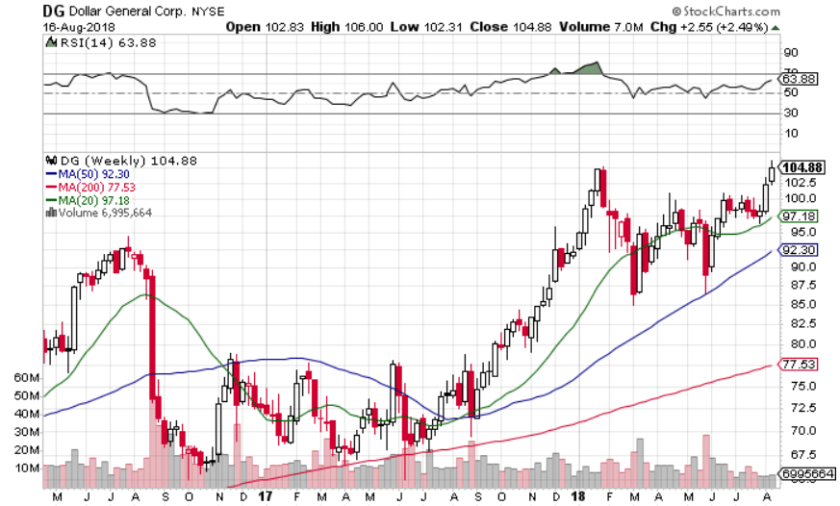
DG.PNG

We still expect further upside in both $WMT and $DG and continue to hold them. Generally, we continue to see strength across the retail complex and may look to add long positions in at least two more stocks.

Burlington Stores $BURL

$BURL operates more than 630 off-price department stores across the US.

The company is expected to report quarterly earnings on 22 Aug with consensus analyst estimates for earnings growth of 33 per cent for the quarter, and 37 per cent growth for the full year. Annual earnings estimates were recently revised upward.
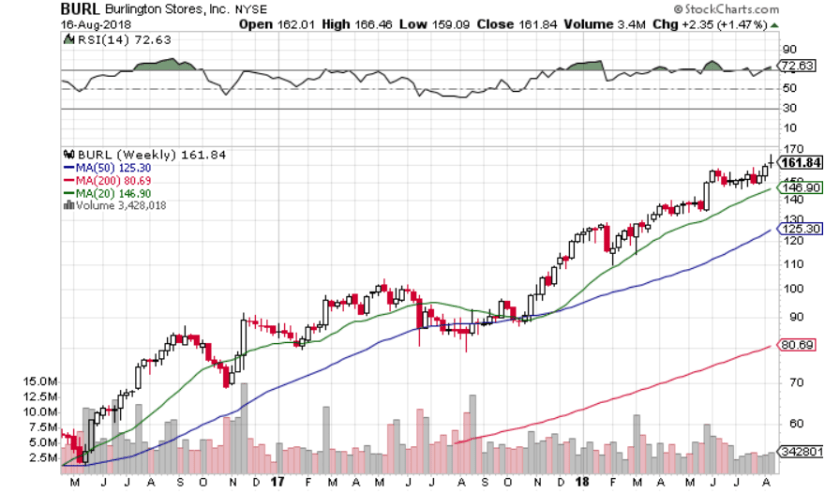
BURL.PNG

Dunkin’ Brands Group $DNKN

$DNKN is a restaurant holding company and franchiser of two chains of quick service restaurants: Dunkin’ Donuts and Baskin Robbins. The company franchises over 20,000 Dunkin’ Donuts and Baskin Robbins ice cream parlours in the US and across 60 international markets.

DNKN.PNG

Payment Processing

Driven by the rise of global e-commerce and internet-connected mobile devices, physical money is being snubbed in favour of cards and other digital payment options. According to Capgemini, global non-cash transactions are expect to grow at CAGR of 10.9 per cent between 2015 and 2020 and reach US dollars 725 billion.

This secular trend toward ever increasing non-cash transactions is in favour of payment processors – both the near ubiquitous players (e.g. VISA and MasterCard) and niche solutions providers.

We added FleetCor Technologies $FLT to our long trade ideas in June.

$FLT is an independent provider of specialised payment products and services to commercial fleets, major oil companies and petroleum markets.

The company’s payment cards provide significant savings and benefits to local fleets, including purchase controls, lower fraud, and specialised reporting. Penetration levels for the payment cards are relatively low at around 50% and there is significant potential for the company to gradually increase penetration levels.

We continue to hold the stock.

FLT.PNG

Cardtronics $CATM

We will be looking to add $CATM as a second name under the payment processing theme.

$CATM is the world’s largest non-bank ATM operator and a leading provider of fully integrated ATM and financial kiosk products and services.

The company owns Allpoint, an interbank network connecting ATMs. Allpoint offers surcharge-free transactions at ATMs in its network and operates in the US, Canada, Mexico, United Kingdom, and Australia.

Allpoint is in the business of supporting any financial institution provide an ATM network to rival the very largest banks. Allpoint today offers more than 55,000 surcharge-free ATMs to over 1,000 financial institutions.

$CATM’s has recently updated its strategy to increasingly focus on expanding Allpoint’s network and penetration amongst financial institutions.

The company’s strategy update has been accompanied by a strong level of insider buying.

CATM.PNG

Energy Infrastructure and Mid-Stream Services

In April we issued a piece on the opportunities arising out of the infrastructure bottlenecks in shale patch in the US – Oil: Opportunities Arising from Infrastructure Bottlenecks

At the time we identified two industrial equipment suppliers that could benefit from increased demand originating from the shale patch: SPX Flow $FLOW and Flowserve $FLS. Although the stocks have yet to perform we continue to see significant opportunities in the energy infrastructure space and hold on to them.
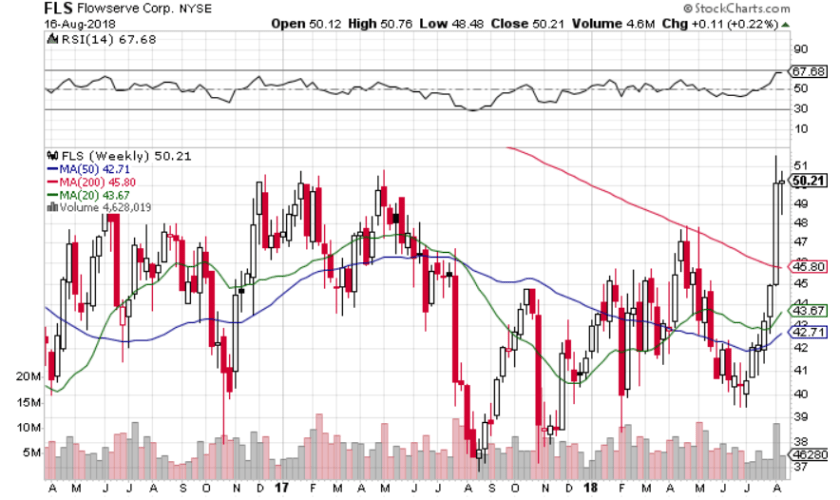
FLS.PNG

FLOW.PNG

Given the scale of the opportunity in the sector, we think there is a lot of room to add additional names to better play the overall theme.

IDEX Corp $IEX

$IEX is engaged in the development, design, and manufacture of fluid handling systems,  and specialty engineered products.Its products include pumps, clamping systems, flow meters, optical filters, powder processing equipment, hydraulic rescue tools, and fire suppression equipment, are used in a variety of industries.

IEX.PNG

UGI Corp $UGI

$UGI is a holding company with interests in propane and butane distribution, natural gas and electric distribution services.

UGI.PNG

Targa Resources Corp $TRGP

$TRGP  is one of the largest providers of natural gas and natural gas liquids in the US. The company’s operations are predominantly concentrated on the Gulf Coast, particularly in Texas and Louisiana.

TRGP.PNG

Digitalisation

Digitisation is the process of converting information from a physical format into a digital one. When this process is utilised to automate and / or enhance business processes and activities, it is referred to ‘digitalisation’.

Digitalisation is concerned with businesses adopting digital technologies to create new revenue streams and / or improving operational processes. Digitalisation is not something new, businesses have been actively engaged in digitalising their operations for decades. The rise of big data, Moore’s law continuing to hold true as it relates to integrated circuits and the ever dropping cost of electronic components, however, has meant that its adoption has started to accelerate in recent years.

Amazon’s supermarket with no checkouts is an example of an outcome when a business fully embraces digitalisation.

We currently do not have any open positions under this theme. We are looking to add longs in two names.

Trimble $TRMB

$TRMB developer of Global Navigation Satellite System receivers, laser rangefinders, unmanned aerial vehicles , inertial navigation systems and software processing tools. The company is best known for its for GPS technology.

The company provides integrated solutions that enable businesses to to collect, manage and analyse complex information.

$TRMB is renowned for having deep domain knowledge of the industries it provides integrated solutions for and generally caters markets ripe for or undergoing rapid digitalisation.

TRMB

Zebra Technologies $ZBRA

$ZBRA  is in the business of  enterprise tracking and manufactures and sells marking, tracking and computer printing technologies primarily to the retail, manufacturing supply chain, healthcare and public sectors. Its products include direct thermal and thermal transfer printers, RFID printers and encoders, dye sublimation card printers,  handheld readers and antennas, and card and kiosk printers.

The  company achieved an adjusted EPS of US dollars 2.48 a share in the second quarter, up 64 per cent year-over-year. Sales rose 13 per cent to US dollars 1.012 billion. The company beat consensus estimates of  US dollars 2.23 in EPS and sales US dollars $989 million.

ZBRA.PNG

Software as a Service (SaaS)

We quote from venture capitalist Marc Andreessen’s seminal essay from 2011:

“This week, Hewlett-Packard (where I am on the board) announced that it is exploring jettisoning its struggling PC business in favor of investing more heavily in software, where it sees better potential for growth. Meanwhile, Google plans to buy up the cellphone handset maker Motorola Mobility. Both moves surprised the tech world. But both moves are also in line with a trend I’ve observed, one that makes me optimistic about the future growth of the American and world economies, despite the recent turmoil in the stock market.

In short, software is eating the world.”

Mr Andreessen’s words ring just as true today as they did back in 2011. Software, specifically SaaS, has continued to proliferate and we have increasingly witnessed the rise of SaaS companies that provide solutions tailored to the needs of individual industries or specific functions within a business.

We are looking to go long two names under this theme.

Paycom $PAYC

$PAYC designs and develops cloud-based human capital management software solutions to support businesses in managing the entire employment life cycle.

$PAYC is a highly disruptive company that is successfully displacing entrenched incumbents across the payroll management space.

Businesses tend to use software to make their employees’ lives easier and to reduce their day-to-day administrative burden. Ask any business, big or small, they will tell you that compliance is a major headache. And there is a lot businesses have to comply with, particularly in the US. Payroll software allows businesses to comply with tax and other payroll related laws. $PAYC started life as a payroll management software provider.

$PAYC’s software solutions have long since evolved beyond payroll management and include applications for talent management, recruitment and general human capital management. Payroll management is serves as the company’s entry product for new customers and the added solutions provide $PAYC with the opportunity to gradually up sell existing customers.

PAYC.PNG

Veeva Systems $VEEV

$VEEV is a cloud-computing company focused on providing solutions for the sales and marketing functions within the pharmaceutical and life sciences industries. The company’s software helps pharmaceutical companies manage customer databases, track drug developments, and organize clinical trials. The software has been widely adopted by ‘Big Pharma’.

The company’s lower-cost and tailored approach has enabled it to upend the on premise software providers such as SAP and Oracle in the pharmaceutical and life sciences sectors.

While the company maintains its core focus in life sciences, it is gradually broadening its products’ functionality to enable it to up sell existing clients and to potentially enter into new industry segments.

VEEV.PNG

Plenty of names for you to chew on for this week. If you would like to discuss any of the names in more detail or to talk you through our more detailed investment cases, feel free to reach out to us over email or by direct message on Twitter.

This post should not be considered as investment advice or a recommendation to purchase any particular security, strategy or investment product. References to specific securities and issuers are not intended to be, and should not be interpreted as, recommendations to purchase or sell such securities. Information contained herein has been obtained from sources believed to be reliable, but not guaranteed. 

Continued Strength in the US Dollar | China’s Line in the Sand | Germany Between a Rock and a Hard Place


“One benefit of summer was that each day we had more light to read by” – Jeanette Walls, American author and journalist


“The best of us must sometimes eat our words.” – J. K. Rowling


“Increasingly, the Chinese will own a lot more of the world because they will be converting their dollar reserves and U.S. government bonds into real assets.” – George Soros


We have a mixed bag here for you this week folks with commentary on:

  • The strength in the US dollar
  • China’s response to Trump’s latest threats to escalate the trade war
  • Germany’s energy needs placing it between a rock and a hard place


Continued strength in the US dollar

A number of you have messaged us about the recent strength in the US dollar and our take on it. For the benefit of all readers, we briefly wanted to touch upon where we stand after the latest move higher by the greenback.

Back in March – Currency Markets: “You can’t put the toothpaste back in the tube” – we wrote:


The major central banks of the world are now in a competitive game. While markets may enter an interim phase where the Fed’s hawkish posturing leads to a strengthening dollar, this phase, in our opinion, is likely to be short-lived.


The line in the sand beyond which we would consider our view to be invalidated is a sustained move above 96 on the US dollar index.


At the time we wrote the above, we were unaware of how or why the 96 level was going to prove to be a significant level for the US dollar. However, we felt that psychologically it was a critical level for market participants. The dramatic plunge in the Turkish lira today, the sentiment being displayed across key media outlets and the general tone on Twitter all seem to validate that around 96 on the DXY is indeed an important level.

For now all we would add is that we are in wait and see mode. If the US dollar continues to move higher or remains above the 96 for a prolonged period (6 to 8 weeks), we would have to accept that our bearish view on the US dollar was wrong. If, however, the greenback fails to sustain above 96 we would likely look to put on carry trades in emerging market currencies and go long the euro and Japanese yen.

Until we have more clarity we will remain on the side lines.


China’s Line in the Sand

Last week, the People’s Bank of China (PBoC) imposed a reserve requirement of 20 per cent on some trading of foreign-exchange forward contracts, effectively increasing the cost of shorting the Chinese yuan. The move has offset some of the pressure from President Trump’s threats to further escalate the trade war and has brought stability to the currency.

Official statements indicate that the PBoC made the move to reduce both “macro financial risks” and the volatility in foreign exchange markets.  To us the move by the PBoC, however, suggests that China is not yet ready to trigger a sharp devaluation of its currency in the trade war with the US.

What is more confounding, however, is figuring out what China can do to respond to the threats of further escalation of the trade war by the Trump Administration. Initially China tried to appease Mr Trump by:

  • Lavishly hosting him in China;
  • Offering to increase imports from the US to reduce its trade surplus;
  • Proposing to gradually opening its local markets to US corporations; and even
  • Engaging in commercial dealings in favours of Mr Trump’s family;

Failing at that, China has tried to respond by:

However, China’s retaliatory efforts have not swayed Mr Trump either.

The problem, as we described in Trade Wars: Lessons from History, is one of creed:


President Trump and his band of trade warriors are hell-bent on stopping the Chinese from moving up the manufacturing value chain.


Alexander Hamilton understood that America’s long-term stability hinged upon its transition from an agrarian to industrial society, the Chinese leadership deeply appreciates the need to transition its economy from being the toll manufacturer of global industry to playing a leading role in the high-tech industries of tomorrow.


The only way we see the Trump Administration relenting in its push to corner the Chinese is if Trump the “dealmaker” takes control of proceedings. That is, in his desire to make a deal and claim victory, President Trump tells his band of trade warriors and security hawks to take a backseat and instead strikes a deal with China that involves a combination of China buying more from the US and opening up its markets to more foreign ownership (something we suspect China wants to do any way, but on its own terms).


Germany: Stuck Between a Rock and a Hard Place

President Trump began his visit to the annual summit of NATO allies in June this year by breaking from diplomatic protocol and verbally attacking Germany:


“We’re supposed to protect you from Russia, but Germany is making pipeline deals with Russia. You tell me if that’s appropriate. Explain that.”


In May 2011 Germany decided to abandon nuclear power in favour of greener sources of energy such as wind and solar. Nuclear power accounted for almost a fifth of Germany’s national electricity supply at the time Chancellor Angela Merkel announced plans to mothball the country’s 17 nuclear power stations by 2022 following the Fukushima Daiichi nuclear disaster in 2011.

Germany, however, failed in its attempt at adequately fulfilling a greater proportion of its energy needs through alternative sources of renewable energy. And the direct consequence of Chancellor Merkel’s decision to drop nuclear power has been that Germany has become increasingly dependent on Russia’s plentiful natural gas supplies.

Germany has a difficult decision to make. Does it choose to maintain its geopolitical alliance with the US and abstain from Russian gas or does it choose cheap gas and re-align itself geopolitically?

German Foreign Minister Heiko Maas’ interview on 9 August suggests that Germany may well be leaning towards the latter (emphasis added):


“Yes, in future we Europeans will have to look out for ourselves more. We’re working on it. The European Union has to finally get itself ready for a common foreign policy. The principle of unanimity in line with which the European Union makes its foreign policy decisions renders us incapable of taking action on many issues. We’re in the process of transforming the European Union into a genuine security and defence union. We remain convinced that we need more and not less Europe at this time.”


Russia is under US sanctions. China is under pressure from the US. And now Germany – in no small part due to its massive trade surplus with the US – finds itself in the cross-hairs.

What if Russia, China and Germany were to form an economic, and dare we ask political, alliance? Something that would have seemed far-fetched less than a year ago, does not seem to sound so crazy anymore.


This post should not be considered as investment advice or a recommendation to purchase any particular security, strategy or investment product. References to specific securities and issuers are not intended to be, and should not be interpreted as, recommendations to purchase or sell such securities. Information contained herein has been obtained from sources believed to be reliable, but not guaranteed. 

Too Much of a Good Thing


“Why then, can one desire too much of a good thing?” – William Shakespeare, As You Like It Act 4, scene 1


“Water is life’s matter and matrix, mother and medium. There is no life without water.” – Albert Szent-Gyorgyi (1893 – 1986), Hungarian biochemist who won the Nobel Prize in Physiology or Medicine in 1937


“Anyway, no drug, not even alcohol, causes the fundamental ills of society. If we’re looking for the source of our troubles, we shouldn’t test people for drugs, we should test them for stupidity, ignorance, greed and love of power.” – P. J. O’Rourke, American political satirist and journalist


According to the World Health Organisation (WHO), at least 2 billion people globally only have access to drinking water from sources contaminated with faeces. Contaminated water is known to transmit diseases such diarrhoea, cholera, dysentery, typhoid, and polio and is estimated to cause 502 000 diarrhoeal deaths each year.

The WHO estimates that by 2025 half of the world’s population will be living in water-stressed areas – that is, areas where the demand for water exceeds the available amount or when poor quality restricts its use.

Water is essential. There is no life on earth without water. All of us have known this from a very young age.


During our first year at university, we had a friend, let’s call him Zed. Zed was an odd fellow, eccentric even. Even his taste in music could be described as being unusual: Tom Waits and Chuck E. Weiss’ Do You Know What I Idi Amin could regularly be heard playing loudly from his room in the wee hours of the night. One evening, as a group of us gathered together for dinner at our dormitory’s dining hall, Zed joined us a little later and mentioned that he had not had anything to drink all day and that he was incredibly thirsty. Instead of a tray full food like the rest of us, Zed came to the dining table with a tray holding eight glasses of cold water. He needed to drink all the water to quench his thirst he claimed.

After quickly chugging down six of the eight glasses of water, Zed stood up, told us he was not feeling well and left. We did not see Zed for the next day and a half. When we did finally see him, he told us that he had been bed ridden ever since he downed all that water. Having so much water, so quickly had made him sick.


In 2007, David Rogers, a fitness instructor from Milton Keynes, died at the tender age of 22 died during the London Marathon. David did not die from exhaustion, nor did he die as a direct consequence of the sweltering temperatures – which reached their highest level in the event’s, at the time, 27-year history – during the race. No, he died from hyponatraemia, or water intoxication.

Water intoxication occurs when the amount of water in the body is so great that it dilutes vital minerals such as sodium down to dangerous levels. It can lead to confusion, headaches and a fatal swelling of the brain.

David Rogers drank too much water during the race without taking in the commensurate amount of minerals.

Do not let anyone ever tell you that “You can never have too much of a good thing”.


Investment Perspective


When AT&T announced its intention to buy Time Warner in late 2016, Netflix was valued at 18 per cent of the combined stock market value of AT&T and Time Warner.

By the time the courts cleared the way for AT&T to acquire Time Warner in June this year, Netflix’s value stood at a much heftier 60 per cent of the combined market capitalisation of AT&T and Time Warner.

The rationale for AT&T acquiring Time Warner was provided by CEO Stephan Randall at the time the intention to acquire the media company was revealed in late 2016:


Premium content always wins. It has been true on the big screen, the TV screen and now it’s proving true on the mobile screen. We’ll have the world’s best premium content with the networks to deliver it to every screen. A big customer pain point is paying for content once but not being able to access it on any device, anywhere. Our goal is to solve that.  We intend to give customers unmatched choice, quality, value and experiences that will define the future of media and communications.

 With great content, you can build truly differentiated video services, whether it’s traditional TV, OTT or mobile. Our TV, mobile and broadband distribution and direct customer relationships provide unique insights from which we can offer addressable advertising and better tailor content.


 It’s an integrated approach and we believe it’s the model that wins over time.

Time Warner’s leadership, creative talent and content are second to none. Combine that with 100 million plus customers who subscribe to our TV, mobile and broadband services – and you have something really special.

It’s a great fit, and it creates immediate and long-term value for our shareholders.


What AT&T did not mention, however, is how they intend to treat Time-Warner content on their network post-acquisition. That is, will they give Time-Warner content consumer on AT&T’s network a zero-rating much the way they have done for DirecTV content or not?

According to Wikipedia, zero-rating is the practice of providing Internet access without financial cost under certain conditions, such as by only permitting access to certain websites or by subsidizing the service with advertising.

Simply put, if AT&T gives a zero-rating to all Time Warner content, any of this content consumed by AT&T customers will incur no charge (i.e. it will not count against their allotted data / download quotas).

Also in June this year, Disney received approval from the antitrust courts to acquire 21st Century Fox on the condition that Disney divest Fox’s regional sports networks, as they would create anti-competitive conflicts due to its ownership of ESPN.

Sporting rights aside, the combination of Disney and Fox will create a media behemoth. Disney and Fox’s combined domestic box office intake equalled US dollars 4.5 billion in 2017 – representing approximately 40 per cent market share, a figure no single major studio has ever hit. Even more staggering, however, is that with the acquisition of Fox, Disney will control the rights to two of the biggest back catalogues in entertainment, which includes full ownership of all Marvel Comic characters and the Star Wars, Simpsons, X-Files, Indiana Jones, Pixar, and Alien/Predator franchises.

To complement the huge catalogue of content, Disney plans to launch its proprietary streaming service during the second half of 2019. In preparation for the launch of streaming service, Disney has also announced that it will be pulling all of its content from Netflix in 2019.


Netflix is spending cash hand over fist to produce new content.

The US’s largest telecommunication network may well monetise the huge library of Time Warner content by zero rating it on their network. And just for good measure, it is also spending some of its cash pile on original content creation.

Disney, probably the largest media company in the world after it completes the acquisition of Fox,  is likely to put a chunk of its vast amount of content on its proprietary streaming service in 2019.

Let’s not forget that Amazon, Alibaba, and Apple, are all throwing money at original content too.

We may soon reach a stage, if we have not already, where there is just too much content.

The bull and bear cases for and against Netflix are well known and we will not regurgitate them here. We will, however, say that given the tectonic shifts taking place in the online video streaming space, holding Netflix at current valuations does not make sense, to us at least.

A Week of Plenty: Parsing the Big and the Small


“A lot happens in our everyday life, but it always happens within the same routine, and more than anything else it has changed my perspective of time. For, while previously I saw time as a stretch of terrain that had to be covered, with the future as a distant prospect, hopefully a bright one, and never boring at any rate, now it is interwoven with our life here and in a totally different way. Were I to portray this with a visual image it would have to be that of a boat in a lock: life is slowly and ineluctably raised by time seeping in from all sides. Apart from the details, everything is always the same. And with every passing day the desire grows for the moment when life will reach the top, for the moment when the sluice gates open and life finally moves on.” – Karl Ove Knausgård, Norwegian novelist


There are a lot of interesting and market moving developments that have either transpired or come to light over the course of the last week or so. This week we take a break from taking a deep(ish)-dive into a given theme and instead parse through some of these developments.


US Market Breadth

 As US markets have recovered and moved within a whisker of the year-to-date highs recorded in January, we have witnessed a growing chorus of criticism on the robustness of the recent rally. One of the more common criticisms is how only a handful of stocks – namely Facebook, Amazon, Netflix, Google, Microsoft and Salesforce.com – are responsible for the positive returns of the S&P500 Index year to date and were it not for these stocks, the market would be in the red.

To that we counter with two pieces of evidence.

The equally weighted index of the constituents of the S&P500 Index, as of Wednesday’s close, is 2.3 per cent from its January highs.

SPW Index (S&P 500 Equal Weighte 2018-07-26 13-45-34.jpg


The equally weighted index of the constituents of the Nasdaq 100 Index, as of Wednesday’s close, is above its January highs.

NDXE Index (NASDAQ 100 Equal Wei 2018-07-26 13-47-07


There have been and continue to be plenty of opportunities to outperform the broad market indices without the need to invest in the FAANG or other large cap tech stocks. You just need to do the work.

There are of course other criticisms including valuations, such as price-to-sales and price-to-earnings multiples, and the near record high net profit margins being achieved by companies, which critics argue should all mean revert over time and said reversion should lead to a sharp drop stock prices.

With respect to valuations, we counter with two arguments: (1) valuations can mean revert by either prices dropping or sales / earnings increasing, as the quarterly results of the current reporting season have demonstrated, valuations in many instances are adjusting on higher sales and / or earnings; and (2) rich valuations are not in and of themselves a precursor for market corrections, rich valuations are a necessary condition for equity market corrections but not a concurrent one.

Turning to record high profit margins as a bearish argument against owning US stocks, we counter that such arguments do not adjust for the change in the composition of major US equity market indices. Once the S&P500 Index, for example, is adjusted for the changes in sector weights, profit margins do not appear to be anywhere near as high as they appear to be without adjusting the index for changes in sector allocations. This is because the current heavyweights of the index, namely tech and healthcare stocks, tend to generate much higher margins than businesses in other sectors that dominated index historically.

The changes in the composition of the index also go some way to explaining the high level of the price-to-sales ratio the market is trading at – at risk of stating the obvious, higher margin businesses capture much more of their sales as profits than do lower margin businesses, and thus high margin businesses are bound to trade at higher multiples of sales than do low margin businesses.


 Is Amazon the biggest threat to Google’s dominance in search-driven advertising?

Quoting Brian Olsavsky, Amazon’s chief financial officer, from the company’s quarterly earnings update:

 “A big contributor to the quarter and the last few quarters obviously has been strong growth in our highest profitability businesses and also advertising.”

The CFO further added that Amazon is working to automate tasks for advertisers and to help media buyers measure the results.

Last quarter, Amazon’s revenue from the advertising sales category and some other items grew 132 per cent year-over-year to US dollars 2.2 billion. Quarterly revenue of over US dollars 2 billion is not to be scoffed at. More importantly, this revenue is coming straight out of Google’s share of the advertising market.

The appeal of advertising on Amazon for advertisers is obvious: customers searching on Amazon are already there with the intent of buying something. With Amazon controlling close to 45 per cent of total online sales in the US and perpetually increasing its product offering, it becomes progressively more convenient for online shoppers to begin their product searches with Amazon and not Google. If the propensity of consumers to being their product searches with Amazon over Google continues to increase, the proclivity of advertisers to spend their dollars on Amazon over Google is also likely to follow suit.

How Google responds to this challenge is something we await with much intrigue.

We expect Amazon to be the first company to achieve a trillion dollar market capitalisation.


Japanese Government Bonds

Global bond markets have been roiled by speculation that the Bank of Japan (BoJ) is considering tweaking its policy stance and could scale back its stimulus programme. Yields on 10-year Japanese government hit a fresh twelve-month high on Thursday, forcing the BoJ’s in making a rare intervention in the bond market to push yields on the 10-year government bonds back below 10 basis points.

In practical terms, the BoJ currently guides the yields on 10 year government bonds to be within the range of 0 to 11 basis points. The official directive, however, only states that “The Bank will purchase Japanese government bonds (JGBs) so that 10-year JGB yields will remain at around zero percent.”

We are of the opinion that the BoJ will take steps to widen the tight range of 0 to 11 basis points on 10-year government bonds associated with the ‘around zero’ directive. The objective of said widening being to allow Japanese banks to have more influence on 10-year rates and to steepen the curve ever so slightly to enable them to make their lending activities profitable.


 Qualcomm / NXP Semiconductor

The two-year saga of Qualcomm’s attempted acquisition of Dutch chipmaker NXP Semiconductors came to an abrupt end after the deal failed to receive final approval from Chinese regulators ahead of the expiration of the companies’ agreement on Wednesday night. Had the transaction gone through, it would have been the semiconductor industry’s largest ever acquisition.

Unquestionably, the Qualcomm-NXP deal is collateral damage in the political game between Beijing and Washington and can be seen as retaliation for President Donald Trump’s tariffs on Chinese imports.

After Congress, earlier this month, decided against re-imposing a seven-year ban on ZTE, the Chinese telecommunications equipment and systems company, from buying equipment in the US market — a move that would have effectively put the Chinese firm out of business, it was widely expected that China would have cleared the Qualcomm-NXP deal quid pro quo. By effectively ending the Qualcomm-NXP deal, however, the Chinese leadership is essentially adopting an extremely hawkish strategy toward the US.

We believe the Chinese move to end the Qualcomm-NXP deal is a significant escalation of trade-related tensions with the US, and see it is as weakening the position of dovish officials on both sides: in this case, Steve Mnuchin for the US and Liu He for the Chinese. This should only further complicate US-China trade related negotiations.


Trump-Juncker Meeting and the Prospect of Improved US-EU Trade Relations

In a joint announcement after meetings in Washington on Wednesday, President Donald Trump and the EU’s Jean-Claude Juncker declared a truce on trade-related tensions with the aim of eliminating all tariffs, trade barriers and subsidies related to non-auto industrial goods.

The rosiest outcome, from the perspective of the global economy, following this joint declaration is that President Trump seeks to settle the US trade-related tensions with the EU, Canada and Mexico, and instead focuses his energy on China – something Peter Navarro, Robert Lighthizer and other security and trade hawks in the administration have probably wanted all along.

If the rosy scenario does indeed materialise then the EU is likely to join in on US efforts to back against China’s efforts to move up the industrial value, discriminatory tariffs and abuse of intellectual property rights. The US-China trade-related tensions would escalate and Qualcomm’s failed acquisition of NXP would not be the last casualty in this spat. Every major US and Chinese company and asset would become fair game and everyone loses – China more than the US we suspect.

Earlier this year, President Trump announced broad based tariffs on steel and aluminium imports. Following the announcement, however, there were clear signals given by his administration that many of the US’s allies would be granted exemptions. Given that this not only did  not happen but that the tariffs were fully imposed on US allies, we assign a very low probability to the rosy scenario materialising.

Instead, we expect Mr Trump to keep upping the ante on trade, irrespective of the counterparty, right up until the mid-term elections. And only expect a coherent strategy on trade to materialise after the elections.


 Uranium: Extension of Cameco’s Facility Shutdowns

In November last year, Cameco Corporation, the world’s largest publicly traded uranium mining company, announced that it was temporarily suspending production at two of its northern Saskatchewan facilities – Key Lake and McArthur River – for a period of ten months. The decision was driven by the oversupply of uranium and low market prices that have persisted ever since Japan shut down its nuclear reactors following the radiation leaks at Tokyo Electric Power’s Fukushima Daiichi nuclear plant in 2011.

Taking Cameco’s lead, Kazatomprom – Kazakhstan’s state-owned uranium mining company and the world’s largest natural uranium producer – announced in December last year that it would cut production by 20 per cent, representing 7.5 per cent of total global supply, over the next three years.

The impact of these two announcements was to send both uranium spot prices and share prices of listed uranium miners sharply higher. The euphoria did not last long, however. Spot prices gradually drifted lower, falling from just under US dollars 25 per pound at the start of the year to under US dollars 21 per pound by late April.  And the stock prices of many of the uranium miners fell below where they traded prior to Cameco’s announcement in November.

As spot prices fell, expectations that Cameco would extend the shutdown of its two Saskatchewan facilities started to grow. And Cameco has not disappointed, announcing on Wednesday after market, along with its quarterly results, that it would be suspending production at the two mines ‘indefinitely’ and does not plan to resume production at the site until the company can commit its ‘production under long-term contracts that provide an acceptable rate of return’.

The corollary of the extended suspension is that Cameco will be a buyer of up to 14 million pounds of uranium from the spot market (or otherwise) over the next 18 months to fulfil its commitments under on-going contracts.

Prior to their quarterly earnings call on Thursday morning, Cameco’s shares in pre-market trading were marked at 7 plus per cent below their closing price on Wednesday evening. Cameco shares closed up 3.4 per cent by end of trading on Thursday and spot uranium prices jumped 6.2 per cent to year-to-date highs at US dollars 25.65 per pound.

The malaise in the uranium sector may turn out to be much worse than Cameco’s management anticipating and the rally in the spot could well prove to be fleeting once again. If, however, uranium spot prices can push above US dollar 26.25 per pound, the highs recorded in 2017, they have significant room to run much higher.

For now we remain long select uranium miners as well as commodity pure play Uranium Participation Corporation $URPTF.


This post should not be considered as investment advice or a recommendation to purchase any particular security, strategy or investment product. References to specific securities and issuers are not intended to be, and should not be interpreted as, recommendations to purchase or sell such securities. Information contained herein has been obtained from sources believed to be reliable, but not guaranteed.

Trade Wars: Lessons from History


“There is nothing new in the world except the history you do not know.” – Harry Truman


“Give us a protective tariff and we will have the greatest nation on earth” – Abraham Lincoln


“If a nation expects to be ignorant and free, in a state of civilisation, it expects what never was and never will be.” – Thomas Jefferson


At the Luzhniki Stadium in Moscow last week, France defeated Croatia in the final of 2018 FIFA World Cup. As the French toasted their second FIFA World Cup triumph, pundit upon pundit and football fan after football fan debated the manner of France’s victory and the controversial decisions that went France’s way. Our small group of friends and colleagues also got caught up in a debate on whether the referee rightly or wrongly rewarded the penalty that led to France’s second goal. Our debate was not limited to those of us that watched the match together but rather extended to our WhatsApp groups and roped in friends from all over the world.

It is often said that it is human nature to see what we want to see and ignore that which goes against our expectations.

As our arguments for and against the penalty went round and round in circles, we decided to watch replays of the incident from the match to try and settle which side of the debate had more merit. The funny thing is as we watched the replays the conviction levels on either side of the debate became even stronger. By some means what each of us saw, or at least thought we saw, reaffirmed our predisposition.

Of course, whether it was a penalty or not (it wasn’t) does not really matter. The record books will show that the French defeated the Croats by four goals to two. There will be no asterisk next to the record to note that arm chair fan Joe Schmoe disputed the validity of France’s victory due to the award of a dubious penalty.

Reflecting upon the harmless nature of our argument, we think of the oft quoted words of Winston Churchill:

“Those who fail to learn from history are doomed to repeat it.”

Powerful statements can often hide as much as they reveal.

Can we learn what actually happened from studying history? Unlike the final score of a football match, the record of any past event that cannot be definitively quantified is likely to be clouded by the prejudices of historians and distorted by our individual partisanship.  And if we do not truly know what happened, can we really be doomed to repeat it?

Reality or not, below we examine the recorded history of American protectionism, reflect upon the successful adoption of the ‘American System’ by China and consider the possible outcomes of the rising trade-related tensions between the US and China.


American Independence and British Retaliation

On 18 April 1775, a clash between the British redcoats and the local militia at Lexington, Massachusetts, led to the fighting that began the American War of Independence.

Fifteen months after fighting began the American colonists claimed independence from the British and Thomas Jefferson drafted the Declaration of Independence.

The British did not take the colonists’ declaration lying down and made attempts to forcibly regain control over America. Economic warfare was one of the tools used by the British to inflict pain upon the Americans.

Britain closed off its markets to American trade by raising tariffs on American manufactured goods. US exports to England and its colonies fell from an estimated 75 per cent of total exports prior to the Declaration of Independence to around 10 per cent after it. The sharp fall in trade brought on an economic depression in the US.

Britain did not stop at just tariffs. It wanted to halt the US’s transformation from its agrarian roots to an industrialised nation and in this pursuit it went as far as outlawing skilled craftsmen from overseas travel and banning the export of patented machinery.


The American System

The American System, also known as the American School of Economics, is an economic plan based on the ideas of Alexander Hamilton, the first Secretary of the Treasury of the United States, which guided the US national economic policy from first half of the 19th century till the early 1970s. The system is widely credited as having underpinned the US’s transformation from an agrarian frontier society to global economic powerhouse.

The American System is rooted in the mercantilist principles presented by Alexander Hamilton to Congress in December 1791 in the Report on the Subject of Manufactures. The three basic guiding economic principles of the system demanded the US Government to:

  1. Promote and protect American industries by selectively imposing high import tariffs and / or subsidising American manufacturers;
  2. Create a national bank to oversee monetary policy, stabilise the currency and regulate the issuance of credit by state and local banks; and
  3. Make internal improvements by investing in public infrastructure – including but not limited to roads, canals, public schools, scientific research, and sea ports – to facilitate domestic commerce and economic development.

These guiding principles are based on Alexander Hamilton’s insight that long-term American prosperity could not be achieved with an economy dependent purely on the financial and resource extraction sectors. And that economic self-sufficiency hinged upon the US Government intervening to protect and to support the development of captive manufacturing capabilities.

Alexander Hamilton’s ideas were not immediately accepted by Congress – Congress was dominated by Southern planters, many of whom favoured free trade. One Thomas Jefferson, in particular, vehemently opposed Hamilton’s protectionist proposals.

Congress and Jefferson became much more receptive to Hamilton’s ideas in the aftermath of the Anglo-American War of 1812, during which the British burnt down the White House. The government’s need for revenue and a surge in anti-British fervour, in no small part, made favouring Hamilton’s proposals politically expedient for Congress.

In 1816 Congress passed an import tariff, known as the Dallas Tariff, with the explicit objective of protecting American manufacturers and making European imported goods more expensive. The legislation placed import duties of 25 per cent on cotton and wool textiles and manufactured iron; 30 per cent on paper and leather goods and hats; and 15 per cent on most other imported products. Two years later, and in response to predatory dumping of goods by the British, Congress further increased import duties.

American industry blossomed after the imposition of tariffs and vested interests lobbied to keep or even increase import duties. With the public strongly in support, Congress continued raising tariffs and American import duties rose to around 40 per cent on average by 1820.

Also in 1816, Congress created the “The President, Directors, and Company, of the Bank of the United States”, commonly referred to as the Second Bank of the United States, and President James Madison gave it a 20-year charter to handle all fiscal transactions for the US Government, regulate the public credit issued by private banking institutions, and to establish a sound and stable national currency.

The third and final tenet of the American System, federally funded internal improvements, was never fully adopted. Nonetheless, the US Government did end up using a part of the revenues generated from the import duties and the sale of public lands in the west to subsidise the construction of roads, canals and other public infrastructure.

Abraham Lincoln, Theodore Roosevelt, and many of the other great leaders from American history supported the American System. That is, they were all protectionists. Republican protectionist instincts used to be so ingrained that even if there was the slightest liberalisation of trade made by the Democrats, it would be reversed as soon as the Republican regained power. For instance the Revenue Act of 1913, passed during the early days of President Woodrow Wilson’s administration, which lowered basic tariff rates from 40 to 25 per cent, was almost entirely reversed after Republicans regained power following World War I.

It is only as recently as 1952, upon the election of Dwight D. Eisenhower, do we find a notable Republican leader that favoured free trade over protectionism.

Coincidentally, or not, President Eisenhower’s willingness to betray the Republican protectionist heritage in favour of free trade policies just so happened to be around the same time funding of the Marshall Plan ended. By 1952, the economy of every participant state in the Marshall Plan had surpassed pre-war levels; economic output in 1951 of each and every participant exceeded their respective output in 1938 by at least 35 per cent.

Happenstance or not, the economic recovery of Western Europe and its growing alliance with the US, created powerful inducements to free trade and overall wealth creation.


China’s Adoption of The American System

In 1978, China initiated the transformation of its economy towards a more liberal and market-based regime. The reforms, as it would become glaringly apparent over the following decades, were predicated on promoting exports over imports by adopting a combination of mercantilist and protectionist policies. The government supported exporters by waiving duties on materials imported for export purposes, creating dedicated export-processing zones, and granting favourably priced loans for capital investment. At the same time, the government supported the creation of national champions and industry leaders by limiting (or altogether prohibiting) foreign participation in strategic industries. These steps were in adherence with the first tenet of the American System.

The Chinese government also tightly managed monetary policy and kept its currency artificially undervalued through the combination of capital controls and intervention, driving capital exports and the build-up of trade surpluses – the second tenet.

A significant portion of government directed investment in China, especially since the early 1990s, has been in increasing the amount and improving the quality of public infrastructure. Investment was directed into all forms of public infrastructure including but not limited to developing power and telecommunications networks, public buildings, dams, rural road networks, manufacturing facilities, and academic institutions – the third tenet.

Much as the US economy flourished under the mercantilist tenets of the American System, China too has flourished over the last four decades by adopting the very same system.

Just as the Republicans in America were willing to make a turn toward free trade as the global economic environment became conducive to a US led global order, the Chinese leadership is beginning to espouse the virtues of free trade as its version of the Marshall Plan, the Belt and Road Initiative, gathers steam.

The Chinese leadership has guided its economy to such great heights based on, we suspect, their acute understanding of American economic history. It is China’s demonstrated adherence to the American System, which leads us to believe that just as Alexander Hamilton understood that America’s long-term stability hinged upon its transition from an agrarian to industrial society, the Chinese leadership deeply appreciates the need to transition its economy from being the toll manufacturer of global industry to playing a leading role in the high-tech industries of tomorrow.


Investment Perspective


Chinese Premier Li Keqiang and his cabinet unveiled the “Made in China 2025” strategic plan in May 2015. The plan lays out a roadmap for China take leadership role in 12 strategic high-tech industries and to move up the manufacturing value chain. The Council on Foreign Relations believes Made in China 2025 is a “real existential threat to US technological leadership”.

Just as the British insisted upon the US remaining an agrarian society in the 18th century, President Trump and his band of trade warriors are hell-bent on stopping the Chinese from moving up the manufacturing value chain. Short of going to war, the Trump Administration is even following the same playbook by imposing tariffs, blocking technology transfer and withholding intellectual property.

President Trump, however, appears ready to go further and even upend the global trade system and call into question the US dollar’s global reserve currency status. Mr Trump’s stated objective is to revive the US’s industrial base. This objective, however, is unachievable in a global trade system in which the US dollar is the world’s reserve currency. The privilege of having the world’s reserve currency comes with the responsibility of consistently running current account deficits and providing liquidity to the rest of the world.


Imposition of Tariffs

Unlike any other currency, the global reserve currency cannot be easily devalued. As we discussed in Don’t wait for the US Dollar Rally, its Already Happened, as the US dollar weakens international demand for the greenback increases. For this reason, it is probably easier for the US to pursue alternative means that have the same effect as a devaluation of its currency.

The imposition of tariffs, from foreign manufacturers’ perspective, is the equivalent of a devaluation of the US dollar. For US based buyers and consumers, tariffs lower the relative prices of US manufactured goods with respect to foreign manufactured goods. Tariffs, however, are only effective if their imposition does not result in an equivalent relative increase in the price of the US dollar. It is perhaps no coincidence then that the Chinese yuan started to tumble as soon as the US moved to impose tariffs on Chinese goods. And in response Mr Trump is turning on the Fed and its tightening of monetary policy.


The Nuclear Option

Mr Trump always has the nuclear option in his bid to revive industry in the US. He can attempt to overturn the global trade system and the status of US dollar as the world’s reserve currency by limiting the amount of US dollar available to the rest of the world – pseudo-capital controls. If this were to happen, any and every foreign entity or nation that is short US dollars (has borrowed in US dollars) will suffer from an almighty short squeeze. In response, China specifically would have to take one of two paths:

  1. Open up its economy to foreign investment and sell assets to US corporations to raise US dollars.
  2. Loosen capital controls to allow the settlement of trade in yuan.


A G2 Compromise

The final, and in our minds the most painless, alternative to the above scenarios is that of a G2 compromise i.e. China and the US come to an agreement of sorts that results in China making significant concessions in return for the US maintaining the current global trade system.

What such a compromise will look like we do not know but it most definitely involves a weakening of the US dollar.


This post should not be considered as investment advice or a recommendation to purchase any particular security, strategy or investment product. References to specific securities and issuers are not intended to be, and should not be interpreted as, recommendations to purchase or sell such securities. Information contained herein has been obtained from sources believed to be reliable, but not guaranteed.


Don’t wait for the US Dollar Rally, its Already Happened


“Don’t cry because it’s over. Smile because it happened.” – Dr Seuss


“Republicans are for both the man and the dollar, but in case of conflict the man before the dollar.” – Abraham Lincoln


“Dark economic clouds are dissipating into an emerging blue sky of opportunity.” – Rick Perry


According to the minutes of the Fed’s June meeting, released on Thursday, some companies indicated they had already “scaled back or postponed” plans for capital spending due to “uncertainty over trade policy”. The minutes added: “Contacts in the steel and aluminum industries expected higher prices as a result of the tariffs on these products but had not planned any new investments to increase capacity. Conditions in the agricultural sector reportedly improved somewhat, but contacts were concerned about the effect of potentially higher tariffs on their exports.”

Despite the concerns around tariffs, the minutes also revealed that the Fed remained committed to its policy of gradual rate hikes and raising the fed funds rate to its long-run estimate (or even higher): “Participants generally judged that…it would likely to be appropriate to continue gradually raising the target rate for the federal-funds rate to a setting that was at or somewhat above their estimates of its longer-run level by 2019 or 2020”.

The somewhat hawkish monetary policy stance of the Fed combined with (i) expectations of continued portfolio flows into the US due to the interest rate differentials between the US and non-US developed markets, (ii) fears of the Trump Administration’s trade policies causing an emerging markets crisis, and (iii) the somewhat esoteric risk of ‘dollar shortage’ have led many to conclude that the US dollar is headed higher, much higher.

Of all the arguments for the US dollar bull case we consider the portfolio flows into the US to be the most pertinent to the direction of the greenback.

According to analysis conducted by the Council of Foreign Relations (CFR) “all net foreign demand for ‘safe’ US assets from 1990 to 2014 came from the world’s central banks”. And that “For most of the past 25 years, net foreign demand for long-term U.S. debt securities has increased in line with the growth in global dollar reserves.”  What the CFR has described are quite simply the symptoms of the petrodollar system that has been in existence since 1974.

Cumulative US Current Account Deficit vs. Global Foreign Exchange Holdings1aSources: Council on Foreign Relations, International Monetary Fund, Bureau of Economic Analysis


In recent years, however, global US dollar reserves have declined – driven by the drop in the price of oil in late 2014 which forced the likes of Norges Bank, the Saudi Arabian Monetary Agency, and the Abu Dhabi Investment Authority to draw down on reserves to make up for the shortfall in state oil revenues – yet the portfolio flows into the US continued unabated.

Using US Treasury data on major foreign holders of Treasury securities as a proxy for foreign central banks’ US Treasury holdings and comparing it to the cumulative US Treasury securities issuance (net), it is evident that in recent years foreign central banks have been either unable or unwilling to finance the US external deficit.

Cumulative US Marketable Treasury Issuance (Net) vs. US Treasury Major Foreign Holdings1Sources: US Treasury, Securities Industry and Financial Markets Association


Instead, the US has been able to fund its external deficit through the sale of assets (such as Treasuries, corporate bonds and agency debt) to large, yield-starved institutional investors (mainly pension funds and life insurers) in Europe, Japan and other parts of Asia. The growing participation of foreign institutional investors can be seen through the growing gap between total foreign Treasury holdings versus the holdings of foreign central banks.

US Treasury Total Foreign Holdings vs. US Treasury Major Foreign Holdings2Source: US Treasury


Before going ahead and outlining our bearish US dollar thesis, we want to take a step back to understand how and why the US was able to finance its external deficit, particularly between 2015 and 2017, despite the absence of inflows from its traditional sources of funding and without a significant increase in its cost of financing. This understanding is the key to the framework that shapes our expectations for the US dollar going forward.

We start with Japan. In April 2013, the Bank of Japan (BoJ) unveiled a radical monetary stimulus package to inject approximately US dollars 1.4 trillion into the Japanese economy in less than two years. The aim of the massive burst of stimulus was to almost double the monetary base and to lift inflation expectations.

In October 2014, Governor Haruhiko Kuroda shocked financial markets once again by announcing that the BoJ would be increasing its monthly purchases of Japanese government bonds from yen 50 trillion to yen 80 trillion. And just for good measure the BoJ also decided to triple its monthly purchases of exchange traded funds (ETFs) and real estate investment trusts (REITs).

Staying true to form and unwilling to admit defeat in the fight for inflation the BoJ also went as far as introducing negative interest rates. Effective February 2016, the BoJ started charging 0.1 per cent on excess reserves.

Next, we turn to Europe. In June 2014, Señor Mario Draghi announced that the European Central Bank (ECB) had taken the decision to cut the interest rate on the deposit facility to -0.1 per cent. By March 2016, the ECB had cut its deposit facility rate three more times to take it to -0.4 per cent. In March 2015, the ECB also began purchasing euro 60 billion of bonds under quantitative easing. The bond purchases were increased to euro 80 billion in March 2016.

In response to the unconventional measures taken by the BoJ and the ECB, long-term interest rates in Japan and Europe proceeded to fall to historically low levels, which prompted Japanese and European purchases of foreign bonds to accelerate. It is estimated that from 2014 through 2017 Japanese and Eurozone institutional investors and financial institutions purchased approximately US dollar 2 trillion in foreign bonds (net). During the same period, selling of European fixed income by foreigners also picked up.

As the US dollar index ($DXY) is heavily skewed by movements in EURUSD and USDJPY, the outflows from Japan and Europe into the US were, in our opinion, the primary drivers of the US dollar rally that started in mid-2014.

US Dollar Index3Source: Bloomberg


In 2014 with Japanese and European outflows accelerating and oil prices still high, the US benefited from petrodollar, European and Japanese inflows simultaneously. These flows combined pushed US Treasury yields lower and the US dollar sharply higher. The strong flows into the US represented an untenable situation and something had to give – the global economy under the prevailing petrodollar system is simply not structured to withstand a strong US dollar and high oil prices concurrently. In this instance, with the ECB and BoJ staunchly committed to their unorthodox monetary policies, oil prices crashed and the petrodollar flows into the US quickly started to reverse.

Notably, the US dollar rally stalled and Treasury yields formed a local minimum soon after the drop in oil prices.

US 10-Year Treasury Yield4Source: Bloomberg


Next, we turn to China. On 11 August 2015, China, under pressure from the Chinese stock market turmoil that started in June 2015, declines in the euro and the Japanese yen exchange rates and a slowing economy, carried out the biggest devaluation of its currency in over two decades by fixing the yuan 1.9 per cent lower.  The Chinese move caught capital markets by surprise, sending commodity prices and global equity markets sharply lower and US government bonds higher.

In January 2016, China shocked capital markets once again by setting the official midpoint rate on the yuan 0.5 per cent weaker than the day before, which took the currency to its lowest since March 2011. The move in all likelihood was prompted by the US dollar 108 billion drop in Chinese reserves in December 2015 – the highest monthly drop on record.

In addition to China’s botched attempts of devaluing the yuan, Xi Jinping’s anti-corruption campaign also contributed to private capital fleeing from China and into the US and other so called safe havens.

China Estimated Capital Outflows5Source: Bloomberg


The late Walter Wriston, former CEO and Chairman of Citicorp, once said: “Capital goes where it is welcome and stays where it is well treated.” With the trifecta of negative interests in Europe and Japan, China’s botched devaluation effort and the uncertainty created by Brexit, capital became unwelcome in the very largest economies outside the US and fled to the relative safety of the US. And it is this unique combination, we think, that enabled the US to continue funding its external deficit from 2014 through 2017 without a meaningful rise in Treasury yields.

Moreover, in the absence of positive petrodollar flows, we suspect that were it not for the flight to safety driven by fears over China and Brexit, long-term Treasury yields could well have bottomed in early 2015.


Investment Perspective


  1. Foreign central banks show a higher propensity to buy US assets in a weakening US dollar environment


Using US Treasury data on major foreign holders of Treasury securities as a proxy for foreign central banks’ US Treasury holdings, we find that foreign central banks, outside of periods of high levels of economic uncertainty, have shown a higher propensity to buy US Treasury securities during phases of US dollar weakness as compared to during phases of US dollar strength.

Year-over-Year Change in Major Foreign Holdings of Treasury Securities and the US Trade Weighted Broad Dollar Index 6Sources: US Treasury, Bloomberg


The bias of foreign central banks, to prefer buying Treasury securities when the US dollar is weakening, is not a difficult one to accept. Nations, especially those with export oriented economies, do not want to see their currencies rise sharply against the US dollar as an appreciating currency reduces their relative competitiveness. Therefore, to limit any appreciation resulting from a declining US dollar, foreign central banks are likely to sell local currency assets to buy US dollar assets. However, in a rising US dollar environment, most foreign central banks also do not want a sharp depreciation of their currency as this could destabilise their local economies and prompt capital outflows. And as such, in a rising US dollar environment, foreign central banks are likely to prefer selling US dollar assets to purchase local currency assets.


  1. European and Japanese US treasury Holdings have started to decline


European and Japanese US Treasury Holding 7Source: US Treasury


The ECB has already scaled back monthly bond purchases to euro 30 billion and has outlined plans to end its massive stimulus program by the end of this year. While BoJ Governor Haruhiko Kuroda in a testimony to the Japanese parliament in April revealed that internal discussions were on going at the BoJ on how to begin to withdraw from its bond buying program.

In anticipation of these developments and the increased possibility of incurring losses on principal due to rising US inflation expectations, it is likely that European and Japanese institutional investors and financial institutions have scaled back purchases of US dollar assets and even started reducing their allocations to US fixed income.


  1. Positive correlation between US dollar and oil prices


One of the surprises thrown up by the markets this year is the increasingly positive correlation between the US dollar and the price of oil. While the correlation may prove to be fleeting, we think there have been two fundamental shifts in the oil and US dollar dynamic that should see higher oil prices supporting the US dollar, as opposed to the historical relationship of a strengthening US dollar pressuring oil prices.

The first shift is that with WTI prices north of US dollar 65 per barrel, the fiscal health of many of the oil exporting nations improves and some even begin to generate surpluses that they can recycle into US Treasury securities. And as oil prices move higher, a disproportionality higher amount of the proceeds from the sale of oil are likely to be recycled back into US assets. This dynamic appears to have played out to a degree during the first four months of the year with the US Treasury securities holdings of the likes of Saudi Arabia increasing. (It is not easy to track this accurately as a number of the oil exporting nations also use custodial accounts in other jurisdictions to make buy and sell their US Treasury holdings.)

WTI Crude vs. US Dollar Index8Source: Bloomberg


The second shift is that the US economy no longer has the same relationship it historically had with oil prices. The rise of shale oil means that higher oil prices now allow a number of US regions to grow quickly and drive US economic growth and job creation. Moreover, the US, on a net basis, spends much less on oil (as a percentage of GDP) than it has done historically. So while the consumers may take a hit from rising oil prices, barring a sharp move higher, the overall US economy is better positioned to handle (and possibly benefit from) gradually rising oil prices.


  1. As Trump has upped the trade war rhetoric, current account surpluses are being directed away from reserve accumulation


Nations, such as Taiwan and the People’s Republic of Korea, that run significant current account surpluses with the US have started to re-direct surpluses away from reserve accumulation (i.e. buying US assets) in fear of being designated as currency manipulators by the US Treasury. The surpluses are instead being funnelled into pension plans and other entitlement programs.


  1. To fund its twin deficits, the US will need a weaker dollar and higher oil prices


In recent years, the US current account deficit has ranged from between 2 and 3 per cent of GDP.

US Current Account Balance (% of GDP)9Source: Bloomberg


With the successful passing of the Trump tax plan by Congress in December, the US Treasury’s net revenues are estimated to decrease by US dollar 1.5 trillion over the next decade. While the increase in government expenditure agreed in the Bipartisan Budget Act in early February is expected to add a further US dollar 300 billion to the deficit over the next two years. The combined effects of these two packages, based on JP Morgan’s estimates, will result in an increase in the budget deficit from 3.4 per cent in 2017 to 5.4 per cent in 2019. This implies that the US Treasury will have to significantly boost security issuance.

Some of the increased security issuance will be mopped by US based institutional investors – especially if long-term yields continue to rise. US pension plans, in particular, have room to increase their bond allocations.

US Pension Fund Asset Allocation Evolution (2007 to 2017) 10Source: Willis Tower Watson


Despite the potential demand from US based institutional investors, the US will still require foreign participation in Treasury security auctions and markets to be able to funds its deficits. At a time when European and Japanese flows into US Treasuries are retreating, emerging market nations scrambling to support their currencies by selling US dollar assets is not a scenario conducive to the US attracting foreign capital to its markets. Especially if President Trump and his band of trade warriors keep upping the ante in a bid to level the playing field in global trade.

Our view is that, pre-mid-term election posturing aside, the Trump Administration wants a weaker dollar and higher oil prices so that the petrodollars keep flowing into US dollar assets to be able to follow through on the spending and tax cuts that form part of their ambitious stimulus packages. And we suspect that Mr Trump and his band of the not so merry men will look to talk down the US dollar post the mid-term elections.


This post should not be considered as investment advice or a recommendation to purchase any particular security, strategy or investment product. References to specific securities and issuers are not intended to be, and should not be interpreted as, recommendations to purchase or sell such securities. Information contained herein has been obtained from sources believed to be reliable, but not guaranteed.

Searching for Value in Retail


“A robber who justified his theft by saying that he really helped his victims, by his spending giving a boost to retail trade, would find few converts; but when this theory is clothed in Keynesian equations and impressive references to the ‘multiplier effect,’ it unfortunately carries more conviction.” – Murray Rothbard, Austrian school economist, historian and political theorist

“Star Trek characters never go shopping.” – Douglas Coupland, Canadian novelist and artist

“I went to a bookstore and asked the saleswoman, ‘Where’s the self-help section?’ She said if she told me, it would defeat the purpose.” – George Carlin

“A bookstore is one of the many pieces of evidence we have that people are still thinking.” – Jerry Seinfeld


Pets.com – the short-lived e-commerce business that sold pet accessories and supplies direct to consumers over the internet – was launched in February 1999 and went from an IPO on a the Nasdaq Stock Market to liquidation in 268 days. The failed venture came to epitomise the excesses and hubris of the tech bubble.

Bernie Madoff and Lehman Brothers were the defining casualties of the Global Financial Crisis and Greece became the poster child of Europe’s sovereign debt crisis.

In any prolonged bull market signs of ‘irrational exuberance’ begin to emerge prior to the onset of the inevitable bear market. And it is not uncommon in such bull markets for many a market participant to begin pointing out specific areas of the market where excesses may exist well ahead of a crash. Very few, if any, market participants, however, are able to identify a priori the very companies and assets that come to define the bull market.

In the present iteration of the bull market investors and commentators have pointed out all sorts of potential ‘bubbles’ including but not limited to negative yielding developed market bonds, 100 year sovereign bond issues by emerging market nations, bitcoin ethereum ripple crypto currencies, Chinese credit, unlisted unicorns, Australian real estate, Canadian real estate, and FAANG stocks. While any one or all of these assets may come to define the animal spirits of this bull market, to us the US equity bull market of the past decade is best captured by the fortunes of two companies: Amazon ($AMZN) and Barnes & Noble ($BKS) – the disruptor and the disrupted.

Amazon versus Barnes Noble Price Performance (04 July, 2008 = 100)

BKS AMZNSource: Bloomberg

The price of $AMZN shares is 23 times higher than it was in July 2008, while the price of $BKS shares today is approximately 60 per cent lower than it was then.

The above chart captures within it the dominant trend of this US equity bull market: growth outperforming value. Consider the relative performance of S&P 500 Growth Index to that of the S&P 500 Value Index during this bull market: from the indices being almost even in July 2008, the growth index is almost 50 per cent higher than the value index today.

S&P Growth Index to S&P Value Index Ratio

SGX to SVXSource: Bloomberg

In fact, the ratio of the growth index to value index is at its highest level since June 2000 when the ratio peaked at the height of the tech bubble. This ratio is now less than 5 per cent from its tech bubble peak.


Investment Perspective


Value investors have had a rough ride over the last decade and despite the significant out performance of growth during this period it is arguably even more difficult to invest in value today than it has been at any point over the last ten years.  The struggles of value investors has led to many questioning the “value of value” and even one of its strongest proponents, David Einhorn of Greenlight Capital, to joke about it. Did not someone wise one once say “There’s a grain of truth in every joke”?

For the record, we do not think value investing is dead. We do acknowledge, however, that differentiating value from value traps has probably never been more difficult in the modern era than it is today. The sheer number of incumbent business models being disrupted means that for anyone, except the most insightful, it is only hubris that would allow one to have rock solid confidence in the durability of any incumbent business model.

With that being said and given that the ratio of the growth index to the value index is reaching record levels, we would be seriously remiss to not add a value tilt to our portfolio at this stage of the bull market. Our approach in making a value allocation within our portfolio is to add a basket of stocks that may collectively prove to have had value but the failure of one or two of the businesses do not permanently impair the portfolio. In this regard, we identify three retail stocks to add to our portfolio and will look to add more value candidates from other sectors to our portfolio over time.


Barnes & Noble $BKS

Trading at a price to consensus forward earnings of around 10x and with a market capitalisation of under US dollars 500 million, $BKS remains a potential target for even the smallest of activist investors or private equity funds.

$BKS has already initiated a turnaround plan which includes trialling five prototype stores this fiscal year. These stores will be approximately 14,000 square feet, making them roughly 40 per cent smaller than typical $BKS stores. The new format will be focused on books, and include a café as well as a curated assortment of non-book products including toys and games. Under performing categories like music and DVDs will be dropped.

Whether the turnaround can stop the bleeding or not remains to be seen but given where sentiment and valuation for the stock are, we think any signs of a turnaround in financial performance will be rewarded with a significant re-rating of the stock.


Bed, Bath & Beyond $BBBY

Trading at a price to consensus forward earnings of around 9x and with a market capitalisation of under US dollars 3 billion, $BBBY is also a viable target for activist investors or private equity funds.

$BBBY has also initiated a turnaround plan.

More importantly, however, millennials are gradually stepping into home ownership and the wave of home buying is only getting started. With increasing home ownership comes increasing consumption, new homeowners have to fill up their houses with everything from furniture to lawnmowers. The marginal dollar of conspicuous consumption will be spent on stuff. For the homeowners this will be household goods. For the non-homeowners this will be on clothes, shoes, sports equipment, and health and beauty products.

We think $BBBY could be a beneficiary of increased millennial home ownership.


GameStop $GME

The stock trades at a price to consensus forward earnings of less than 5x. $GME may ultimately fail but at such a low valuation and a dividend yield of around 10 per cent, if the business can simply manage to survive a few years longer than the market expects it to, it will turn out to be a very good investment.


We cautiously add $BKS, $BBBY and $GME to our long trade ideas.


This post should not be considered as investment advice or a recommendation to purchase any particular security, strategy or investment product. References to specific securities and issuers are not intended to be, and should not be interpreted as, recommendations to purchase or sell such securities. Information contained herein has been obtained from sources believed to be reliable, but not guaranteed.


The Great Unwind and the Two Most Important Prices in the World

“The cost of a thing is the amount of what I will call life which is required to be exchanged for it, immediately or in the long run.” – Walden by Henry David Thoreau

 “The way to crush the bourgeoisie is to grind them between the millstones of taxation and inflation.” – Vladimir Lenin

“There are only three ways to meet the unpaid bills of a nation. The first is taxation. The second is repudiation. The third is inflation.” – Herbert Hoover

The Federal Reserve for the better part of a decade has been engaged in the business of suppressing interest rates through the use of easy monetary policies and quantitative easing. For US bond market participants all the Fed’s policies entailing interest rate suppression meant that there was a perpetual bid for US treasury bonds and it was always at the best possible price. The Fed has recently embarked on the journey toward unwinding the suppression of interest rates through the process of quantitative tightening. QT has US bond market participants worried that there will be a perpetual offer of US treasury bonds at the worst possible price.

The Organisation of Petroleum Exporting Countries (OPEC) and Russia have, since late 2016, taken steps to prop up the price of oil by aggressively cutting output. With a history of mistrust amongst OPEC and non-OPEC producers and a lackadaisical approach to production discipline, oil market participants did not immediately reward oil producers with higher oil prices in the way bond market participants rewarded the Fed with immediately higher bond prices / lower yields. It took demonstrable commitment to the production quotas by the oil producing nations for oil market participants to gain the confidence to bid up prices. And just as confidence started to peak, Russia and Saudi Arabia signalled that they are willing to roll back the production cuts.

Arguably the US dollar and oil are the two most important ‘commodities’ in the world. One lubricates the global financial system and the other fuels everything else. Barring a toppling of the US dollar hegemony or a scientific breakthrough increasing the conversion efficiency of other sources of energy, the importance of these commodities is unlikely to diminish. Hence, the US (long-term) interest rates and the oil price are the two most important prices in the world. The global economy cannot enjoy a synchronised upturn in an environment of sustainably higher US interest rates and a high price of oil.

In the 362 months between end of May 1988 and today there have only been 81 months during which both the US 10-year treasury yield and the oil price have been above their respective 48-month moving averages – that is less than a quarter of the time. (These periods are shaded in grey in the two charts below.)

US 10-Year Treasury Yield10Y YieldSource: Bloomberg

West Texas Intermediate Crude (US dollars per barrel)

WTISource: Bloomberg

Over the course of the last thirty years, the longest duration the two prices have concurrently been above their respective 48-month moving averages is the 25 month period between September 2005 and October 2007. Since May 1988, the two prices have only been above their respective 48-month moving averages for 5 or more consecutive months on only four other occasions: between (1) April and October 1996; (2) January and May 1995; (3) October 1999 and August 2000; and (4) July 2013 and August 2014.

Notably, annual global GDP growth has been negative on exactly five occasions since 1988 as well: 1997, 1998, 2001, 2009, and 2015. The squeeze due to sustainably high US interest rates and oil prices on the global economy is very real.

Global GDP Growth Year-over-Year (Current US dollars)

global GDP

Source: Federal Reserve Bank of St. Louis


On 13 June, 2018 President Donald Trump tweeted:

“Oil prices are too high, OPEC is at it again. Not good!”

And today, nine days later, OPEC and non-OPEC nations (read: Saudi Arabia and Russia) obliged by announcing that OPEC members will raise output by at least 700,000 barrel per day, with non-OPEC nations expected to add a further 300,000 barrels per day in output.

Iran may accuse other oil exporting nations of being bullied by President Trump but we think it is their pragmatic acceptance that the global economy cannot withstand higher oil prices that has facilitated the deal amongst them. (Of course we do not deny that a part of the motivation behind increasing output is bound to be Saudi Arabia wanting to return the favour to Mr Trump for re-imposing sanctions on Iran.)


Last week the Fed raised the Fed funds target rate by 25 basis points to a range between 1.75 per cent and 2 per cent. At the same time it also increased the interest rate on excess reserves (IOER) – the interest the Fed pays on money placed by commercial banks with the central bank – by 20 basis points to 1.95 per cent. The Federal Open Market Committee (FOMC) also raised its median 2018 policy rate projection from 3 hikes to 4.

With the Fed forging ahead with interest rate increases it may seem that it is the Fed and not OPEC that may squeeze global liquidity and cause the next financial crisis. While that may ultimately prove to be the case, the change in the policy rate projection from 3 to 4 hikes is not as significant as the headlines may suggest – the increase is due to one policymaker moving their dot from 3 or below to 4 or above. Jay Powell, we think, will continue the policy of gradualism championed by his predecessors Ben Bernanke and Janet Yellen. After all, the Chairman of the Fed, we suspect, oh so desires not to be caught in the cross hairs of a Trump tweet.


Investment Perspective


Given our presently bullish stance on equity markets, the following is the chart we continue to follow most closely (one can replace the Russell 1000 Index with the S&P500 or the MSCI ACWI indices should one so wish):

Russell 1000 IndexRussell 100Source: Federal Reserve Bank of St. Louis

If the shaded area on the far right continues to expand – i.e. the US 10-year treasury yield and oil price concurrently remain above their respective 48-month moving averages – we would begin to dial back our equity exposure and hedge any remaining equity exposure through other asset classes.

Sign up to our mailing list or send us an email at info@lxvresearch.com to receive our free research updates.

This post should not be considered as investment advice or a recommendation to purchase any particular security, strategy or investment product. References to specific securities and issuers are not intended to be, and should not be interpreted as, recommendations to purchase or sell such securities. Information contained herein has been obtained from sources believed to be reliable, but not guaranteed. 

Charts & Markets – 21 Jun, 2018


Emerging Markets

The iShares Emerging Markets ETF $EEM had 3 corrections of 20% or more and another 3 corrections of between 10% and 20% from mid-2003 to late-2007, a period during which $EEM went up 400%+.

Since the 2016 low, $EEM is still to record a 20% correction. Don’t be shaken out so easily.

EEM US Equity (iShares MSCI Emer 2018-06-20 14-37-28

Nasdaq Biotechnology Index

Based on the 52-week rate of change in the index (second panel), biotech stocks during the last 18 months have been in their most benign (no pun intended) trading range over the last 10 years. A big move, either up or down, seems like its coming.

NBI Index (Nasdaq Biotechnology 2018-06-20 16-18-07

US 10-Year Treasury Yields

Yields are retreating from where they topped out during the 2013 Taper Tantrum.

USGG10YR Index (US Generic Govt 2018-06-20 14-39-24

Rogers International Commodity Agriculture Index 

Agriculture commodities are stuck in a rut.

RICIAGTR Index (Rogers Internati 2018-06-20 16-30-02

The Trillion Dollar Company

Who is going to be the first? $AAPL, AMZN or $GOOG. We think it will not be $AAPL. The momentum is surely with $AMZN.

GOOG US Equity (Alphabet Inc) UX 2018-06-21 12-41-01

Australian Banks

The price action in Australian banking stocks is terrible. Here is National Australia Bank.

NAB AU Equity (National Australi 2018-06-20 15-06-39

And here is Commonwealth Bank of Australia.

CBA AU Equity (Commonwealth Bank 2018-06-20 15-19-25

Southwest Airlines

Not feeling the $LUV.  Will it break $50? Well we have been short for some time now.

LUV US Equity (Southwest Airline 2018-06-20 17-01-26


This post should not be considered as investment advice or a recommendation to purchase any particular security, strategy or investment product. References to specific securities and issuers are not intended to be, and should not be interpreted as, recommendations to purchase or sell such securities. Information contained herein

The Crisis Everyone Knows About


“There are decades where nothing happens; and there are weeks where decades happen.” – Vladimir Lenin


“There cannot be a crisis next week. My schedule is already full.” – Henry Kissinger


“When written in Chinese, the word ‘crisis’ is composed of two characters. One represents danger and the other represents opportunity.” – John F. Kennedy


“The crisis of today is the joke of tomorrow.” – H. G. Wells


On Tuesday President Donald Trump met with North Korean leader Kim Jong-un in Singapore and offered a significant concession: to halt the “tremendously expensive” joint US-South Korean military exercises. The North Korean leader in turn committed to the “complete denuclearisation of the Korean Peninsula”. While we think the meeting is a positive step towards reducing tensions in the Korean Peninsula, we remain sceptical – after all the US just recently did an about turn on the Iran nuclear deal and announced fresh sanctions on the Persian state. We suspect, with the possibility of US military action against North Korea diminished, that China and South Korea are the only parties truly satisfied with the outcome of the Trump-Kim summit.


On Wednesday the Federal Reserve raised the Fed funds target rate by 25 basis points to a range between 1.75 per cent and 2 per cent. At the same time it also increased the interest rate on excess reserves (IOER) – the interest the Fed pays on money placed by commercial banks with the central bank – by 20 basis points to 1.95 per cent. Finally, the Federal Open Market Committee (FOMC) raised its median 2018 policy rate projection from 3 hikes to 4.


The change in the policy rate projection from 3 to 4 hikes is not as significant as the headlines may suggest – the increase is due to one policymaker moving their dot from 3 or below to 4 or above. In fact, the mean 2018 rate increase is only 5 basis points. The median number of 2019 rate hikes remains at 3, while for 2020 one rate hike was removed and the median projection is now at 2 hikes.


On Thursday the European Central Bank (ECB) after holding a two-day Governing Council session in Riga announced its decision to halve the size of monthly asset purchases to €15 billion after September and end its asset purchase program by the end of the year. As a reminder, the ECB had already started implementing a step-by-step exit from its bond buying as follows:


  • First, in December 2016, the ECB announced that its monthly purchases would decline from €80 billion to €60 billion as of April 2017 until yearend.


  • Second, in October 2017, the ECB announced that the monthly purchases would fall to €30 billion as of April 2018 until at least September of this year.


  • Third, in March 2018, removed its easing bias by omitting in its statement a reference to the possibility of bigger bond purchases.


The ECB did not tighten monetary policy, however, and is committing to keeping interest rates at record lows for another year by adding that it expected rates to “remain at their present levels at least through the summer of 2019.”


Lastly ahead of the small matter of the FIFA World Cup kicking off in Russia on Thursday with the host nation playing against Saudi Arabia, Messrs Vladimir Putin of Russia and Mohammed bin Salman of Saudi Arabia had a meeting. The state of the oil market was unsurprisingly a key talking point during the meeting, what with the OPEC meeting in Vienna next week and Trump demanding concessions on OPEC-NOPEC supply constraints.


The events of this week may have brought about much for market participants to digest and could well shape the way markets play out over the remainder of the year. For now and  in terms of prospects of global equity markets and the US dollar we, however, think that the events of this week only matter at the margin and that the prevailing trends remain intact.


Investment Perspective


As is the financial media’s wont, Fed and ECB pronouncements are followed by a flurry of commentary and analysis on the ramifications of the central bankers’ statements. In the flood of digital ink commentaries warning of either (1) a stock market crash that is surely to follow due to the major central banks shrinking their balance sheets, or (2) a US dollar shortage that will undoubtedly squeeze emerging markets, have become almost customary.


We address the concerns of tightening monetary policy leading to a stock market crash with some historical context. In 1928, the Fed started raising interest rates, taking them from 3.5 per cent in January to 5 per cent by July. Concurrently, the FOMC proceeded to drain excess reserves from the US banking system.


Instead of the stock market crashing, the Dow Jones Industrial Stock Price Index proceeded to increase by 82 per cent between 1 January 1928 and 1 September 1929. To further contextualise the performance of the stock market, the index had already increased by 160 per cent between 1 January 1918 and 1 January 1 1928, excluding dividends.


Dow Jones Industrial Stock Price IndexDJI 1928.pngSource: Federal Reserve Bank of St. Louis


Reiterating our message from The Bull Market is Not Dead from earlier this year, we consider the equity market sell-off in the first quarter of this year to be a correction and not the end the of the bull market. Adding to that, we think it is not the recent actions of the Federal Reserve or the ECB that will bring this bull market to an end, instead it will be a speculative over extension of the market driven by excessive optimism and greed that will lead to the eventual market crash. For now we maintain our expectation that the US equity markets will record significantly higher new highs before the party is over.


Stay long US equities.


The issue of a US dollar shortage is a little more complex. It is something both the IMF and the Bank for International Settlements (BIS) have repeatedly warned about. The warnings have been prompted by the Fed undertaking quantitative tightening and the Trump Tax Plan, which removes the tax loophole corporations exploited by keeping US dollar abroad.  The argument goes that these two US-centric developments will result in US dollars fleeing from international markets and into the US. This analysis is not wrong, data from the Institute of International Finance shows that investors pulled out more than US dollar 12 billion out of emerging debt and equity markets in May this year.


While we acknowledge that short-term risks can arise due to US dollar shortages, we consider the risk of a broad based US dollar funding shortage to be technical not endemic in nature. And technical risks by design can be fixed by a few strokes of the pen. Again, we turn to history for some context. In October 2008, at the height of the global financial crisis, the Fed authorised temporary arrangements extending US dollar 45 billion in liquidity to New Zealand, Brazil, Mexico, South Korea and Singapore. Around the same time, the IMF launched a short-term financing fund to help emerging market economies weather the global credit crisis.


If there truly is a US dollar funding crisis, the Fed will find a technical solution to a technical problem. For now, we agree with the Fed in that there are no major concerns around US dollar funding in international markets. We quote from the minutes of FOMC’s meeting in May this year (emphasis added):


“While term LIBOR (London interbank offered rates) had widened relative to comparable maturity OIS (overnight index swap) rates in recent months, the cost of dollar funding through the foreign exchange swap market had not risen to the same degree. Recent usage of standing U.S. dollar liquidity swap lines had been low, consistent with a view that the recent widening in LIBOR–OIS spreads did not reflect increased funding pressures or rising concerns about the condition of financial institutions.”


Do not short emerging market currencies. Short the US dollar instead.


If you have questions about this post or generally on our views, feel free to email us or message us on Twitter at any time.


This post should not be considered as investment advice or a recommendation to purchase any particular security, strategy or investment product. References to specific securities and issuers are not intended to be, and should not be interpreted as, recommendations to purchase or sell such securities. Information contained herein has been obtained from sources believed to be reliable, but not guaranteed.