Inflation, Earnings Yields, Stock Prices and Gold

We examine the relationships between inflation, stock prices, valuation multiples, real yields and gold. 15 Nov 2019.

“To understand is to perceive patterns.” ― Sir Isaiah Berlin (1909 – 1997)

“The great hope for a quick and sweeping transition to renewable energy is wishful thinking.” ― Vacliv Smil

Amazon has been in the news lately and not for the right reasons:

  • Nike has ended its deal with Amazon to sell  its shoes and clothing directly to consumers on the e-commerce website. Nike cited a lack of follow through on Amazon’s part to crack down on sales of Nike branded products by unlicensed distributors and knockoffs by third-party sellers.
  • Amazon has accused the US government of having exhibited an “unmistakable bias” for the Pentagon awarding the US dollars 10 billion Jedi cloud computing contract to Microsoft after several rounds of bidding.

All does not seem right at Amazon. Probably making it one of the large cap stocks to avoid even as the US equity market continues to head higher.

On to this week’s update.

Inflation, Earnings Yields, Stock Prices and Gold

Federal Reserve Chairman Jay Powell told lawmakers at the Congressional Testimony that he saw little need to cut interest rates further after making three reductions since July. He also expressed that US inflation should progressively rise toward the Fed’s target rate of 2 per cent.

The day before Chairman Powell’s testimony, President Trump criticised the Fed for keeping rates too high and expressed envy towards nations in Europe that have interest rates below zero.

President Trump, understandably, wants higher stock prices and a booming economy as the US heads into an election year. Since stock prices are supposed to reflect the values of discounted future cash flows, a lower discount rate and / or high earnings growth expectations should translate into higher stock prices. President Trump cannot goose up earnings as easily as the Fed can cut interest rates, from his perspective, it then makes sense that he goes after the Fed and its hawkish stance, relative to that of the European Central Bank and Bank of Japan, on monetary policy.

Assuming lower policy interest rates translate into a lower discount rate, the US equity market’s earnings yield should decline (or price-to-earnings ratio increase). Barring a sharp drop in earnings, a lower earnings yield equates to higher stock prices.

The fly in the ointment is that, historically, US earnings yields have been more closely related to the rate of inflation than to nominal or real bond yields. And, high price-to-earnings ratios have had modest predictive power over future earnings growth.

The chart below is of the trailing earnings yield of US stocks and realised inflation rates.

Earning Yield and Inflation.png

A comparable relationship between inflation and earnings yields exists in many other markets as well.

Theoretically, since stocks are real assets, changes in the rate of inflation should not have a meaningful impact on stock prices or valuation multiples. In practice, however, the principle does not hold. Studies in behavioural finance suggest that a cognitive bias, known as the “money illusion”, explains the theoretical and practical disconnect that makes equity markets undervalued when inflation is high and overvalued when inflation is low.

The money, or price, illusion is to think of money in nominal, rather than real, terms. That is, when inflation is high (low), market participants incorrectly discount real cash flows using nominal discount rates, resulting in an undervalued (overvalued) price.

Explanations based on cognitive biases, such as the money illusion, while appealing, lack explanatory power however. That is, analysis reveals the ‘sweet spot’ for equity valuations occurs when the rate of inflation is in the range of 1 to 4 per cent. Valuation ratios compress at rates of inflation both above and below this range.  Markets like neither high-levels of inflation nor deflation.

This is bad news for long-term equity investors that consider the probability of one of either deflation or high inflation occurring in the future to be higher than the level of inflation being witnessed in the US economy at present. 

Relation Between Gold and the Price-to-Earnings Ratio

PE vs SPGOLD.png

The above is a chart of the S&P 500 Index express in terms of gold (in US dollars per Troy Ounce) versus the index’s price-to- ratio. In simple terms, the price of gold is inversely correlated to the price-to-earnings multiple of the index.

This relation can be better visualised by using the cyclically adjusted price-to-earnings (CAPE), or Shiller price-to-earnings, ratio as the impact of the Global Financial Crisis is smoothed out.

CAPE SPGOLD.png

Outside of periods when demand for high-quality, liquid collateral is at a premium, such as during a financial crisis, the price of gold is generally driven by the trend in US real yields. Rising real yields, that is rising interest rates and / or declining inflation, tend to push gold lower. While declining real yields, that is declining interest rates and / or rising inflation, tend to push gold higher.

The critical question for investors in US equity markets, or any other stock market for that matter, to ask then is: where are real yields headed?

Higher real yields translate into expanding valuation multiples implying that positive returns can be generated even with benign levels of earnings growth. While shrinking real yields are likely to spell negative returns unless earnings really surprise to the upside.

With Mr Powell signalling that the Fed is done cutting rates for now, if a drop in real yields is to manifest, it is more likely to come from a spike in inflation. With the continued reluctance of US corporations to make capital investments, the most likely candidate to lead a spike in inflation, in our opinion, is an unexpected rise in the price of oil.

Equity market multiple contraction risk can be hedged by owning gold or by investing in oil related plays such as companies operating in the energy sector. With gold having rallied to multi-year highs just recently and energy stocks trading at or near multi-year lows, our preference is for the latter.

This post should not be considered as investment advice or a recommendation to purchase any particular security, strategy or investment product. References to specific securities and issuers are not intended to be, and should not be interpreted as, recommendations to purchase or sell such securities. Information contained herein has been obtained from sources believed to be reliable, but not guaranteed.

Safe Haven Bid: Ahead of Itself?


Marilyn: Thank you for coming over, Mr. Baer. Welcome back and forgive me if I wade right in, but forgetting for a second your bureaucratic checklist, I’m trying to get undigested information, so if you could give me a reading of the temperature over there?

India is now our ally. Russia is our ally. Even China will be an ally. Everybody between Morocco and Pakistan is the problem. Failed states and failed economies, but Iran is a natural cultural ally of the U.S. The Persians do not want to roll back the clock to the 8th century.

I see students marching in the streets. I hear Khatami making the right sounds. And what I’d like to know is if we keep embargoing them on energy, then someday soon are we going to get a nice, secular, pro-Western, pro-business government?

Bob: It’s possible. It’s complicated.

Marilyn: Of course it is, Mr. Baer. Thank you for your time.

Intelligence is the misnomer of the century.

Bob: They let young people march in the street and then the next day shut down fifty newspapers. They have a few satellite dishes up on roofs, let ’em have My Two Dads, but that doesn’t mean the Ayatollahs have relinquished one iota of control over that nation.

Distinguished Gentlemen: Mr. Baer, the reform movement in Iran is one of the President’s great hopes for the region and crucial to the petroleum security of the United States.

Terry George: These gentlemen are with the CLI.

Distinguished Gentlemen: The Committee for the Liberation of Iran, Mr. Baer

Bob: We’ve had Iran in embargo for almost thirty years, we backed their neighbor, a neighbor we invaded twice, in a ten year war against them, we’re hanging on by a thread with a massive occupation force, so I got news for you… Thomas Jefferson just ain’t that popular over there right now.

Syriana (2005)


Iranian foreign minister, Javad Zarif, made a surprise visit Sunday to the the Group of Seven summit, meeting with a delegation including French President, Emmanuel Macron, as leaders grappled with how to defuse tensions and salvage the landmark nuclear deal after a US pullout.


Mr Javad Zarif did not meet with the US delegation in Biarritz, France, although President Trump has indicated that he is open to meeting Iranian officials without preconditions.


The narrative in the noughties when oil was rallying and the spectre of peak oil (supply not demand) was of popular concern ― the BBC even produced a film titled The Crude Awakening: The Oil Crash in 2007 to warn of the end of life as we know it because the world was running out of oil ― was that of the US’s need to ensure hydrocarbon security. Today, the narrative is that the world is awash with oil and the US is energy independent, affording President Trump the luxury to scrap the deal with Iran and to re-impose economic sanctions.


As it relates to oil, the truth lies somewhere in between the fears over peak demand and peak supply but almost never, barring a energy paradigm changing supply- or demand-shock, at the extremes.


As it relates to geopolitics, should oil prices rise sufficiently, driven by a flurry of  bankruptcies in the US shale patch or US shale production plateauing, it would be of no surprise to see the US either return to the negotiating table with Iran or to ease sanctions.


The overarching consensus for oil appears to be that of lower oil prices. With some even calling for a crash to below the US dollars 30 per barrel level, that would lead to global deflationary bust. In our opinion, these calls seem premature. Rather, if anything, we see the greater risk being to the upside.


We often use the 48-month moving average, for commodities and major currency crosses, to guide our trading strategy. For now, WTI crude prices remain above the moving average, albeit just barely. Given the proximity of the current price to the moving average, the best course of action may be to be on the sidelines. That being said, as long as prices do not meaningfully breach the 48-month moving average, our bias is to be long in expectation of prices climbing the ‘Wall of Worry’ over the next 6 to 12 months.


USCRWTIC Index (US Crude Oil WTI 2019-08-26.png


Has the Safe Haven Bid Got Ahead of Itself?


In the below chart, the magenta line is the ratio of the price of gold to the Merrill Lynch 10-year Treasury Total Return Index. The orange line is that of core price index.


XAU Curncy (Gold Spot $_Oz) GL 2019-08-26 11-47-07


The US dollar price of gold, loosely an inflation hedge, rising relative to the 10-year Treasury index generally coincides with rising core inflation. There, of course, are periods that the ratio over- or under-shoots core inflation but over time the roughly coincident movement of core inflation and the gold-to-ten-year Treasury index tends to reassert itself.


In recent months we have seen safe haven assets, government bonds and precious metals, get bid up. Notably, gold has outperformed 10-year Treasury bonds in 2019 even as core inflation has witnessed a sharp drop. Between early 2017 and early 2018 we saw a similar dynamic play out, when long-term bond yields rallied (long bonds sold off) and gold remained steady while at the same time core inflation moved sharply lower.


In 2018, core inflation  eventually moved higher and caught up with the gold-to-Treasuries ratio. Suggesting that markets had correctly anticipated the move higher in core inflation.


We will know in time if the markets have got it right again or not. If core inflation does not move higher, it is likely that the safe haven bid, specifically in gold and other precious metals, has gotten ahead of itself and investors are better off owning government bonds over precious metals.


With long-term bond yields near all-time lows, it is difficult to make a strong case for bonds, however.


The below chart is that of WTI crude (magenta) and gold (orange). The two commodity prices tend to, over the long-term, have the same directional move. Oil does not have the safe haven characteristics of gold and therefore has stronger moves than gold both to the up and down sides.


USCRWTIC Index XAU (US Crude Oil WTI 2019-08-26.png


Much like the relation between the gold-to-Treasuries ratio and core inflation, a gap has opened up between the price of gold and that of oil, much like it did in 2017. In 2018, the gap was closed with oil moving higher. Will that also be the case this time around?


Finally, the last chart in this week’s piece. This one compares the price of oil to core inflation.


USCRWTIC Index PCE.png


The price of oil is one of the primary drivers of core inflation, albeit with a lag. Should oil prices move higher from here, core inflation will be higher 6 to 12 months down-the-line; justifying the move higher in gold and likely proving the current rally in government bonds to be a bull trap.


On the other hand, if oil prices make new lows, gold should be sold in favour of government bonds.


The price of oil is probably the most important price in capital markets today. The next move in oil will drive many of key tactical decisions for asset allocators.


If oil moves higher, portfolios will be found to be lacking allocations to assets that do well in periods of rising inflation ― resource and mining companies, resource rich emerging markets, high yield credit and precious metals ―and over exposed to high duration assets such as loss-making technology companies as well as utilities and long-terms bonds.


If oil moves lower, the stampede into developed market government bonds, technology stocks and utilities is likely to continue unabated.


We will be following the oil price ever so closely hereon out.


This post should not be considered as investment advice or a recommendation to purchase any particular security, strategy or investment product. References to specific securities and issuers are not intended to be, and should not be interpreted as, recommendations to purchase or sell such securities. Information contained herein has been obtained from sources believed to be reliable, but not guaranteed. 

Notes on Russia and Oil & Gas

“My problem is that my imagination won’t turn off. I wake up so excited I can’t eat breakfast. I’ve never run out of energy. It’s not like OPEC oil; I don’t worry about a premium going on my energy. It’s just always been there. I got it from my mom.” — Steven Spielberg

“Russia is tough. The history, the land, the people — brutal.” — Henry Rollins

We recently met with the management team at Rosneft — the third largest company in Russia and one of the top 25 oil & gas exploration companies in the world by revenue —  for a wide ranging discussion on oil & gas, Russian macro, the deal with Saudi Arabia and OPEC, shale oil and geopolitics. In this week’s piece we share our notes from the meeting.

On Russian macro:

  • Russian budget balances at an oil price of around US dollar 47 per barrel.
  • Government and corporate external debt has declined from around US dollars 730 billion in 2014 to approximately US dollars 450 billion by the end of 2018.
  • 50 per cent of crude oil production is exported unrefined, 50 per cent of production is utilised for refined products of which 50 per cent are exported. Directly and indirectly, approximately 75 per cent of oil produced is exported.
  • The government is actively running a weak ruble policy, which is benefiting exporters at the cost of lower domestic economic growth and lower purchasing power for the Russian consumer. This is translating into Russian economic growth being investment-led as opposed to consumption-led.
  • Moreover, the policy is resulting in weaker than potential economic growth. Real GDP growth is around 2 per cent while the economy has the potential to grow between 3 to 5 per cent annually.
  • To counter the below potential growth, the government is trying to attract foreign direct investment into the economy — Russia moved up to 31st in the World’ Bank’s ‘Doing Business’ rankings in 2018, up from 120th in 2011. The spectre of further economic sanctions, however, has thus far deterred foreign capital.
  • To implement the weak ruble policy, the Central Bank of Russia sterilises all oil revenues above US dollars 40 per barrel. At current oil prices, the central bank purchases between US dollars 200 to 300 million from the open market on a daily basis
  • Russia is able to implement its weak ruble policy as the majority of costs, even for oil & gas exploration companies, are priced in rubles. For example, Schlumberger and Haliburton price onshore oil rigs lease rates in rubles, not US dollars. Oil & gas companies are only impacted if they are engaged in offshore drilling as offshore drills are not available in Russia. At present none of the Russian oil & gas majors are engaged in offshore drilling.
  • Pension reforms implemented in 2018 raised the retirement age from 60 to 65 years for men and 55 to 60 years for women.  The reforms were deeply unpopular  amongst the populace and instigated protests across the former Soviet Union. Eventually only a watered down version of the originally proposed reforms were implemented.

On the deal with OPEC / Saudi Arabia:

  • The production quotas / deal between Russia and OPEC holds far greater significance for Saudi Arabia than for Russia given Russia’s lower budget break even price, free floating currency and ruble based cost structure.
  • Russian oil production peaked in October 2018 at 11.4 million barrels per day. It has been cutting daily production levels by 65,000 barrels each month starting January 2019 and will reach the agreed upon production level in May 2019, which should be between 220,000 to 230,000 barrels per day lower than levels recorded in October.
  • Saudi Arabia has already cut production by more than the levels they had committed to as part of the deal with Russia and they expect the Kingdom to enact further cuts in the coming months.
  • Subsequent to our meeting, Bloomberg reported that “Saudi Arabia will supply its clients with significantly less oil than they requested in April, extending deeper-than-agreed production cuts into a second month”.
  • Although Rosneft is opposed to the production quotas, they expect the deal between Russia and OPEC to be extended beyond June 2019.
  • Rosneft, which accounts for 41 per cent of Russian oil production, could have increased its output by 5 per cent in 2019 but will limit growth to 2 per cent. In return, they have submitted a request for tax breaks to the Russian Ministry of Finance to compensate for the lost revenue.
  • One of the unintended consequences of the production cuts has been heavy, high-sulphur (or “sour”) crude trading at a premium to Brent crude in parts of North West Europe and the United States despite its lower grade. This has occurred as the majority of OPEC producers, predominantly Saudi Arabia, have focused their production cuts on high-sulphur crude and at the same time sanctions have been enacted on Venezuela, a major producer of high-sulphur crude. Demand from US refiners, which are configured to operate only with high-sulphur crude, and China’s preference for it as well — a byproduct of refining heavy crude is bitumen, which is used in the construction of roads  — has caused the squeeze.

On demand:

  • Demand erosion from electric vehicles has not been evident and it will take a much higher adoption rate for it to have a meaningful impact. Whatever adoption that is taking place is being more than compensated for by first time automobile buyers in emerging markets, particularly India and China.
  • Global demand is robust and should remain so as long as the US can avoid a recession in 2019.

On shale oil:

  • Full cycle, operating and capital expenditures cash break even for the Permian basin is between US dollar 40 to 50 per barrel versus the widely touted US dollars 35 to 40 dollars. This excludes the cost of land, which can push break even levels to as high as US dollars 55 to 60 per barrel.
  • There are signs of high cost inflation in the shale patch, particularly in the Permian, which may push up break even levels.
  • Listed shale oil companies returning capital to shareholders are being rewarded and those increasing capital expenditures have been punished. This suggests that the capital expenditure cycle for US shale may have peaked and that an increasing number of companies will choose to return capital as opposed to increasing production. If this happens, US production growth is likely to disappoint to the downside.

On natural gas and geopolitics:

  • Nord Stream is an offshore natural gas pipeline between Russia and Germany that is owned and operated by Nord Stream AG, whose majority shareholder is the Russian state company Gazprom. It has an annual capacity of 55 billion cubic metres.
  • Gazprom has a monopoly on all Russian natural gas exports.
  • Nord Stream 2 is a project to lay two additional lines and double annual capacity to 110 billion cubic metres and due for completion in 2019 . The project was backed by Chancellor Angela Merkel and the German government despite objections from some EU and NATO member states and from the European Commission
  • Since November 25, 2015, Ukraine has no longer imported Russian gas; instead, all supplies that enter Ukraine’s gas network from Russia are transferred to Europe. The gas transit agreement with Ukraine expires in December 2019. Nord Stream 2 is incidentally due for completion in December 2019. The completion of the project would allow all Russian gas to flow directly into Germany without transiting through Ukraine.
  • The cost of liquefaction, transportation and gasification of natural gas from alternate sources means that Russian gas remains the most economically viable source for Europe. Given Germany’s reliance on natural gas, especially after Chancellor Merkel outlawed nuclear power in Germany, it is difficult to see Europe turning away from Russian gas. German dependence on Russian gas has, however, caused a rift between France and Germany in the recent past.
  • Russia is confident that it can find alternative buyers for its supplies should Europe decide to stop buying from them.
  • In 2017, Rosneft sold a 20 per cent stake in Verkhnechonskneftegaz — one of the largest-producing fields in eastern Siberia that connects Russia with China, Japan and South Korea — to Beijing Gas. This is a sign of growing collaboration between the two states and a possible step towards de-dollarization.  With the added benefit for Rosneft and Beijing Gas of undermining the domestic monopolies of Gazprom and China National Petroleum Corporation.

Some data points:

  • Organic reserve replacement costs in Russia are approximately US dollar 0.20 per barrel of oil equivalent vs. US dollars 1.10 for BP, 1.00 for Chevron, 2.90 for Royal Dutch Shell and 5.70 for PetroChina
  • Lifting costs (the cost of producing oil and gas after drilling is complete) is US dollar 2.50 in Saudi Arabia and US dollars 3.10 in Russia vs. US dollars 5.60 for Total, 7.30 for BP, 10.60 for Royal Dutch Shell, 11.40 for Chevron, 11.50 for PetroChina and 12.30 for ExxonMobil.

This post should not be considered as investment advice or a recommendation to purchase any particular security, strategy or investment product. References to specific securities and issuers are not intended to be, and should not be interpreted as, recommendations to purchase or sell such securities. Information contained herein has been obtained from sources believed to be reliable, but not guaranteed.

The Hawks Have Not Left the Building


“Difficulties are meant to rouse, not discourage. The human spirit is to grow strong by conflict.” – William Ellery Channing


“Very few negotiations are begun and concluded in the same sitting. It’s really rare. In fact, if you sit down and actually complete your negotiation in one sitting, you left stuff on the table.” – Christopher Voss


The Hawks Have Not Left the Building


A “typical feature of conflicts is that […] the intergroup conflict tends to be exacerbated and perpetuated by intragroup conflicts: by internal conflicts within each of the two contending parties. Even when there is growing interest on both sides in finding a way out of the conflict, movement toward negotiations is hampered by conflicts between the “doves” and the “hawks” –or the “moderates” and “extremists” –within each community”.  So wrote Herbert C. Kelman, the Richard Clarke Professor of Social Ethics, Emeritus at Harvard University, in Coalitions Across Conflict Lines: The Interplay of Conflicts and Between the Israeli and Palestinian Communities.


Kelman – renowned for his work in the Middle East and efforts to bring Israel and Palestine closer towards the goal of achieving peace in the Middle East – identifies, in the paper he authored in 1993, the “relationship between intergroup and intragroup conflict” as a key hurdle towards building coalitions across conflict lines. According to Kelman, “doves on the two sides and hawks on the two sides have common interests”. The hawks, unlike the doves, can pursue their interests without the need to coordinate with their counterparts on the opposing side. The hawks simply “by engaging in provocative actions or making threatening statements” reaffirm the enemy’s worst fears and embolden the hawks on the opposing side. The doves, on the other hand, “tend to be preoccupied with how their words will sound, and how their actions will look, at home, and with the immediate political consequences of what they say and do.” Therefore, the doves tend to take a more measured approach in communicating their views and underplay their side’s willingness to negotiate – the kind of behaviour that plays right into the hands of the hawks and reduces the effectiveness of the doves


Kelman’s recommendation to increase the chances of resolving a conflict by means of negotiation is to facilitate greater coordination between the doves on the opposing sides and minimise the involvement of the hawks.


The lessons from Professor Kelman’s work, we think, are highly relevant today. His insights provide a framework for determining the possibility of success in each round of negotiations between the US and China in resolving the on-going trade dispute.


Subsequent to the working dinner between President Trump and President Xi in Buenos Aires following the G20 summit, the headlines have focused on the temporary ceasefire in the trade dispute. President Trump has pledged to suspend the increase in tariffs on US dollars 200 billion of Chinese imports that was to go into effect on 1 January 2019 for a period of up to 90 days. In return President Xi has pledged that China will buy more US goods, ban exports of the opioid drug, and offered to reconsider the Qualcomm-NXP merger that failed to receive regulatory approval in China earlier in the year.


The three-month period, before the suspension of the tariff increase lapses, provides the two-sides a window of opportunity to initiate a new round of talks to tackle some of the more sensitive issues surrounding the trade dispute, including ownership and access to technology and intellectual property.


Despite the announcements lacking details, capital markets have reacted positively to the news of the temporary ceasefire and the Chinese yuan, on Monday, posted its largest single day gain since February 2016.


We are not surprised by the bare bones nature of the agreement following the meeting between President Trump and President Xi. The last minute inclusion of Peter Navarro, White House trade policy adviser and prominent China hawk, to the list of guests attending the working dinner was, at least to us, a clear signal that meaningful progress on trade relations during the meeting was unlikely. After all, Mr Navarro’s role in the Trump Administration, as The Atlantic puts it, is “to shepherd Trump’s more extreme ideas into reality, ensuring that the president’s convictions are not weakened as officials translate them from bully-pulpit shouts to negotiated legalese. He is the madman behind Trump’s “madman theory” approach to trade policy, there to make enemies and allies alike believe that the president can and will do anything to make America great again.”


Moreover, we do not expect a breakthrough in negotiations to materialise during the next round of talks between Washington and Beijing before the suspension of the increase in tariffs lapses. As long as hawks such as Peter Navarro and Robert E. Lighthizer continue to have President Trump’s ear our view is unlikely to change. If, however, the dovish members of the Trump Administration, such as Treasury Secretary Steve Mnuchin and Director of the National Economic Council Lawrence Kudlow, begin to take control of proceedings we would become much more hopeful of a positive resolution to the trade dispute.


For now, we see the temporary agreement between the two sides as providing much needed short-term respite for China. More importantly, we see President Trump’s offer of a temporary ceasefire without President Xi offering any concessions on sensitive issues, such as industrial policy, state funded subsidies and intellectual property rights, to be a symptom of the short-termism that seemingly besets democratically elected leaders without exception. Had the US equity capital markets not faltered recently and / or the Republicans not lost control of the House of Representatives, it is unlikely, we think, that President Trump would have been as acquiescent.


Liquidity Relief


In June in The Great Unwind and the Two Most Important Prices in the World we wrote:


“In the 362 months between end of May 1988 and today there have only been 81 months during which both the US 10-year treasury yield and the oil price have been above their respective 48-month moving averages – that is less than a quarter of the time.


Over the course of the last thirty years, the longest duration the two prices have concurrently been above their respective 48-month moving averages is the 25 month period between September 2005 and October 2007. Since May 1988, the two prices have only been above their respective 48-month moving averages for 5 or more consecutive months on only four other occasions: between (1) April and October 1996; (2) January and May 1995; (3) October 1999 and August 2000; and (4) July 2013 and August 2014.


Notably, annual global GDP growth has been negative on exactly five occasions since 1988 as well: 1997, 1998, 2001, 2009, and 2015. The squeeze due to sustainably high US interest rates and oil prices on the global economy is very real.”


We have updated the charts we presented alongside the above remarks and provide them below. (The periods during which both the US 10-year treasury yield and the oil price have been above their respective 48-month moving averages are shaded in grey in the two charts below.)


US 10-Year Treasury Yield10YSource: Bloomberg


West Texas Intermediate Crude (US dollars per barrel) WTISource: Bloomberg


The sharp drop in oil prices in recent weeks ended the 10 month streak of the 10-year Treasury yields and oil prices concurrently trading above their respective 48-month moving averages.


The recent drop in oil prices has coincided with the Fed weighing up the possibility of changing its policy guidance language. Several members of the Fed have suggested, according to the minutes of the FOMC’s November policy meeting, a “transition to statement language that [places] greater emphasis on the evaluation of incoming data in assessing the economic and policy outlook”. If the drop in oil prices sustains the data is likely soften and compel the Fed to dial back its hawkishness. With the base effects from the Trump Tax Cut also likely to recede in 2019, there is a distinct possibility that the Fed’s policy will be far less hawkish in 2019 than it has been over the course of 2018.


Lower (or range bound oil prices) and a more dovish Fed (even at the margin) are the conditions under which oil importing emerging markets tend to thrive. Although it is still too early to be sure, if oil prices fail to recover in the coming few months and the Fed is forced into a more dovish stance due to softer data, 2019 might just be the year to once again be long emerging markets.


This post should not be considered as investment advice or a recommendation to purchase any particular security, strategy or investment product. References to specific securities and issuers are not intended to be, and should not be interpreted as, recommendations to purchase or sell such securities. Information contained herein has been obtained from sources believed to be reliable, but not guaranteed.

Oil Market Misery | Amazon Ups Its Advertising Game


“This is a frightening statistic. More people vote in ‘American Idol’ than in any US election.” – Rush Limbaugh, American radio talk show host


“When luck plays a part in determining the consequences of your actions, you don’t want to study success to learn what strategy was used but rather study strategy to see whether it consistently led to success.” – The Success Equation: Untangling Skill and Luck in Business, Sports, and Investing by Michael J. Mauboussin


“Sometimes it is the people no one can imagine anything of who do the things no one can imagine.” – Alan Turing

Oil Market Misery


Since late September, when oil prices hit four year highs, Brent and WTI prices have slumped by more than 20 and 23 per cent, respectively. With economic sanctions fully re-imposed on Iran starting 5 November, the price action of oil market makes one wonder if it is yet another case of buying the rumour and selling news.

The drawdown in oil prices coming at a time when Chinese oil imports have surged to record levels makes it all the more glaring.


Brent.PNG


The sharp drop in oil prices over the last six weeks has attributed to a number of factors, including:


  • The growing conviction that the Trump Administration’s will take a soft-touch approach in policing adherence of the economic sanctions on Iran;


  • Rising US oil production;


  • Expected growth in production from OPEC member states after the easing of production quotas;


  • Global economic growth expectations for next year being revised downwards, in turn implying weaker oil demand growth next year; and


  • Higher than anticipated levels of crude inventory builds in the US.


On Monday, when the US administration announced granting waivers to eight of the largest importers of Iranian oil including China, India and Turkey, it was seen as confirmation that US’s enforcement of sanctions on Iran will be lukewarm at best. We do not agree with this view and see no reason for the Trump Administration to take anything except the most hard line approach towards Iran.

The waivers granted by the US have been on the cards ever since the Trump Administration first announced it would re-impose sanctions on Iran back in May. They are a means to avoid disruption in the oil market and to give importers ample time to shift away from Iranian oil.  The waivers have little to no impact on Iranian oil exports expectations for 2019 and beyond. Iranian oil exports are expected to drop from a peak of 2.5 million barrels per day in 2018 to less than 1 million barrels per day during the grace period afforded to the eight importers and drop off sharply once the waivers lapse.

We expect the Trump Administration to tighten the noose around the Iranian economy in 2019. We see no political or economic incentive for President Trump to act otherwise. Trump’s Middle Eastern allies – Saudi Arabia and Israel – are passionately in support of the sanctions and with mid-terms elections now out of the way Mr Trump is unlikely to agitate over a moderate rise in domestic gas prices at the cost of appearing to go easy on Iran.

Moreover, Mr Trump’s band of trade warriors and security hawks, with one eye on the on-going trade negotiations with China, are likely to be partial to higher oil prices and unlikely to want to see the Administration come across as being soft. Higher oil prices put a squeeze on the Chinese economy and increase its need for US dollars – factors that are likely to give the US an upper hand in trade related negotiations with China.

As it relates to rising US production capacity, nothing has changed since oil prices peaked in September to alleviate capacity constraints and infrastructure bottlenecks that would allow for an uninterrupted rise in US production. If anything, the recent drop in prices is bound to have a negative impact on future production growth.

We also think that worries about rising output from OPEC and Russia are misplaced. Although OPEC member states and Russia agreed in June to raise production by a combined 1 million barrels per day from May levels in order to offset expected losses from Iran and Venezuela, the Saudis and Russians are reportedly already contemplating production cuts for 2019 in response to the reason drop in prices. Our view is that oil exporting nations have little to no incentive to release their stronghold over the oil market.

High oil prices, a strong US dollar, rising interest rates and a slowing China certainly raise cause for concern for global economic prospects in 2019. Despite the concerns, OPEC still expects world oil demand to grow by 1.36 million barrels per day in 2019. Moreover, Chinese demand should continue to increase with at least two major refineries scheduled to start operations during the first half of 2019.

We consider the recent sell-off in oil to be largely sentiment driven and an unwinding of exceedingly bullish positioning by speculative accounts. Total net long exposure has declined by around 40 per cent in the last six weeks – representing almost 400 million barrels of crude.

Given that oil market supply-demand dynamics point to a probable supply deficit in 2019 and waivers for Iranian sanctions set to expire in six months, we expect oil prices to consolidate and move higher from current levels in the coming weeks and months – potentially even making a new cyclical high in the process.

Amazon Ups Its Advertising Game


Just a quick update on Amazon and another step the company has taken to increase its share of the advertising pie.

Amazon is shipping its first-ever printed holiday toy catalogue, titled “A Holiday of Play”, to millions of customers starting this month. Toys featured in the catalogue come with a QR code, allowing readers to instantly scan and shop for the products. Readers can also scan the product images in the catalogue with their Amazon App to get more information.

This is quite an interesting development in our view. We have a hunch that Amazon’s efforts have been heavily subsidised by advertising dollars from brands eager to feature their products and logos in the catalogue.

If Amazon’s efforts to blur the boundaries between offline and online prove successful in increasing consumer spending on its website, we can certainly envision a scenario where Amazon, the combination of the website and catalogues, becomes the go to destination for consumer brand advertising. Which half of the advertising pie Amazon gets its share from is likely to have far reaching implications for both digital incumbents (Google and Facebook) and traditional media.


This post should not be considered as investment advice or a recommendation to purchase any particular security, strategy or investment product. References to specific securities and issuers are not intended to be, and should not be interpreted as, recommendations to purchase or sell such securities. Information contained herein has been obtained from sources believed to be reliable, but not guaranteed.

Olson’s Paradox and the Successful Collusion Amongst Oil Exporters


“What most of these doomsday scenarios have gotten wrong is the fundamental idea of economics: people respond to incentives. If the price of a good goes up, people demand less of it, the companies that make it figure out how to make more of it, and everyone tries to figure out how to produce substitutes for it. Add to that the march of technological innovation (like the green revolution, birth control, etc.). The end result: markets figure out how to deal with problems of supply and demand.” – Steven D. Levitt


“The only thing about sanctions is that, like a lot of drone strikes, there are countless unintended victims.” – Henry Rollins, American musician


“The English language has 112 words for deception, according to one count, each with a different shade of meaning: collusion, fakery, malingering, self-deception, confabulation, prevarication, exaggeration, denial.” – Robin Marantz Henig, contributing author to the New York Times


Mancur Olson in his seminal book The Logic of Collective Action: Public Goods and the Theory of Groups challenged the prevailing wisdom during his time and developed a theory of collective action, commonly referred to as Olson’s Paradox, to explain why the existence of a common interest among a group of people is not sufficient to induce cooperative behaviour amongst the members of the group.

Olson argued that “unless the number of individuals in a group is quite small, or unless there is coercion or some other special device to make individuals act in their common interest, rational, self-interested individuals will not act to achieve their common or group interests.” In a scenario where a change is being proposed and there are two rival groups contesting said change, and the number of members in one group vastly outnumbers those in the other group, the theory poses that the smaller group will have an organising advantage over the larger group and is thus far more likely to achieve a winning outcome.

Oil importing nations greatly outnumber oil exporting nations. And it almost goes without saying that rising oil prices richly benefit oil exporting nations while the gains of declining oil prices are more modestly divided amongst the oil importing nations. Oil exporters then have both (i) a greater incentive to push up the price of oil than do oil importers to push it down and (ii) an organising advantage. It is this combination of incentive and advantage that enabled OPEC and Russia et alia (NOPEC) to implement and maintain joint production cuts that stabilised and eventually propelled oil prices higher.

Oil prices have ripped higher this week, the price of Brent Crude has pushed through the US dollars 80 per barrel mark – a level previously unreached since the collapse in oil prices in late 2014; the level may have remained unreachable had it not been for the Trump Administration’s reinstatement of economic sanctions on the Islamic Republic of Iran in May this year.

The catalyst for this week’s push higher is seen to be the lack of response coming from the OPEC-NOPEC alliance to President Trump’s protestations for an increase in production to cool prices. Mr Trump, it seems, is asking for his vig as the bully who ejected Iranian oil from global markets.

Even though OPEC did indicate that it has the necessary capacity to replace Iranian supplies markets remain concerned about a supply deficit next year, especially with infrastructure bottlenecks limiting supply from shale.

The International Energy Agency (IEA) estimates oil demand growth to average 1.5 million barrels per day in 2019. Assuming that the moderate pace of global economic growth anticipated for 2019 is not derailed by the on-going trade conflict between China and the US, realised demand levels should not differ significantly from the estimate.

The supply side is where the challenge, we think, lies.

In the absence of renewed sanctions on Iran, the supply-demand dynamics would have remained evenly balanced. Shale production has continued to exceed expectations; US production has reached 11 million barrels per day – increasing by 1.6 million barrels per day over the course of the last 12 months. With oil prices as high as they are, shale producers are likely to continue pushing for increased output and US production may well continue to surprise to the upside.

The Trump Administration is likely to prove far less tolerant of importers breaching sanctions than the Obama Administration, which allowed China and other nations to continue exploiting legal loopholes to access Iranian oil

The impact of the Iranian sanctions on the oil supply-demand dynamic will come down to China and whether it chooses to comply with the US-led sanctions or not. We think China, at least in the near term, is far more likely to reduce (or completely halt) oil imports from Iran. Our thinking is led by the fact that the major Chinese oil corporations, such as SINOPEC, are listed on the New York Stock Exchange and have sprawling global operations that can easily be targeted by the US. Given the ZTE experience, the Chinese leadership, we believe, is unlikely to want one more of its national champions to get caught in the Trump Administration’s cross hairs.

If we our correct in our thinking on China, oil markets will end up losing a large chunk of the 1.5 million barrels per day of Iranian output starting November. Add this to curtailed Venezuelan output and the world could find itself in an oil supply deficit anywhere in the range of 2 to 4 million barrels per day in 2019, depending on how shale and OPEC production ramps up following the sanctions.


Investment Perspective


The figure of US dollars 100 per barrel of oil has been bandied in headlines recently. We think the three-figure market is largely symbolic and not one that concerns us much. Nonetheless, given the high likelihood of a supply deficit occurring next year, we expect oil prices to remain high (if not move higher) until we see a meaningful supply response or an unexpected drop in demand.

We have been long the SPDR Energy Select Sector ETF $XLE since late October last year and remain long.


This post should not be considered as investment advice or a recommendation to purchase any particular security, strategy or investment product. References to specific securities and issuers are not intended to be, and should not be interpreted as, recommendations to purchase or sell such securities. Information contained herein has been obtained from sources believed to be reliable, but not guaranteed. 

Thought Experiment: China Oil for Gold Contracts


“Too many people in the modern world view poetry as a luxury, not a necessity like petrol. But to me it’s the oil of life.” – Sir John Betjeman, English poet, writer, and broadcaster


“Oil is like a wild animal. Whoever captures it has it.” – J. Paul Getty


“Gold is a treasure, and he who possesses it does all he wishes to in this world, and succeeds in helping souls into paradise.” – Christopher Columbus


“We Spaniards know a sickness of the heart that only gold can cure.” – Hernan Cortes


China imports a lot of oil and produces very little of it. And for all its progress, the People’s Republic has been able to do very little in overcoming its dependence on the black stuff. In fact, even a cursory glance at a time series of Chinese import statistics shows that, China is becoming increasingly more dependent on oil imports.

This is the price China pays to be the ‘factory of the world’.


China Oil ImportsChina Imports.pngSource: BP Statistical Review

Oil is priced in US dollars. Oil importing nations have but no choice to hold US dollars.  This is ‘American Privilege’.

No wonder then when the price of oil goes up, especially when US dollars are becoming increasingly difficult to come by, oil importing nations suffer a liquidity squeeze and see their economic performance deteriorate in short order.

The price of Brent crude averaged US dollars 54 per barrel last year; year-to-date it has averaged almost US dollars 72 per barrel – close to a third higher. It follows then that the stock markets of many of the largest oil importers amongst the emerging economies have had a torrid time of it this year.


Emerging Market Indices Year-to-Date Total Return (US dollars)EMSource: Bloomberg, Note: MSCI Indices


China, if it is to realise its economic and geopolitical ambitions, must overcome this oil price and liquidity conundrum. Unless China discovers the equivalent of the Ghawar oilfield in Saudi Arabia or undergoes a Permian like shale revolution, the solution to this problem is likely to be found in a reconfiguration of Chinese capital markets.

In March this year, China launched renminbi-denominated oil futures, which coincidentally is also the first Chinese futures product that can be traded by overseas entities without a presence in China. Simply launching an oil futures contract, however, is not enough especially for an economy with a closed capital account.

While the prospect of a renminbi-denominated oil contract may appeal to oil exporters, such as Russia and Iran, that have suffered from the weaponised dollar, the contract on its own provides nothing more than a case of out of the frying pan and into the fire.  Most oil exporters, we suspect, are far more willing to trust the United States than China given the status quo. For this reason, China must do more to provide the necessary comfort to oil exporters to trade in renminbi and a means for them to swap their renminbi for other more freely tradable assets.

China has taken steps to provide two alternatives to anyone settling physical deliveries in renminbi. The first is the equivalent of the US petrodollar model whereby renminbi receipts can be recycled into Chinese bonds with the gradual opening up of the Chinese bond market. The second is the back-to-back conversion of renminbi-denominated oil contracts into renminbi-denominated gold contracts for physical delivery in gold.

The latter solution is particularly intriguing because it eliminates the need for trust and rewards exporters in the form of an unencumbered asset.


Thought Experiment


From Wikipedia:

A thought experiment considers some hypothesis, theory, or principle for the purpose of thinking through its consequences. Given the structure of the experiment, it may not be possible to perform it, and even if it could be performed, there need not be an intention to perform it.

With China completing the first physical delivery for crude futures yesterday, we think it a good time to think through the non-conspiratorial implications of the oil for gold structure that China is offering for oil settlement.

The relevant statistics to think this through are as follows:


  • Chinese oil imports have now reached 8.4 million barrels per day or 3.066 barrels per year


  • At US dollars 70 per barrel that translates into an annual oil import bill of US dollars 214.62 billion; growing at 3 per cent per annum this would take Chinese spending in oil imports to over US dollar 315 billion by 2030


  • Chinese gold mine output is estimated at around 450 tonnes per annum and expected to rise to 500 tonnes by 2020


  • At US dollars 1,200 per troy ounce, Chinese gold mine output of 500 tonnes translates to US dollars 19.29 billion; at US dollars 1,600 per troy ounce it translates to US dollars 25.72 billion


  • Global gold production is estimated 3,150 tonnes per annum


  • At US dollars 1,200 per troy ounce, global gold production is valued US dollars 121.53 billion; at US dollars 1,600 per troy ounce translates to US dollars 162.04 billion


At current oil and gold prices and assuming China only uses gold flow and not stock to fund its oil imports, the People’s Republic can only pay for about 12 per cent of its oil imports using its annual gold mine production. Moreover, even if China was to buy 100 per cent of the gold mined in the world (it cannot), it would still only be able to pay for approximately 57 per cent of its oil imports in gold.

Lest we ignore the obvious, buying the equivalent of annual global gold production neither solves China’s problem of having a large commodity related import bill nor does it end its reliance on US dollars.

China needs a 9x re-rating of the gold-to-oil ratio for the oil-for-gold structure to be a wholesale solution to its oil-liquidity conundrum. Unless the cost of mining gold relative to the cost of extracting oil increases nine fold, there is little to no economic basis for such a re-rating. For this reason we doubt that the oil-for-gold structure is the most feasible solution to the problem. Moreover, it does not seem, to us at least, a sound thesis for investing in gold.

For those who can, investing in Chinese government bonds, we think, is a better bet than investing in gold in expectation of the gold-to-oil ratio re-rating 9 times higher.


This post should not be considered as investment advice or a recommendation to purchase any particular security, strategy or investment product. References to specific securities and issuers are not intended to be, and should not be interpreted as, recommendations to purchase or sell such securities. Information contained herein has been obtained from sources believed to be reliable, but not guaranteed. 

Financial Misery and the Flattening Yield Curve


“Every day is a bank account, and time is our currency. No one is rich, no one is poor, we’ve got 24 hours each.” – Christopher Rice, bestselling author


“He tried to read an elementary economics text; it bored him past endurance, it was like listening to somebody interminably recounting a long and stupid dream. He could not force himself to understand how banks functioned and so forth, because all the operations of capitalism were as meaningless to him as the rites of a primitive religion, as barbaric, as elaborate, and as unnecessary. In a human sacrifice to deity there might be at least a mistaken and terrible beauty; in the rites of the moneychangers, where greed, laziness, and envy were assumed to move all men’s acts, even the terrible became banal.” – Excerpt from The Dispossessed by Ursula K. Le Guin


“A bank is a place that will lend you money if you can prove that you don’t need it.” – Bob Hope


Before we get to the update, just a quick comment on the New York Times op-ed “I Am Part of the Resistance Inside the Trump Administration” written by a hitherto anonymous member of the Trump Administration, which we suspect many of you have already read. Our reaction to the piece is that an “elite” politician issuing an editorial in a highbrow broadsheet and talking of resistance against the President is far more likely to stoke populism than to weaken it. Moreover, as angry as President Trump may appear to be about the editorial on television, it gives him just the kind of ammunition he needs to drum up the “us against them” rhetoric and rouse his core supporters to turn up to vote during the forthcoming mid-term elections.

Moving swiftly on, this week we write about US financials.


Financials have not had a great year so far. The MSCI US Financials Index is up less than one per cent year-to-date, tracking almost 7 per cent below the performance of the S&P500 Index. While the equivalent financials indices for Japan and Europe are both down more than 11 per cent year to date.

At the beginning of the year, investors and the analyst community appeared to be positive on the prospects for the financial sector. And who can blame them? The Trump Tax Plan had made it through Congress, the global economy was experiencing synchronised growth, progress was being made on slashing the onerous regulations that had been placed on the sector in the aftermath of the global financial crisis, and banks’ net interest margins were poised to expand with the Fed expected to continue on its path of rate hikes.


So what happened?

We think US financials’ under performance can in large part be explained by the flattening of the US yield curve, which in turn can result in shrinking net interest margins and thus declining earnings. The long-end of the US yield curve has remained stubbornly in place, for example 30-year yields still have not breached 3.25 per cent, and all the while the Fed has continued to hike interest rates and pushed up the short-end of the curve.


Why has the long-end not moved?

There are countless reasons given for the flattening of the yield curve. Many of them point to the track record of a flattening and / or inverted yield curve front running a recession and thus conclude with expectations of an imminent recession.

The Fed and its regional banks are divided over the issue. In a note issued by the Fed in June, Don’t Fear the Yield Curve, the authors conclude that the “the near-term forward spread is highly significant; all else being equal, when it falls from its mean level by one standard deviation (about 80 basis points) the probability of recession increases by 35 percentage points. In contrast, the estimated effect of the competing long-term spread on the probability of recession is economically small and not statistically different from zero.”

Atlanta Fed President, Mr Raphael Bostic, and his colleagues on the other hand see “Any inversion of any sort is a sure fire sign of a recession”. While the San Francisco Fed notes that “[T]he recent evolution of the yield curve suggests that recession risk might be rising. Still, the flattening yield curve provides no sign of an impending recession”.

Colour us biased but we think the flattening of the yield curve is less to do with subdued inflation expectations or deteriorating economic prospects in the US and far more to do with (1) taxation and (2) a higher oil price.

US companies have a window of opportunity to benefit from an added tax break this year by maximising their pension contributions. Pension contributions made through mid-September of this year can be deducted from income on tax returns being filed for 2017 — when the U.S. corporate tax rate was still 35 per cent as compared to the 21 per cent in 2018. This one-time incentive has encouraged US corporations to bring forward pension plan contributions. New York based Wolfe Research estimates that defined-benefit plan contributions by companies in the Russell 3000 Index may exceed US dollars 90 billion by the mid-September cut-off – US dollars 81 billion higher than their contributions last year.

US Companies making pension plan contributions through mid-September and deducting them from the prior year’s tax return is not new. The difference this year is the tax rate cut and the financial incentive it provides for pulling contributions forward.

Given that a significant portion of assets in most pension plans are invested in long-dated US Treasury securities, the pulled forward contributions have increased demand for 10- and 30-year treasuries and pushed down long-term yields.

Higher oil prices, we think, have also contributed to a flattening of the yield curve.

Oil exporting nations have long been a stable source of demand for US Treasury securities but remained largely absent from the market between late 2014 through 2017 due to the sharp drop in oil prices in late 2014. During this time these nations, particularly those with currencies pegged to the US dollar, have taken drastic steps to cut back government expenditures and restructure their economies to better cope with lower oil prices.

With WTI prices above the price of US dollars 65 per barrel many of the oil exporting nations are now generating surpluses. These surpluses in turn are being recycled into US Treasury securities. The resurgence of this long-standing buyer of US Treasury securities has added to the demand for treasuries and subdued long-term yields.


Investment Perspective


A question we have been recently asked is: Can the US equity bull market continue with the banking sector continuing to under perform?

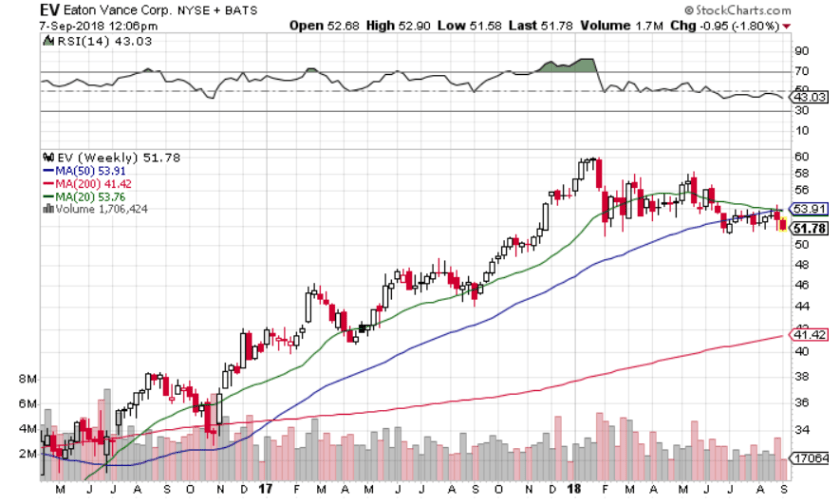
Our response is to wait to see how the yield curve evolves after the accelerated demand for treasuries from pension funds goes away. Till then it is very difficult to make a definitive call and for now we consider it prudent to add short positions in individual financials stocks as a portfolio hedge to our overall US equities allocation while also avoiding long positions in the sector.

We have identified three financials stocks that we consider as strong candidates to short.


Synovus Financial Corp $SNV 


SNV


Western Alliance Bancorp $WAL


WAL 

Eaton Vance Corp $EV


EV


 This post should not be considered as investment advice or a recommendation to purchase any particular security, strategy or investment product. References to specific securities and issuers are not intended to be, and should not be interpreted as, recommendations to purchase or sell such securities. Information contained herein has been obtained from sources believed to be reliable, but not guaranteed. 

Don’t wait for the US Dollar Rally, its Already Happened


“Don’t cry because it’s over. Smile because it happened.” – Dr Seuss


“Republicans are for both the man and the dollar, but in case of conflict the man before the dollar.” – Abraham Lincoln


“Dark economic clouds are dissipating into an emerging blue sky of opportunity.” – Rick Perry


According to the minutes of the Fed’s June meeting, released on Thursday, some companies indicated they had already “scaled back or postponed” plans for capital spending due to “uncertainty over trade policy”. The minutes added: “Contacts in the steel and aluminum industries expected higher prices as a result of the tariffs on these products but had not planned any new investments to increase capacity. Conditions in the agricultural sector reportedly improved somewhat, but contacts were concerned about the effect of potentially higher tariffs on their exports.”

Despite the concerns around tariffs, the minutes also revealed that the Fed remained committed to its policy of gradual rate hikes and raising the fed funds rate to its long-run estimate (or even higher): “Participants generally judged that…it would likely to be appropriate to continue gradually raising the target rate for the federal-funds rate to a setting that was at or somewhat above their estimates of its longer-run level by 2019 or 2020”.

The somewhat hawkish monetary policy stance of the Fed combined with (i) expectations of continued portfolio flows into the US due to the interest rate differentials between the US and non-US developed markets, (ii) fears of the Trump Administration’s trade policies causing an emerging markets crisis, and (iii) the somewhat esoteric risk of ‘dollar shortage’ have led many to conclude that the US dollar is headed higher, much higher.

Of all the arguments for the US dollar bull case we consider the portfolio flows into the US to be the most pertinent to the direction of the greenback.

According to analysis conducted by the Council of Foreign Relations (CFR) “all net foreign demand for ‘safe’ US assets from 1990 to 2014 came from the world’s central banks”. And that “For most of the past 25 years, net foreign demand for long-term U.S. debt securities has increased in line with the growth in global dollar reserves.”  What the CFR has described are quite simply the symptoms of the petrodollar system that has been in existence since 1974.

Cumulative US Current Account Deficit vs. Global Foreign Exchange Holdings1aSources: Council on Foreign Relations, International Monetary Fund, Bureau of Economic Analysis


In recent years, however, global US dollar reserves have declined – driven by the drop in the price of oil in late 2014 which forced the likes of Norges Bank, the Saudi Arabian Monetary Agency, and the Abu Dhabi Investment Authority to draw down on reserves to make up for the shortfall in state oil revenues – yet the portfolio flows into the US continued unabated.

Using US Treasury data on major foreign holders of Treasury securities as a proxy for foreign central banks’ US Treasury holdings and comparing it to the cumulative US Treasury securities issuance (net), it is evident that in recent years foreign central banks have been either unable or unwilling to finance the US external deficit.

Cumulative US Marketable Treasury Issuance (Net) vs. US Treasury Major Foreign Holdings1Sources: US Treasury, Securities Industry and Financial Markets Association


Instead, the US has been able to fund its external deficit through the sale of assets (such as Treasuries, corporate bonds and agency debt) to large, yield-starved institutional investors (mainly pension funds and life insurers) in Europe, Japan and other parts of Asia. The growing participation of foreign institutional investors can be seen through the growing gap between total foreign Treasury holdings versus the holdings of foreign central banks.

US Treasury Total Foreign Holdings vs. US Treasury Major Foreign Holdings2Source: US Treasury


Before going ahead and outlining our bearish US dollar thesis, we want to take a step back to understand how and why the US was able to finance its external deficit, particularly between 2015 and 2017, despite the absence of inflows from its traditional sources of funding and without a significant increase in its cost of financing. This understanding is the key to the framework that shapes our expectations for the US dollar going forward.

We start with Japan. In April 2013, the Bank of Japan (BoJ) unveiled a radical monetary stimulus package to inject approximately US dollars 1.4 trillion into the Japanese economy in less than two years. The aim of the massive burst of stimulus was to almost double the monetary base and to lift inflation expectations.

In October 2014, Governor Haruhiko Kuroda shocked financial markets once again by announcing that the BoJ would be increasing its monthly purchases of Japanese government bonds from yen 50 trillion to yen 80 trillion. And just for good measure the BoJ also decided to triple its monthly purchases of exchange traded funds (ETFs) and real estate investment trusts (REITs).

Staying true to form and unwilling to admit defeat in the fight for inflation the BoJ also went as far as introducing negative interest rates. Effective February 2016, the BoJ started charging 0.1 per cent on excess reserves.

Next, we turn to Europe. In June 2014, Señor Mario Draghi announced that the European Central Bank (ECB) had taken the decision to cut the interest rate on the deposit facility to -0.1 per cent. By March 2016, the ECB had cut its deposit facility rate three more times to take it to -0.4 per cent. In March 2015, the ECB also began purchasing euro 60 billion of bonds under quantitative easing. The bond purchases were increased to euro 80 billion in March 2016.

In response to the unconventional measures taken by the BoJ and the ECB, long-term interest rates in Japan and Europe proceeded to fall to historically low levels, which prompted Japanese and European purchases of foreign bonds to accelerate. It is estimated that from 2014 through 2017 Japanese and Eurozone institutional investors and financial institutions purchased approximately US dollar 2 trillion in foreign bonds (net). During the same period, selling of European fixed income by foreigners also picked up.

As the US dollar index ($DXY) is heavily skewed by movements in EURUSD and USDJPY, the outflows from Japan and Europe into the US were, in our opinion, the primary drivers of the US dollar rally that started in mid-2014.

US Dollar Index3Source: Bloomberg


In 2014 with Japanese and European outflows accelerating and oil prices still high, the US benefited from petrodollar, European and Japanese inflows simultaneously. These flows combined pushed US Treasury yields lower and the US dollar sharply higher. The strong flows into the US represented an untenable situation and something had to give – the global economy under the prevailing petrodollar system is simply not structured to withstand a strong US dollar and high oil prices concurrently. In this instance, with the ECB and BoJ staunchly committed to their unorthodox monetary policies, oil prices crashed and the petrodollar flows into the US quickly started to reverse.

Notably, the US dollar rally stalled and Treasury yields formed a local minimum soon after the drop in oil prices.

US 10-Year Treasury Yield4Source: Bloomberg


Next, we turn to China. On 11 August 2015, China, under pressure from the Chinese stock market turmoil that started in June 2015, declines in the euro and the Japanese yen exchange rates and a slowing economy, carried out the biggest devaluation of its currency in over two decades by fixing the yuan 1.9 per cent lower.  The Chinese move caught capital markets by surprise, sending commodity prices and global equity markets sharply lower and US government bonds higher.

In January 2016, China shocked capital markets once again by setting the official midpoint rate on the yuan 0.5 per cent weaker than the day before, which took the currency to its lowest since March 2011. The move in all likelihood was prompted by the US dollar 108 billion drop in Chinese reserves in December 2015 – the highest monthly drop on record.

In addition to China’s botched attempts of devaluing the yuan, Xi Jinping’s anti-corruption campaign also contributed to private capital fleeing from China and into the US and other so called safe havens.

China Estimated Capital Outflows5Source: Bloomberg


The late Walter Wriston, former CEO and Chairman of Citicorp, once said: “Capital goes where it is welcome and stays where it is well treated.” With the trifecta of negative interests in Europe and Japan, China’s botched devaluation effort and the uncertainty created by Brexit, capital became unwelcome in the very largest economies outside the US and fled to the relative safety of the US. And it is this unique combination, we think, that enabled the US to continue funding its external deficit from 2014 through 2017 without a meaningful rise in Treasury yields.

Moreover, in the absence of positive petrodollar flows, we suspect that were it not for the flight to safety driven by fears over China and Brexit, long-term Treasury yields could well have bottomed in early 2015.


Investment Perspective


  1. Foreign central banks show a higher propensity to buy US assets in a weakening US dollar environment


Using US Treasury data on major foreign holders of Treasury securities as a proxy for foreign central banks’ US Treasury holdings, we find that foreign central banks, outside of periods of high levels of economic uncertainty, have shown a higher propensity to buy US Treasury securities during phases of US dollar weakness as compared to during phases of US dollar strength.

Year-over-Year Change in Major Foreign Holdings of Treasury Securities and the US Trade Weighted Broad Dollar Index 6Sources: US Treasury, Bloomberg


The bias of foreign central banks, to prefer buying Treasury securities when the US dollar is weakening, is not a difficult one to accept. Nations, especially those with export oriented economies, do not want to see their currencies rise sharply against the US dollar as an appreciating currency reduces their relative competitiveness. Therefore, to limit any appreciation resulting from a declining US dollar, foreign central banks are likely to sell local currency assets to buy US dollar assets. However, in a rising US dollar environment, most foreign central banks also do not want a sharp depreciation of their currency as this could destabilise their local economies and prompt capital outflows. And as such, in a rising US dollar environment, foreign central banks are likely to prefer selling US dollar assets to purchase local currency assets.


  1. European and Japanese US treasury Holdings have started to decline


European and Japanese US Treasury Holding 7Source: US Treasury


The ECB has already scaled back monthly bond purchases to euro 30 billion and has outlined plans to end its massive stimulus program by the end of this year. While BoJ Governor Haruhiko Kuroda in a testimony to the Japanese parliament in April revealed that internal discussions were on going at the BoJ on how to begin to withdraw from its bond buying program.

In anticipation of these developments and the increased possibility of incurring losses on principal due to rising US inflation expectations, it is likely that European and Japanese institutional investors and financial institutions have scaled back purchases of US dollar assets and even started reducing their allocations to US fixed income.


  1. Positive correlation between US dollar and oil prices


One of the surprises thrown up by the markets this year is the increasingly positive correlation between the US dollar and the price of oil. While the correlation may prove to be fleeting, we think there have been two fundamental shifts in the oil and US dollar dynamic that should see higher oil prices supporting the US dollar, as opposed to the historical relationship of a strengthening US dollar pressuring oil prices.

The first shift is that with WTI prices north of US dollar 65 per barrel, the fiscal health of many of the oil exporting nations improves and some even begin to generate surpluses that they can recycle into US Treasury securities. And as oil prices move higher, a disproportionality higher amount of the proceeds from the sale of oil are likely to be recycled back into US assets. This dynamic appears to have played out to a degree during the first four months of the year with the US Treasury securities holdings of the likes of Saudi Arabia increasing. (It is not easy to track this accurately as a number of the oil exporting nations also use custodial accounts in other jurisdictions to make buy and sell their US Treasury holdings.)

WTI Crude vs. US Dollar Index8Source: Bloomberg


The second shift is that the US economy no longer has the same relationship it historically had with oil prices. The rise of shale oil means that higher oil prices now allow a number of US regions to grow quickly and drive US economic growth and job creation. Moreover, the US, on a net basis, spends much less on oil (as a percentage of GDP) than it has done historically. So while the consumers may take a hit from rising oil prices, barring a sharp move higher, the overall US economy is better positioned to handle (and possibly benefit from) gradually rising oil prices.


  1. As Trump has upped the trade war rhetoric, current account surpluses are being directed away from reserve accumulation


Nations, such as Taiwan and the People’s Republic of Korea, that run significant current account surpluses with the US have started to re-direct surpluses away from reserve accumulation (i.e. buying US assets) in fear of being designated as currency manipulators by the US Treasury. The surpluses are instead being funnelled into pension plans and other entitlement programs.


  1. To fund its twin deficits, the US will need a weaker dollar and higher oil prices


In recent years, the US current account deficit has ranged from between 2 and 3 per cent of GDP.

US Current Account Balance (% of GDP)9Source: Bloomberg


With the successful passing of the Trump tax plan by Congress in December, the US Treasury’s net revenues are estimated to decrease by US dollar 1.5 trillion over the next decade. While the increase in government expenditure agreed in the Bipartisan Budget Act in early February is expected to add a further US dollar 300 billion to the deficit over the next two years. The combined effects of these two packages, based on JP Morgan’s estimates, will result in an increase in the budget deficit from 3.4 per cent in 2017 to 5.4 per cent in 2019. This implies that the US Treasury will have to significantly boost security issuance.

Some of the increased security issuance will be mopped by US based institutional investors – especially if long-term yields continue to rise. US pension plans, in particular, have room to increase their bond allocations.

US Pension Fund Asset Allocation Evolution (2007 to 2017) 10Source: Willis Tower Watson


Despite the potential demand from US based institutional investors, the US will still require foreign participation in Treasury security auctions and markets to be able to funds its deficits. At a time when European and Japanese flows into US Treasuries are retreating, emerging market nations scrambling to support their currencies by selling US dollar assets is not a scenario conducive to the US attracting foreign capital to its markets. Especially if President Trump and his band of trade warriors keep upping the ante in a bid to level the playing field in global trade.

Our view is that, pre-mid-term election posturing aside, the Trump Administration wants a weaker dollar and higher oil prices so that the petrodollars keep flowing into US dollar assets to be able to follow through on the spending and tax cuts that form part of their ambitious stimulus packages. And we suspect that Mr Trump and his band of the not so merry men will look to talk down the US dollar post the mid-term elections.


This post should not be considered as investment advice or a recommendation to purchase any particular security, strategy or investment product. References to specific securities and issuers are not intended to be, and should not be interpreted as, recommendations to purchase or sell such securities. Information contained herein has been obtained from sources believed to be reliable, but not guaranteed.

The Great Unwind and the Two Most Important Prices in the World

“The cost of a thing is the amount of what I will call life which is required to be exchanged for it, immediately or in the long run.” – Walden by Henry David Thoreau

 “The way to crush the bourgeoisie is to grind them between the millstones of taxation and inflation.” – Vladimir Lenin

“There are only three ways to meet the unpaid bills of a nation. The first is taxation. The second is repudiation. The third is inflation.” – Herbert Hoover

The Federal Reserve for the better part of a decade has been engaged in the business of suppressing interest rates through the use of easy monetary policies and quantitative easing. For US bond market participants all the Fed’s policies entailing interest rate suppression meant that there was a perpetual bid for US treasury bonds and it was always at the best possible price. The Fed has recently embarked on the journey toward unwinding the suppression of interest rates through the process of quantitative tightening. QT has US bond market participants worried that there will be a perpetual offer of US treasury bonds at the worst possible price.

The Organisation of Petroleum Exporting Countries (OPEC) and Russia have, since late 2016, taken steps to prop up the price of oil by aggressively cutting output. With a history of mistrust amongst OPEC and non-OPEC producers and a lackadaisical approach to production discipline, oil market participants did not immediately reward oil producers with higher oil prices in the way bond market participants rewarded the Fed with immediately higher bond prices / lower yields. It took demonstrable commitment to the production quotas by the oil producing nations for oil market participants to gain the confidence to bid up prices. And just as confidence started to peak, Russia and Saudi Arabia signalled that they are willing to roll back the production cuts.

Arguably the US dollar and oil are the two most important ‘commodities’ in the world. One lubricates the global financial system and the other fuels everything else. Barring a toppling of the US dollar hegemony or a scientific breakthrough increasing the conversion efficiency of other sources of energy, the importance of these commodities is unlikely to diminish. Hence, the US (long-term) interest rates and the oil price are the two most important prices in the world. The global economy cannot enjoy a synchronised upturn in an environment of sustainably higher US interest rates and a high price of oil.

In the 362 months between end of May 1988 and today there have only been 81 months during which both the US 10-year treasury yield and the oil price have been above their respective 48-month moving averages – that is less than a quarter of the time. (These periods are shaded in grey in the two charts below.)

US 10-Year Treasury Yield10Y YieldSource: Bloomberg

West Texas Intermediate Crude (US dollars per barrel)

WTISource: Bloomberg

Over the course of the last thirty years, the longest duration the two prices have concurrently been above their respective 48-month moving averages is the 25 month period between September 2005 and October 2007. Since May 1988, the two prices have only been above their respective 48-month moving averages for 5 or more consecutive months on only four other occasions: between (1) April and October 1996; (2) January and May 1995; (3) October 1999 and August 2000; and (4) July 2013 and August 2014.

Notably, annual global GDP growth has been negative on exactly five occasions since 1988 as well: 1997, 1998, 2001, 2009, and 2015. The squeeze due to sustainably high US interest rates and oil prices on the global economy is very real.

Global GDP Growth Year-over-Year (Current US dollars)

global GDP

Source: Federal Reserve Bank of St. Louis


On 13 June, 2018 President Donald Trump tweeted:

“Oil prices are too high, OPEC is at it again. Not good!”

And today, nine days later, OPEC and non-OPEC nations (read: Saudi Arabia and Russia) obliged by announcing that OPEC members will raise output by at least 700,000 barrel per day, with non-OPEC nations expected to add a further 300,000 barrels per day in output.

Iran may accuse other oil exporting nations of being bullied by President Trump but we think it is their pragmatic acceptance that the global economy cannot withstand higher oil prices that has facilitated the deal amongst them. (Of course we do not deny that a part of the motivation behind increasing output is bound to be Saudi Arabia wanting to return the favour to Mr Trump for re-imposing sanctions on Iran.)


Last week the Fed raised the Fed funds target rate by 25 basis points to a range between 1.75 per cent and 2 per cent. At the same time it also increased the interest rate on excess reserves (IOER) – the interest the Fed pays on money placed by commercial banks with the central bank – by 20 basis points to 1.95 per cent. The Federal Open Market Committee (FOMC) also raised its median 2018 policy rate projection from 3 hikes to 4.

With the Fed forging ahead with interest rate increases it may seem that it is the Fed and not OPEC that may squeeze global liquidity and cause the next financial crisis. While that may ultimately prove to be the case, the change in the policy rate projection from 3 to 4 hikes is not as significant as the headlines may suggest – the increase is due to one policymaker moving their dot from 3 or below to 4 or above. Jay Powell, we think, will continue the policy of gradualism championed by his predecessors Ben Bernanke and Janet Yellen. After all, the Chairman of the Fed, we suspect, oh so desires not to be caught in the cross hairs of a Trump tweet.


Investment Perspective


Given our presently bullish stance on equity markets, the following is the chart we continue to follow most closely (one can replace the Russell 1000 Index with the S&P500 or the MSCI ACWI indices should one so wish):

Russell 1000 IndexRussell 100Source: Federal Reserve Bank of St. Louis

If the shaded area on the far right continues to expand – i.e. the US 10-year treasury yield and oil price concurrently remain above their respective 48-month moving averages – we would begin to dial back our equity exposure and hedge any remaining equity exposure through other asset classes.

Sign up to our mailing list or send us an email at info@lxvresearch.com to receive our free research updates.

This post should not be considered as investment advice or a recommendation to purchase any particular security, strategy or investment product. References to specific securities and issuers are not intended to be, and should not be interpreted as, recommendations to purchase or sell such securities. Information contained herein has been obtained from sources believed to be reliable, but not guaranteed.