Investment Observations


“People’s minds are changed through observation and not through argument.” – Will Rogers


“If you make listening and observation your occupation you will gain much more than you can by talk.” – Robert Baden-Powell


“The important thing is not to stop questioning. Curiosity has its own reason for existing.” – Albert Einstein


Autumn months are more volatile; 2017 was an aberration

October is, on average, the most volatile month of the year for US equity markets. From 1993, the year the VIX index was launched, through 2017, the average level for the VIX for the month of October has been 21.8 per cent.

In October 2017, the VIX averaged 10.8 per cent, which at the time was the lowest monthly average for any month on record since the VIX index was launched. The complacency witnessed in capital markets last year was an aberration and should not be the yardstick by which investors manage their portfolios.


US mid-term elections: History is on the side of equity markets

Regardless of how midterm elections turn out, equity investors tend to be the big winner. At least that is what history suggests.

The S&P 500 index has climbed in the twelve months following each of the midterm elections going back to 1946, with an average return of 16.7 per cent. That is eighteen elections irrespective of who won and what changes were wrought on the balance of power.

Do not let the typical level of volatility witnessed in months starting with the letter ‘O’ put you on the wrong side of history. Stay long US stocks.


Treasuries: “The dog that didn’t bark”

If stocks go down, treasuries go up. Rinse and repeat. This is the axiom on which strategic asset allocations of institutional investors and quantitative investment strategies, such as ‘all-weather’ and ‘risk parity’, have been built.

Yet this past month we have seen treasuries fail to bounce even though global equity markets have sold off. This failure is even more surprising given that speculative short futures positions across the US Treasury bond curve are at or near record highs. The inability of bonds to rally in the face of an equity market sell-off gives credence to the argument that the short bond positions are not speculative but rather hedges to long positions held by institutional investors and / or hedge funds.


Gold: Risk-off rally?

Unlike treasuries, the recent sell-off in stocks has coincided with a strengthening of the price of gold. This is all the more surprising when we consider that the US dollar has not weakened but rather strengthened as well.


Is gold the new hedge to stock market volatility? We are not sure. The recent rally might just be a case of unwinding of oversold conditions or of speculative investors closing their short gold positions in response to redemptions or margin calls caused by their declining long positions.

Alternatively, we wonder if a new bull market in precious metals is getting underway. It is, we feel, too early to tell and with gold miners remaining weak despite the gold price holding strengthening, it should give anyone bullish on the prospects of precious metals some pause.

For example, Newmont Mining, one of the few ‘blue chip’ gold mining companies, reported solid third quarter earnings yesterday that handily surpassed consensus estimates but still saw its stock price decline by almost 7 per cent. (Admittedly, at the time of writing some of yesterday’s weakness has been reversed today.)


SoftBank’s Vision Fund and the race for venture capital exits

Over the last twelve months there has been little to no incentive for venture capital backed companies to go public. They have had a much better alternative that does not come with the scrutiny faced by a publicly listed company: sell to SoftBank’s Vision Fund.

The Vision Fund, the largest ever venture capital fund raised anchored by capital commitment of US dollars 45 billion from Saudi Arabia, has been deploying capital at record pace with, what appears to us at least, limited consideration for valuation and due diligence.

Take for instance Benchmark Capital’s partial exit in Uber. The venture capital fund was able to monetise one of its most successful investments without a trade sale or public listing. Benchmark sold 14.5 per cent of its holding in Uber for around US dollars 900 million to the Vision Fund. Considering that Benchmark originally invested US dollars 12 million in Uber, the partial exit is quite the coup and something, we feel, that would not have been possible without a public listing were it not for the Vision Fund

Given the recent events surrounding Saudi Arabia and deceased Washington Post columnist Jamal Khashoggi, there is likely to be little appetite in Silicon Valley to accept  Saudi Arabian money henceforth. For example, Ari Emanuel’s media and entertainment group Endeavor is considering terminating a US dollars 400 million investment into the company by Saudi Arabia’s Public Investment Fund.

SoftBank’s Vision Fund is synonymous with Saudi Arabian money.

Masayoshi Son, SoftBank’s founder, was as recently as August talking up the prospects for a second Vision Fund with Saudi Arabia once again the cornerstone investor. Talks of the second fund have died down given recent events.

Given recent developments and Silicon Valley likely to shy away from engaging the Vision Fund any further, we suspect many venture capital backed “unicorns” are actively soliciting proposals from investment banks to help them go public.

We expect a flurry of tech-led IPO activity in the first half of 2019.


Brazilian election: Fears of a Latin Rodrigo Duterte

Brazil held the first round of general elections on 7 October, 2018 to elect the President, Vice President and the National Congress.

Rio de Janeiro congressman Jair Bolsonaro came first in the first round of the election. The run-off will be between him and former São Paulo mayor Fernando Haddad.

Fernando Haddad represents the Workers’ Party – the leftist party that has won the last four elections held in Brazil.

Former army captain and seven-time congressman Jair Bolsonaro is the right-wing candidate representing the Social Liberal Party. Barring a late twist, Mr Bolsonaro is expected to be elected as Brazil’s next president on Sunday. Mr Bolsonaro has ridden a wave of populism and angst against the incumbent party to put himself in pole position.

Since Mr Bolsonaro’s victory in the first round of the elections, Brazilian assets have rallied even as other emerging markets struggled. Market participants do not want the Worker’s Party back in power – fearing that the leftists will undo the reforms that have stabilised the Brazilian economy in the aftermath of the 2014-16 recession. Moreover, there is hope that Mr Bolsonaro will continue on the path of reforming the Brazilian economy.

Mr Bolsonaro’s proposed economic team, should he come into power as expected, will be made up of technocrats under the leadership of University of Chicago-trained financier Paulo Guedes. Mr Guedes is an advocate of deep public spending cuts and deficit reduction with the seemingly incongruent goals of reigniting consumer and business confidence. He has advised Mr Bolsonaro to push ahead with painful reforms, should he be elected, from the very beginning of his term. In particular, Mr Guedes is pushing for social security and pension reform that would trim benefits and raise the state retirement age to 65 for men, and 62 for women to be at the top of Mr Bolsonaro’s agenda.

While right-wing candidate’s economic agenda appears to be encouraging, his social agenda is eerily reminiscent of the type of opinions expressed by Philippine President Rodrigo Duterte. Mr Bolsonaro, to quote the Financial Times, “is known as an apologist for the 1964-85 military dictatorship, for endorsing torture and for making disparaging remarks about homosexuals, women and black people.”

We are concerned that Mr Bolsonaro will try to prolong the wave of populism as much as possible by prioritising his social agenda over economic reforms. In particular, we would be surprised, if he makes the unpopular social security pension reforms his key priority early in his presidential term. In fact, during his campaign, Mr Bolsonaro went as far as criticising current president Michel Temer’s planned social security system reforms as well as the tax changes proposed by Mr Guedes.

Brazilian assets may continue to rally should the country elect Jair Bolsonaro as its 38th president on Sunday. We, however, prefer to tread carefully until there is more clarity on Mr Bolsonaro’s priorities once he is in office.


This post should not be considered as investment advice or a recommendation to purchase any particular security, strategy or investment product. References to specific securities and issuers are not intended to be, and should not be interpreted as, recommendations to purchase or sell such securities. Information contained herein has been obtained from sources believed to be reliable, but not guaranteed.

The Bull Market is Not Dead.

“Bulls do not win bull fights. People do.” – Normal Ralph Augustine


 “Stocks fluctuate, next question.”Alan Greenberg, former CEO and Chairman of the Board of Bear Stearns, in response to questions about the crash, October 22, 1987


“If you have trouble imagining a 20% loss in the stock market, you shouldn’t be in stocks.” – Jack Bogle


November last year, in Volatility Selling and Volatility Arbitrage Ideas Using Equities, we wrote:


Based on the tenets of Prospect Theory, the popularity of short volatility strategies is somewhat confounding. By investing in such strategies, investors are underweighting as opposed to overweighting a low probability event (a market crash). At the same time, they are giving preference to negative skewness, favouring small gains at the risk of incurring large losses.

 During October, 2017, the VIX recorded its lowest monthly average since the launch of the index dating back to January, 1993. What makes this statistic even more remarkable is that autumn months are generally more volatile with October being, on average, the most volatile month during the year.  The average level of the VIX for October, starting 1993, is 21.8 – more than double the 10.1 averaged last month.

With all that being said, we do consider the short volatility trade to be richly valued. That does not mean we expect the equity market to crash, instead the differential between implied and realised volatility has tightened to such a degree that this gap can easily close and invert. The trade can become loss making without a meaningful correction in equity markets.


Poorly structured short-volatility products and the limited – almost non-existent – down-side risk to going long volatility has, in our opinion, led to the emphatic short-squeeze in volatility witnessed over the last ten days or so. The tail has well and truly wagged the dog. That is, higher volatility has led to the sharp correction in the market. Not the other way round. The late-afternoon equity sell-off on Monday 5 February is indicative of as much.

S&P 500 Index on 5 February, 2018SPX 5 FebSource: Bloomberg

XIV, SVXY and other products of their ilk are not the first, and are almost certainly not going to be the last, poorly conceived investment products to blow-up. Think back to portfolio insurance, synthetic collateralised debt obligations (CDOs) and CDO-squared as a reminder. There has been plenty of commentary, and no shortage of memes, lambasting regulators of and speculators in short-volatility products alike – many of the critics make valid arguments that should give regulators pause for thought. For investors the time, however, is not to reflect on the flaws of these products but rather to focus on whether the blow-up of these products can lead to a contagion into adjacent markets or is this just a shake-out of weak hands.

The most convincing argument for the recent correction being a shake-out of weak hands comes from the US corporate bond market. US corporate spreads have been benign in the face of the recent spike in volatility – a first in a very long-time.

US Corporate Yield Spreads vs. VIX IndexCorporate yields and VIXSource: Bloomberg

The narrative of rising inflation expectations leading to the correction in equity market has taken hold in some quarters. Firstly, looking at the USD 5-year, 5-year inflation swap rate, there has not been a sharp increase in market-based inflation expectations. In fact, the increase in inflation expectations was much sharper immediately after Trump won the election than at any time during the last year. Secondly, high inflation does not negatively affect equities. If inflation is high but stable, it is nominally positive for equity markets and is unlikely to cause any damage to the real economy. Moreover, historical data suggests that the highest levels of price-to-earnings multiples are witnessed during periods when inflation ranged from 2 to 3 per cent.


An unexpected acceleration in inflation followed by unanticipated changes in monetary policy, however, can have significant negative consequences for the economy. The Fed, to date, has not shown any signs of panic. As long as the Fed continues on the path of slow and steady rate hikes, we do not expect Fed rate hikes to derail the economy or the equity market. If, however, the US economy overheats in response to the recently passed tax reforms and the tight labour market, the Fed may be forced to react aggressively, which could be catastrophic for both the economy and equity markets.

USD 5-Year, 5-Year Inflation Swap Rate5Y5YSource: Bloomberg

The one change coming out of the recent sell-off, in our opinion, is that volatility has made its secular low. We suspect that retail investors are unlikely to return to short volatility in droves. We also have a hunch that private banks and wealth managers will not be offering short-volatility products to their high-net worth clients any time soon. Volatility, therefore, should stabilise closer to its longer-term average – we do, however, expect volatility to be structurally lower than the past due to the increased prevalence of passive and systematic strategies, which implicitly dampen volatility during a stable market environment.

A necessary corollary of higher volatility is that investors have to be more discerning in security selection.  Active management may soon be back in vogue.


Investment Perspective


In the after-math of the recent market sell-off we have heard market legends claim that “macro is back” or that it is an “exciting turn for macro trading”. At the same time, we have heard old hands speak of the trauma of 1987 and how it shaped their approach to markets going forward. What we do not hear or read of enough though is that as traumatic as 19 October, 1987 was, it was also the buying opportunity of a generation. The S&P 500 compounded at an annualised rate of 18.9 per cent over the next ten years.

We do not expect returns from equity markets for the next ten years to be like those witnessed between 1987 and 1997. We, however, also cannot ignore that global equity markets had a major break out last year.


MSCI All Cap World IndexMSCI ACWISource: Bloomberg

We have one simple, singular thought when it comes to equity markets today. Until we come across evidence to the contrary, we think investors should figure out what they want to own and buy it with both hands.


This post should not be considered as investment advice or a recommendation to purchase any particular security, strategy or investment product. References to specific securities and issuers are not intended to be, and should not be interpreted as, recommendations to purchase or sell such securities. Information contained herein has been obtained from sources believed to be reliable, but not guaranteed. 

Volatility Selling and Volatility Arbitrage Ideas Using Equities

“Here’s something to think about: How come you never see a headline like ‘Psychic Wins Lottery’?” – Jay Leno

 “Nothing in life is as important as you think it is when you are thinking about it.” – Thinking, Fast and Slow, Daniel Kahneman

 “I hate to lose more than I love to win.” – Jimmy Connors


Prospect Theory, developed by Daniel Kahneman and Amos Tversky in 1979, is a descriptive model that characterises how people choose between different options and how they estimate the perceived likelihood of each of these options. The main findings of Prospect Theory are:

  1. People care about gains or losses more than about overall wealth;
  2. People exhibit loss aversion and can be risk seeking when facing the possibility of loss; and
  3. People overweight low-probability events.

The Chicago Board Options Exchange Volatility Index, better known as the VIX, is the primary gauge used by equity and options traders to monitor the anxiety level of market participants. The VIX measures the market’s expectation of 30-day volatility of the S&P 500 index. The higher VIX is, the higher the anxiety levels amongst market participants.

Market participants can express their view on short-term market volatility through a number of instruments. Two of the most common ways used are selling options on an equity index or by shorting the VIX. As equities tend to decline as volatility rises, the preference amongst market participants is to sell puts over selling calls. Added to that, puts are usually more expensive than calls; selling puts generates a higher premium.

Selling volatility, using either equity index options or by shorting the VIX, is the capital markets equivalent to selling lottery tickets. Large losses in a strategy involving selling volatility tend to coincide with market crashes. Large but rare losses, i.e. negative skewness, justify a positive risk premium for the strategy.

Selling volatility on equity indices has provided attractive payoffs over long periods of time. The strategy had a high long-run Sharpe ratio over the two decades between the 1987 crash and the 2008 Global Financial Crisis. Even higher levels of performance have been achieved by the strategy since the equity market lows in 2009. The reason the strategy has been profitable is largely due to implied volatilityon equity indices consistently trading at a premium over realised volatility. Based on monthly data from 2005 till date, as shown in the chart below, the average differential between the implied and realised volatility on the S&P 500 index is 1.2%.

S&P 500 Index Implied Volatility less Realised Volatility

Implied vs RealisedSource: Bloomberg

Selling volatility has become a very popular trade, to say the least. The proliferation of exchange traded funds (ETFs) and exchanged traded notes (ETNs) that track either the performance or the inverse of the performance of the VIX has made selling or buying volatility, otherwise complicated trades to structure, accessible for the average investor. Investors can go long the inverse VIX instruments or short the long VIX products if they want to sell volatility.

Based on the tenets of Prospect Theory, the popularity of short volatility strategies is somewhat confounding. By investing in such strategies, investors are under weighting as opposed to over weighting a low probability event (a market crash). At the same time, they are giving preference to negative skewness, favouring small gains at the risk of incurring large losses.

During October, 2017, the VIX recorded its lowest monthly average since the launch of the index dating back to January, 1993. What makes this statistic even more remarkable is that autumn months are generally more volatile with October being, on average, the most volatile month during the year.  The average level of the VIX for October, starting 1993, is 21.8 – more than double the 10.1 averaged last month.

Proshares Short VIX Short Term Futures ETF Price Performance Proshares Sort VIXSource: Bloomberg

With volatility recording all-times lows and equity markets at all-time highs, some have called selling volatility the “most dangerous trade in the world” while others expect an inevitable rise in volatility to cause a significant correction in US equity markets. While these views may prove to be correct, our view is slightly more nuanced.

The increased availability of volatility instruments has made trading volatility more liquid than it used to be. Just as other securities benefit from a re-rating as their liquidity improves, volatility has structurally re-priced due to the proliferation of vehicles facilitating short and long volatility trades. We do not know the degree to which this increased liquidity should improve valuation but accept that volatility should be lower than it used to be prior to this structural shift.

Another reason why we think volatility should be structurally lower today than it used to be is the rise of passive investing. Passive investment vehicles are gathering an increasing share of assets and deploying them in systematic manner. A systematic allocation strategy is by construct more predictable, less volatile than a discretionary allocation strategy.

Taleb, in his paper “Bleed or Blowup? Why Do We Prefer Asymmetric Payoffs?” featured in the Journal of Behavioral Finance in 2004, argues that the growth of institutional fund management also contributes to the rise in the negative skewness bias. We consider the case for money managers preferring investment strategies exhibiting negative skewness to be credible as such strategies superficially boost Sharpe ratio over extended periods of time, supporting asset gathering efforts.   

With all that being said, we do consider the short volatility trade to be richly valued. That does not mean we expect the equity market to crash, instead the differential between implied and realised volatility has tightened to such a degree that this gap can easily close and invert. The trade can become loss making without a meaningful correction in equity markets.


Investment Perspective

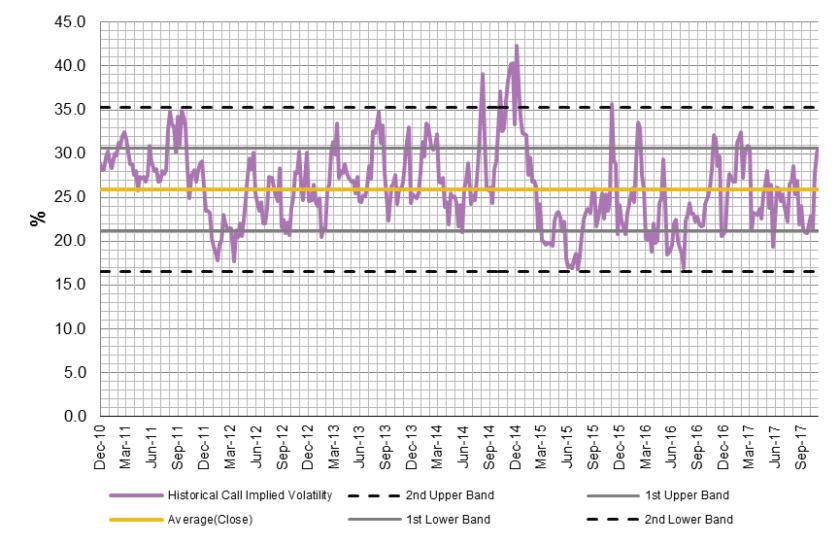
The S&P 500 index’s implied volatility is almost two standard deviations below its average over the last 7 years. Not being psychics and being cognisant of the incremental improvements in the economy, we are not calling for a significant correction in the overall market. However, such low levels of volatility, in our opinion, are bound to lead to investor complacency in areas of the market that do not warrant it. And it is these areas of the market we search for to avoid or short. While at the same time we also search for areas where anxiety levels are extended and have the potential to revert back towards the mean.

S&P 500 Index Historical Implied VolatilitySPX imp volSource: Bloomberg

In our search we have found two sectors where we find unwarranted levels of complacency: airlines and cable & satellite and broadcasting businesses.

Capacities are rising in the airline sector at a time where costs are also rising. Airlines have enjoyed a significant tailwind due to the crash in oil prices; however, oil prices are rising and we expect further upside to oil prices from here. This will be a major headwind for airlines at a time when there are already cost pressures from rising  salaries for pilots due to a shortage of qualified pilots. Despite the headwinds, implied volatility for airlines stocks are at one to two standard deviations below their averages.

Southwest Airlines Historical Implied VolatilityLUV imp vol

Source: Bloomberg

American Airlines Historical Implied VolatilityAAL Imp Source: Bloomberg

Delta Airlines Historical Implied Volatility DAL imp volSource: Bloomberg

Cable & satellite and broadcasting businesses face structural issues that bring into question the viability of their business models. These issues are similar to the challenges faced by advertising agencies that we have articulated in Unbranded: The Risk in Household Consumer Names. Despite the challenging outlook, we find investor complacency to be high in a number of names within the sector.

CBS Historical Implied Volatility CBS imp volSource: Bloomberg

We consider the shorting of stocks in the sectors with challenging prospects combined with high levels of investor complacency, as a means to selectively reduce short volatility exposure or to go long volatility without the time decay or negative carry of direct long volatility trades.

To complement our short ideas, we have also identified one area of the market where we find high levels of anxiety after significant draw downs have already taken place: the general merchandising sector. While there is still potential for further pain in the overall retail sector, we find there is an opportunity to pick up the pieces in a segment where we find some value.

Target Historical Implied Volatility TGT imp volSource: Bloomberg

 Dollar General Historical Implied Volatility DG imp volSource: Bloomberg


Dollar Tree Historical Implied Volatility DLTR imp volSource: Bloomberg

We are long target ($TGT), Dollar General ($DG) and Dollar Tree ($DLTR) and are short Southwest Airlines ($LUV), American Airlines ($AAL), Delta Airlines ($DAL) and CBS ($CBS).


This post should not be considered as investment advice or a recommendation to purchase any particular security, strategy or investment product. References to specific securities and issuers are not intended to be, and should not be interpreted as, recommendations to purchase or sell such securities. Information contained herein has been obtained from sources believed to be reliable, but not guaranteed.