Pick-and-Mix

“The whole world is simply nothing more than a flow chart for capital.” – Paul Tudor Jones

“It’s still true that the big players in the public markets are not good at taking short-term pain for long-term gain.” – Jeffrey W. Uben, ValueAct Capital

In this week’s piece we (i) revisit our call on cloud-based software stocks, (ii) touch upon Dollar Tree Inc. $DLTR, which we think is poised to outperform in the near term, and (iii) consider the possible ramifications of the recent policy statements by the US Treasury and the Fed.

Cloud-Based Enterprise Software Update

We highlighted cloud-based enterprise plays as a potential long idea in Two Investment Ideas on 14 January, 2019. Two out of our three preferred names, Veeva Systems $VEEV and Workday Inc. $WDAY, are up 16.46 and 13.92, respectively, from market close on 14 January through 2 February. In comparison, the S&P 500 Index is up 4.88 per cent during the same period.

We think it is a good time to tactically take profits in both names and to continue playing the theme through Benefitfocus $BNFT and the two additional names we highlighted in our weekly piece on 21 January. We will look to re-enter long positions in $VEEV and $WDAY at lower levels, should they correct.

Dollar Tree Inc.

We have been long $DLTR for more than a year now. Initially the stock did really well,  outperforming the S&P 500 Index. Alas, it did not last and performance was lacklustre between February and December last year.

DLTR US Equity (Dollar Tree Inc) 2019-02-04 14-06-14.png

The underwhelming performance of the stock stems from the declining sales and earnings at its Family Dollar franchise. The company acquired Family Dollar for US dollars 9 billion in a fiercely contested battle with Dollar General $DG during the second half of 2017.

The Family Dollar acquisition was motivated by management’s desire to scale up to better compete with larger players such as $DG and Target $TGT. What transpired, however, is the company ended up buying an under performing business that it has, to date, been unable to turnaround.

What has made the failure to turnaround Family Dollar even more vexing, for shareholders and management alike, is that following $DLTR’s ill-fated acquisition, its direct competitor, $DG, has managed to grow strongly, open up new locations and increase its market share.

$DLTR’s troubles with Family Dollar have attracted the attention of activist investors and in January of this year Starboard Value – the New York Based activist hedge fund – announced that it owned 1.7 per cent of the company and had nominated seven directors to its board.

Starboard wants $DLTR to consider a sale of Family Dollar, even if it means selling it for significantly less than it paid for it. It has also suggested that the company should make changes to its current business model including selling some items at price points above US dollar 1, such as US dollar 1.50 or 2 – something that $DLTR’s competitors already do.

Whether a sale of Family Dollar transpires or not, having an activist hedge fund as a vocal shareholder, we think, is likely to place pressure on $DLTR’s management to make meaningful improvements in the company’s operational performance and create shareholder value.

We have waited on commenting on the stock following Starboard’s announcement as we wanted the initial euphoria to die down and for long frustrated shareholders to take the opportunity to sell following the news.

We think $DLTR is well placed to out perform in the near term and we will be adding to our existing position.

US Treasury Refunding Statement

From the US Department of the Treasury’s press release issued on 28 January:

  • During the January – March 2019 quarter, Treasury expects to borrow $365 billion in privately held net marketable debt, assuming an end-of-March cash balance of $320 billion. The borrowing estimate is $8 billion higher than announced in October 2018. The increase in borrowing is driven primarily by a lower than previously assumed opening cash balance.
  • During the April – June 2019 quarter, Treasury expects to borrow $83 billion in privately-held net marketable debt, assuming an end-of-June cash balance of $300 billion.

The US Treasury’s deposits held in its general account with the Fed stand at US dollars 411.4 billion as of 30 January 2019.

Based on the US Treasury’s press release, around US dollars 110 billion of deposits held with the Fed will be injected into the global banking system between now and 30 June.

This announcement is important because deposits held by the Treasury with the Fed are unlike deposits held with banks. Outside periods of extreme economic instability, the Fed is not engaged in the business of lending money, it only takes money in as deposits. Cash taken in by the Fed does not percolate through the global banking system, rather it sits idly in Fed’s accounts in New York.

Consequently, the build up of cash in the Treasury’s general account, to park funds generated through the issuance of Treasury bills, tightens monetary conditions while withdrawals from the account tend to ease monetary conditions. With the US Treasury contributing to tightening financial conditions for the better part of 18 months, it will for the next five months, at least, reverse course and become a source of monetary easing.

The Fed’s U-Turn

From the Wall Street Journal:

In what arguably was Mr. Powell’s most significant statement on Wednesday, he struck a dovish tone on this process of “balance-sheet normalization.” The signal was that so-called quantitative tightening would continue for now but end sooner than expected. Moreover, he also raised the possibility that the balance sheet could be “an active tool” in the future if warranted—in other words, more bond purchases if markets or the economy cry out for help. Until recently, Fed officials had been insisting the balance-sheet shrinkage was on autopilot.

As discussed last week, the Fed has little choice but to maintain a large balance sheet if it wants the US banking sector to continue being governed under the stringent Basel III framework. Chairman Jay Powell confirmed as much during his press conference on Wednesday last week.

The combination of:

(i) the US Treasury releasing dollars into the banking system;

(ii) the Fed putting interest rate increases on and introducing language that opened up the possibility that the next move in interest rate could either be down or up; and

(iii) increased clarity on the Fed’s plans for shrinking its balance sheet

we think, should be conducive for risk-assets during the first half of the year.

After a strong showing by global markets in January and the little matter of the US-China trade resolution deadline fast approaching, we think caution is warranted in February. Nonetheless our highest conviction ideas for the first half of the year are: long selective emerging markets, long precious metals, short US dollar and long selective US technology companies. 

With respect to precious metals, the Chinese New Year holidays have more often than not proven to be periods of weakness. Those with a bullish disposition should take advantage of this seasonal weakness.

This post should not be considered as investment advice or a recommendation to purchase any particular security, strategy or investment product. References to specific securities and issuers are not intended to be, and should not be interpreted as, recommendations to purchase or sell such securities. Information contained herein has been obtained from sources believed to be reliable, but not guaranteed.

Volatility Selling and Volatility Arbitrage Ideas Using Equities

“Here’s something to think about: How come you never see a headline like ‘Psychic Wins Lottery’?” – Jay Leno

 “Nothing in life is as important as you think it is when you are thinking about it.” – Thinking, Fast and Slow, Daniel Kahneman

 “I hate to lose more than I love to win.” – Jimmy Connors


Prospect Theory, developed by Daniel Kahneman and Amos Tversky in 1979, is a descriptive model that characterises how people choose between different options and how they estimate the perceived likelihood of each of these options. The main findings of Prospect Theory are:

  1. People care about gains or losses more than about overall wealth;
  2. People exhibit loss aversion and can be risk seeking when facing the possibility of loss; and
  3. People overweight low-probability events.

The Chicago Board Options Exchange Volatility Index, better known as the VIX, is the primary gauge used by equity and options traders to monitor the anxiety level of market participants. The VIX measures the market’s expectation of 30-day volatility of the S&P 500 index. The higher VIX is, the higher the anxiety levels amongst market participants.

Market participants can express their view on short-term market volatility through a number of instruments. Two of the most common ways used are selling options on an equity index or by shorting the VIX. As equities tend to decline as volatility rises, the preference amongst market participants is to sell puts over selling calls. Added to that, puts are usually more expensive than calls; selling puts generates a higher premium.

Selling volatility, using either equity index options or by shorting the VIX, is the capital markets equivalent to selling lottery tickets. Large losses in a strategy involving selling volatility tend to coincide with market crashes. Large but rare losses, i.e. negative skewness, justify a positive risk premium for the strategy.

Selling volatility on equity indices has provided attractive payoffs over long periods of time. The strategy had a high long-run Sharpe ratio over the two decades between the 1987 crash and the 2008 Global Financial Crisis. Even higher levels of performance have been achieved by the strategy since the equity market lows in 2009. The reason the strategy has been profitable is largely due to implied volatilityon equity indices consistently trading at a premium over realised volatility. Based on monthly data from 2005 till date, as shown in the chart below, the average differential between the implied and realised volatility on the S&P 500 index is 1.2%.

S&P 500 Index Implied Volatility less Realised Volatility

Implied vs RealisedSource: Bloomberg

Selling volatility has become a very popular trade, to say the least. The proliferation of exchange traded funds (ETFs) and exchanged traded notes (ETNs) that track either the performance or the inverse of the performance of the VIX has made selling or buying volatility, otherwise complicated trades to structure, accessible for the average investor. Investors can go long the inverse VIX instruments or short the long VIX products if they want to sell volatility.

Based on the tenets of Prospect Theory, the popularity of short volatility strategies is somewhat confounding. By investing in such strategies, investors are under weighting as opposed to over weighting a low probability event (a market crash). At the same time, they are giving preference to negative skewness, favouring small gains at the risk of incurring large losses.

During October, 2017, the VIX recorded its lowest monthly average since the launch of the index dating back to January, 1993. What makes this statistic even more remarkable is that autumn months are generally more volatile with October being, on average, the most volatile month during the year.  The average level of the VIX for October, starting 1993, is 21.8 – more than double the 10.1 averaged last month.

Proshares Short VIX Short Term Futures ETF Price Performance Proshares Sort VIXSource: Bloomberg

With volatility recording all-times lows and equity markets at all-time highs, some have called selling volatility the “most dangerous trade in the world” while others expect an inevitable rise in volatility to cause a significant correction in US equity markets. While these views may prove to be correct, our view is slightly more nuanced.

The increased availability of volatility instruments has made trading volatility more liquid than it used to be. Just as other securities benefit from a re-rating as their liquidity improves, volatility has structurally re-priced due to the proliferation of vehicles facilitating short and long volatility trades. We do not know the degree to which this increased liquidity should improve valuation but accept that volatility should be lower than it used to be prior to this structural shift.

Another reason why we think volatility should be structurally lower today than it used to be is the rise of passive investing. Passive investment vehicles are gathering an increasing share of assets and deploying them in systematic manner. A systematic allocation strategy is by construct more predictable, less volatile than a discretionary allocation strategy.

Taleb, in his paper “Bleed or Blowup? Why Do We Prefer Asymmetric Payoffs?” featured in the Journal of Behavioral Finance in 2004, argues that the growth of institutional fund management also contributes to the rise in the negative skewness bias. We consider the case for money managers preferring investment strategies exhibiting negative skewness to be credible as such strategies superficially boost Sharpe ratio over extended periods of time, supporting asset gathering efforts.   

With all that being said, we do consider the short volatility trade to be richly valued. That does not mean we expect the equity market to crash, instead the differential between implied and realised volatility has tightened to such a degree that this gap can easily close and invert. The trade can become loss making without a meaningful correction in equity markets.


Investment Perspective

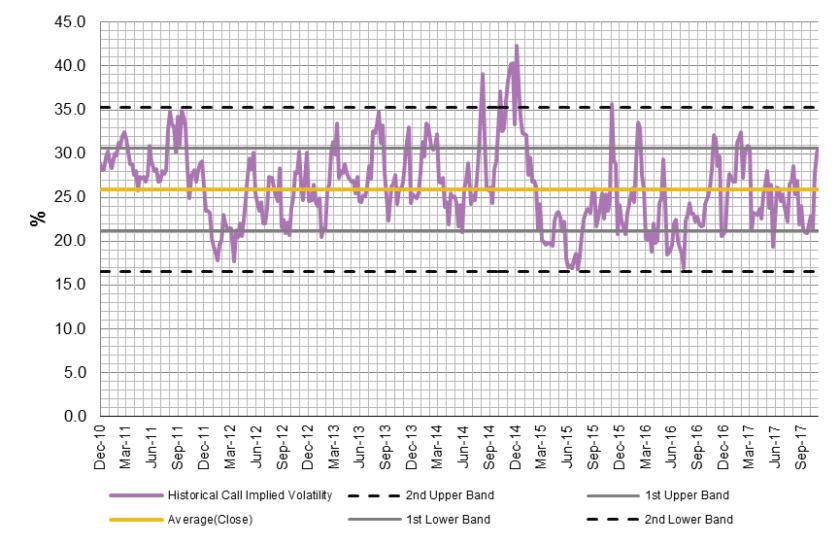
The S&P 500 index’s implied volatility is almost two standard deviations below its average over the last 7 years. Not being psychics and being cognisant of the incremental improvements in the economy, we are not calling for a significant correction in the overall market. However, such low levels of volatility, in our opinion, are bound to lead to investor complacency in areas of the market that do not warrant it. And it is these areas of the market we search for to avoid or short. While at the same time we also search for areas where anxiety levels are extended and have the potential to revert back towards the mean.

S&P 500 Index Historical Implied VolatilitySPX imp volSource: Bloomberg

In our search we have found two sectors where we find unwarranted levels of complacency: airlines and cable & satellite and broadcasting businesses.

Capacities are rising in the airline sector at a time where costs are also rising. Airlines have enjoyed a significant tailwind due to the crash in oil prices; however, oil prices are rising and we expect further upside to oil prices from here. This will be a major headwind for airlines at a time when there are already cost pressures from rising  salaries for pilots due to a shortage of qualified pilots. Despite the headwinds, implied volatility for airlines stocks are at one to two standard deviations below their averages.

Southwest Airlines Historical Implied VolatilityLUV imp vol

Source: Bloomberg

American Airlines Historical Implied VolatilityAAL Imp Source: Bloomberg

Delta Airlines Historical Implied Volatility DAL imp volSource: Bloomberg

Cable & satellite and broadcasting businesses face structural issues that bring into question the viability of their business models. These issues are similar to the challenges faced by advertising agencies that we have articulated in Unbranded: The Risk in Household Consumer Names. Despite the challenging outlook, we find investor complacency to be high in a number of names within the sector.

CBS Historical Implied Volatility CBS imp volSource: Bloomberg

We consider the shorting of stocks in the sectors with challenging prospects combined with high levels of investor complacency, as a means to selectively reduce short volatility exposure or to go long volatility without the time decay or negative carry of direct long volatility trades.

To complement our short ideas, we have also identified one area of the market where we find high levels of anxiety after significant draw downs have already taken place: the general merchandising sector. While there is still potential for further pain in the overall retail sector, we find there is an opportunity to pick up the pieces in a segment where we find some value.

Target Historical Implied Volatility TGT imp volSource: Bloomberg

 Dollar General Historical Implied Volatility DG imp volSource: Bloomberg


Dollar Tree Historical Implied Volatility DLTR imp volSource: Bloomberg

We are long target ($TGT), Dollar General ($DG) and Dollar Tree ($DLTR) and are short Southwest Airlines ($LUV), American Airlines ($AAL), Delta Airlines ($DAL) and CBS ($CBS).


This post should not be considered as investment advice or a recommendation to purchase any particular security, strategy or investment product. References to specific securities and issuers are not intended to be, and should not be interpreted as, recommendations to purchase or sell such securities. Information contained herein has been obtained from sources believed to be reliable, but not guaranteed.