Emerging Market Stock Picks


“I think that if you shake the tree, you ought to be around when the fruit falls to pick it up.” – Mary Stevenson Cassatt, American painter and print maker


“Humans have a knack for choosing precisely the things that are worst for them.” – J. K. Rowling


In this week’s piece we focus on emerging markets, identifying individual stock picks to complement broad-based exposure to emerging markets. Also this week, we briefly  follow-up on the cloud-based software investment ideas discussed last week.


Emerging Markets Stock Picks


Generally speaking, when it comes to emerging markets we prefer broad-based exposures – country, asset class or sector specific ETFs – as opposed to picking individual stocks. Nonetheless, to add more nuance to a portfolio the broader exposures can form the core and individual stock picks can play the role of satellites. These satellites can be a valuable source of alpha, particularly during upward trending markets.

Below we identify six stock across emerging markets that we think warrant taking single stock exposure for.


China Mobile

China Mobile $941.HK (US listed depositary receipt $CHL) is the telecommunication company with the largest mobile customer base in the world.  From January through October last year, the company’s mobile user base grew by over 32 million to almost 920 million with 4G penetration of 76 per cent of the user base.

Chinese consumers, as voracious internet users, are driving a dramatic shift in China Mobile’s business model from voice to data. The launch of 5G, with its super fast transfer speeds, is likely to further accelerate the consumption of video content and the development of ‘Internet of Things’ technologies. In turn, data’s share of telecommunications companies’s revenues is only likely to increase further.

Huawei Technologies is leading the charge in the global 5G race. With anti-China rhetoric increasing across a number western states, however, Huawei is being blocked from participating in the roll out of 5G networks in those markets. Unless Huawei’s western competitors catch up on the technological front, China is likely to be the first major economy to roll out 5G.

China Mobile is well placed to benefit from the deployment of 5G in China.

The stock trades at 12.4 times 2018 earnings and a dividend yield of 4.2 per cent.

China Mobile


Pou Chen

Pou Chen $9904.TT is a leading footwear manufacturer in Taiwan, and the largest branded athletic and casual footwear manufacturer in the world. It manufactures  footwear for major global brands such as Nike, Adidas, Asics, Clarks, Reebok, Puma, New Balance, Crocs, Merrell. Timberland, Converse and Salomon.

The company also has a vast retail network in China with over 5,400 owned stores and directly operated stores and over  3,300 sub-distributors. It is levered to the growth in sportswear consumption in China.

Given the tax cuts recently implemented by the Chinese government and decent prospects for further easing of the tax burden, we think Chinese consumption could pick-up in 2019 and in turn drive Pou Chen’s growth.

Trading at 8.7 times 2018 earnings and a dividend yield of 5.6 per cent, we think the Pou Chen offers good value at current levels.


Pou Chen


Russian Retail: Magnit and X5 Retail Group

In Russia we like two food retail plays: Magnit (London depositary receipt $MGNT.LI) and X5 Retail Group (London depositary receipt $FIVE.LI). Both companies operate supermarkets, convenience stores and discount stores across Russia.


MGNT


The food retail sector in Russia, exacerbated by intense competition, was amongst the worst performing sectors in the Russian market last year. Valuations for a number of the food retailers are now amongst the lowest in emerging markets across the industry group – more than pricing in  the downside we think. Moreover, retail plays should benefit if there is a pick-up in consumer spending driven by a strengthening ruble (weakening dollar) or rising oil prices.


FIVE


Magnit trades at 14.3 times 2018 earnings and a dividend yield of 7.9 per cent while X5 Retail Group trades at 14.8 times 2018 earnings and 4.7 per cent dividend yield.


Indofood

Indofood $INDF.IJ (US listed depositary receipt $PIFMY) is an Indonesian food company engaged in manufacturing instant noodles, wheat flour, baby food, food seasonings, coffee, cooking oil, and snacks. The company is the de facto leader in the Indonesian instant noodles market with pricing power to pass on rising costs but also hold prices steady during periods costs decline.


INDOFOOD


Hypera SA

Hypera Pharma $HYPE3.BZ (US listed depositary receipt $HYPMY), previously known as Hypermarcas, is Brazil’s largest pharmaceutical company by market capitalisation.

Hypera leading position in the market is driven by its low-cost positioning with the market combined continued investment in research & development. Over the coming 4 years the company is expected to significantly expand its portfolio of “power” drugs – products with the potential to reach at least Brazillian rials 100 million is sales.

With the Brazilian pharmaceutical market expected to grow between 10 and 15 per cent per year over the coming 5 years, Hypera is well placed to significantly increase its revenues and earnings in the years to come.

Moreover, with the right leaning Jair Bolsonaro coming into power, there is a distinct possibility that they new government will look to push through pro-business regulatory and tax reform. This can be a near term catalyst for the highly regulated pharmaceutical companies in Brazil.


Hype3


Cloud-Based Software Follow-Up


Last week we shared an investment idea around cloud-based software providers and identified a number of enterprise focused stocks that we think attractive potential longs. This week, we identify a cloud infrastructure play and a SME focused cloud-based software provider as potential longs.


Nutanix

Nutanix $NTNX is a hyper-converged infrastructure pioneer that markets its technology as a building block for private clouds.

$NTNX is a difficult company to understand and its technologies are not easy to parse for the layman. At its simplest, $NTNX provides the basic building block for companies looking to (i) build private clouds to in-source data warehousing, (ii) to manage a hybrid structure consisting of data managed with outsourced cloud-service providers, the likes of Amazon and Microsoft’s Azure, and more sensitive data managed in a captive private cloud, or (iii) build an interface to seamlessly manage data stored with multiple cloud-service providers. Essentially, $NTNX is aiming to do cloud-service providers what cloud-service providers did to servers, commodotise them.

In addition to the infrastructure building blocks for the cloud, $NTNX provides complementary services such a processing, networking and multi-cloud optimisation that it can use to up sell clients after the initial sale.

NTNX


HubSpot

HubSpot $HUBS is a developer and marketer of software products for inbound marketing and sales. The company provides tools for social media marketing, content management, web analytics, landing pages and search engine optimisation. It has integration features for salesforce.com, SugarCRM, NetSuite, Microsoft Dynamics CRM and others.

With the growth in e-commerce and explosion of data monitoring consumers’s behaviour online, companies are increasingly looking to use the data they have gathered to both attract customers and get existing customers to spend more. $HUBS has developed a leading platform that enables small and medium enterprises to do just that.

We think small and medium businesses, particularly in the US, are going to be investing in increasing their online presence and establishing e-commerce platforms, as they do they are likely to require inbound marketing support to generate a meaningful return on their investments. $HUBS is a play on the anticipated increase in penetration of inbound marketing services.

hubs


This post should not be considered as investment advice or a recommendation to purchase any particular security, strategy or investment product. References to specific securities and issuers are not intended to be, and should not be interpreted as, recommendations to purchase or sell such securities. Information contained herein has been obtained from sources believed to be reliable, but not guaranteed. 


Two Investment Ideas


“Since the earliest days of our youth, we have been conditioned to accept that the direction of the herd, and authority anywhere — is always right.” – Rise Up and Salute the Sun: The Writings of Suzy Kassem by Suzy Kassem


“My life seemed to be a series of events and accidents. Yet when I look back, I see a pattern.” – Benoît B. Mandelbrot


In this week’s piece we identify two investment ideas: cloud-based enterprise software companies and European banks. The former has caught our attention through its recent show of strength and the latter for its recurring weakness.


Cloud-Based Enterprise Software


A number of cloud-based, software-as-a-service (SaaS) companies have been out performing markets since the US equity market started to sell-off in October last year.


Volatile Period: 4 Oct, 2018 – 11 Jan, 2019

  Total Return
S&P 500 Index -10.74%
Veeva Systems -5.49%
Workday Inc. +14.97%
Salesforce.com -7.26%
Benefitfocus Inc. +32.01%
Intuit Inc. -10.48%


Sell-Off: 4 Oct – 24 Dec, 2018

Despite being higher beta tech-stocks, some of the SaaS names have fared far better than the S&P 500 Index during the sell-off between October and Xmas, whiles others largely matched the market’s performance.

  Total Return
S&P 500 Index -19.25%
Veeva Systems -23.36%
Workday Inc. -2.23%
Salesforce.com -23.74%
Benefitfocus Inc. +13.18%
Intuit Inc. -20.83%


Rally Off-the-Lows: 26 Dec 2018 – 11 Jan, 2019

On the other had, in the rally off-the-lows all of the SaaS stocks we identify have significantly outpaced the market.

  Total Return
S&P 500 Index +10.54%
Veeva Systems +23.32%
Workday Inc. +17.59%
Salesforce.com +21.61%
Benefitfocus Inc. +16.63%
Intuit Inc. +13.07%


In each of the charts presented below, there are two panels – the top one showing the price performance of each stock and the bottom one showing the performance of the stock relative to the S&P 500 Index. A number of the stocks are witnessing their respective relative performance break to new highs.


Veeva Systems   $VEEV

(This is not the first time we are discussing $VEEV, our previous comments on the stock can be found here.)

$VEEV, founded in 2007, is the leading customer relationship management (CRM) solutions provider to the life sciences industry. The company was founded by and is managed by a highly experienced management team with both software and life sciences experience.

The company delivers its services through cloud-based architecture and its core CRM products, representing close to nine-tenths of revenue, are built upon Salesforce.com’s force.com platform.


Veev


$VEEV counts over two-thirds of the 50 leading global pharmaceutical companies amongst its clients. Its products enable pharmaceutical and life sciences companies to manage customer databases, track drug developments, and organise clinical trials with industry-specific functionality and maintaining regulatory compliance.

Multinational companies’ growing preference for cloud-based solutions has been and continues to be a secular tailwind for $VEEV. Specialised cloud-based solution providers, we think, are well-placed to continue grabbing market share from on-premise incumbents, such as SAP and Oracle, that have been slow in adapting to their clients’ shifting preferences.

$VEEV having established a beachhead with its core CRM products has over the years launched complimentary products that are supporting sales growth.

  • 2011: Introduced Vault, a document management product, which quickly gained traction with existing clients including at least six out of the top 20 global pharma companies.
  • 2013: Launched Network, product that provides critical customer information that can easily be integrated with its other solutions.
  • 2018: Unveiled Nitro, a  ready-to-use commercial data warehouse in the cloud tailored  for the needs of the life sciences industry that comes with a packaged software solution. The company has already signed up four customers for the product since its launch.

The newer solutions, unlike the core CRM products, are based on the company’s proprietary platform and not force.com.


Workday Inc.   $WDAY

$WDAY is a cloud-based financial and human capital management software solutions provider. Amongst the enterprise software companies, $WDAY has one of the largest established and addressable markets. It already counts 35 per cent of the Fortune 500 companies as clients for its human capital management solutions and its financial management solutions are also gaining traction.

WDAY

$WDAY has been extending its international presence and product offering, in a bid to  grab market share from incumbents SAP and Oracle.

The company’s products, ranking at the highest levels in independent customer satisfaction surveys, are regarded by many industry experts to have the potential sustain strong sales growth at scale for many years to come.


Benefitfocus Inc.  $BNFT

We added to $BNFT to our trade ideas on 3 December, 2018.

BNFT


Salesforce.com   $CRM

$CRM, with its iconic 1,070-foot tower in the South of Market district of downtown San Francisco, is of course one of the pioneers of cloud-computing and amongst the very elite tech companies in the world.

CRM


Intuit Inc.   $INTU

$INTU develops and markets business and financial management software solutions for small and medium sized businesses, financial institutions, consumers, and accounting professionals. It is one the highest quality enterprise software franchises in the US market.


Intu


Our preferred picks amongst the above names are $VEEV, $WDAY and $BNFT.  We are neutral to positive on $CRM and neutral on $INTU. We would look to buy our preferred names on any pullbacks. Moreover, for the brave amongst you,  SAP $SAP.GY and Oracle $ORCL can be shorted on rallies.


European Banks

From the Financial Times:

“Representation has splintered in almost every sizeable political system in Europe, making it harder to form governing coalitions, creating political instability and giving a voice to new formations on the radical left and right and in the political centre.”

Add “splintered representation” to the growing list of crises, existential or otherwise, European Union has had to deal with since the Global Financial Crisis.

Greece.

Cyprus.

Other periphery states’ debt crises.

Brexit.

Mouvement des gilets jaunes.

Italy’s populist coalition.

Spain’s Banco Popular.

Italy’s Banca Monte dei Paschi di Siena.

Deutsche Bank.


Given the long-list of challenges faced by Europe, it may seem strange that we are identifying European banks as an investment opportunity. However, one look at the chart of the European banking index below should explain why.


Euro Banks


Ever since the Global Financial Crisis, whenever European banks have fallen to the levels they are currently trading at, the ECB has come out with a statement or a policy to shore up investor confidence.

Given the ECB’s track record, we think being long European banks at current levels has an attractive risk-reward profile. Nonetheless, given the uncertainty surrounding Europe, we think a pair trade involving long European banks and short the STOXX Europe 600 Index might be a prudent way to express the view.

  • If the ECB comes out with a favourable policy announcement and all European stocks rally, European banks, we think, will out perform the broader European stock indices.
  • Alternatively, if the ECB does nothing and things continue to deteriorate, even though banks would probably go down, they are likely to out perform the broader equity market given that they are already at 10-year lows and the average European stock is not.

An alternative expression of the trade could be to be long EURUSD.

Euro Banks EURUSD


This post should not be considered as investment advice or a recommendation to purchase any particular security, strategy or investment product. References to specific securities and issuers are not intended to be, and should not be interpreted as, recommendations to purchase or sell such securities. Information contained herein has been obtained from sources believed to be reliable, but not guaranteed. 

Investment Themes and Considerations for 2019


“Every man is the smith of his own fortune.” – Iranian proverb

“Time is like a sword: if you don’t cut it, it cuts you.” – Arabic proverb

Contents

  • Global Liquidity
    • Enhancers
    • Depressants
  • Investment Themes
    • Infrastructure Diplomacy: The Answer to the Rest-of-the-World’s Under Performance?
    • US Dollar: What Will the US Treasury Do?
    • China: Incrementally Better, Not Worse
    • Emerging Markets: Relief Not Reprieve
    • Semiconductors: Led On the Way Down, To Lead On the Way Up?
    • Saudi Arabia: Emerging Market Indices Inclusion
  • Outsiders for Outsized Returns
    • Triunfo Albicelestes
    • Data Driven Dystopia: “The monetization of every move you make”
  • Books
    • Five We Have Read and Recommend
    • Five from Our 2019 Reading List

Note: Our comparable piece from 2018 can be found here.

This post runs quite long, if you prefer you can click here to download the PDF.


Global Liquidity


As we reflect back on 2018, the year, in a capital markets context, was defined, in our view, by the charging and retarding forces acting upon global liquidity. On the one hand we had the tax reform driven liquidity enhancers, on the other a host of liquidity depressants, including monetary policy driven tightening, pseudo-capital controls under the guise of anti-graft measures, rising interest rates and high oil prices.

In the words of Thomas Joplin, the nineteenth century British banker and merchant,  “A demand for money in ordinary times, and demand for it in periods of panic, are diametrically different. The one demand is for money to put into circulation; the other for money to be taken out of it”.

Last January, with global stock markets off to their best start in more than three decades, the world was in the midst of demand for money to be put into circulation far outstripping demand for it to be taken out of circulation. From October through to the end of the year, as markets witnessed a sharp sell-off, demand to take money out far outweighed the demand to put it back. While in the intervening months between January and October, dominance waxed and waned between the two opposing forces.


Enhancers

One of the leading sources of liquidity in 2018 was US companies’ accelerated contributions to their respective defined-benefit pension schemes. The Republican Party’s tax reforms gave American corporations till mid-September of last year to benefit from the higher 35 per cent corporate tax rate when deducting their pension plan contributions from their tax bill. US Companies making contributions through mid-September and deducting them from the prior year’s tax return is not new. The difference last year was that the value of the deduction fell to 21 per cent following the mid-September deadline.

Pension plan contributions by companies in the Russell 3000 Index are estimated to have topped US dollars 90 billion through mid-September last year – more than 10 times the contributions made the year before.

The other major source of liquidity was also motivated by US tax reforms. The reforms, by subjecting US corporations’ offshore profits to a one-time tax of 15.5 per cent on cash and 8 per cent on non-cash or illiquid assets, eliminated the incentive to keep money offshore. In response, US multinationals are estimated to have repatriated more than US dollars 500 billion last year, a significant portion of which went toward share buybacks. The flow of money was not evenly spread throughout the year, however. Corporations repatriated the vast majority of the funds in first half of the year with the amount of cash being brought back dropping off sharply in the second half of the year.


Depressants

There were many forces working to suck liquidity out of and impede the flow of capital through the global monetary system.

1. Oil and US Interest Rates

Arguably the US dollar and oil are the two most important ‘commodities’ in the world. One lubricates the global monetary system and the other fuels everything else. Barring a toppling of the US dollar hegemony or till such time when the dominance of oil as the world’s primary energy resource diminishes meaningfully, the global economy is unlikely to enjoy prolonged and synchronised economic growth in an environment in which US interest rates are rising and oil prices are high.

In the more than 30 years between end of May 1988 through December 2018, the US 10-year treasury yield and the oil price have simultaneously been above their respective 48-month moving averages for less than a fifth of the time. And only on six occasions have the two prices remained above their respective 48-month moving averages for 5 or more consecutive months. (The periods when both prices are about their respective 48-month moving averages are highlighted in grey in the two charts below.)

US 10-year Treasury Yield 10YSource: Bloomberg

West Texas Intermediate Crude Price per BarrelOilSource: Bloomberg

2. Policy Driven Tightening

The two dominant liquidity centres of the world, the US and China, moved in 2018 to rein in animal spirits and tighten monetary conditions.

In China, the Communist Party’s, in a bid to bridle systemic risks, clamped down on shadow finance. The tightening of credit conditions, however, has thrown up an interesting twist: interest rates, as opposed to increasing as would be expected, have declined.

China Shadow Financing Growth Year-over-YearChina Shadow FinanceSource: Bloomberg

In the US, the Treasury upped issuance of short-term debt to replace maturing long-term bonds just as long-term issues were being worked off the Fed’s balance sheet through quantitative tightening.

The potential ramifications of quantitative tightening and increased Treasury bill issuance bubbling under the surface are difficult to assess. In a monetary system governed by the hitherto untested Basel III framework and the many policy tweaks enacted by the Fed, such as money market fund reform and setting the interest on excess reserves below the upper band of the feds fund rate, following the Global Financial Crisis, it is difficult to grasp what, if any, hiccups there will be in the transmission of monetary policy as the Fed continues to drain reserves from the banking sector.

Nonetheless, the tightening policies employed by the Fed and the People’s Bank of China, have squeezed global liquidity. Using year-over-year growth in money supply (M2) across the US, China and Europe, as a proxy, we can see global liquidity growth fell to multi-decade lows in 2018.

Global Money Supply Growth vs. MSCI ACWI and EM Indices Money SupplySources: Bloomberg, European Central Bank

3. Anti-Graft

A number of governments across the world have, in recent years, taken drastic measures to crackdown on corruption and the outflow of illicit funds from within their borders. We share a few examples below.

India

In 2016, in a bid to curtail corruption and weaken its shadow economy, the Indian government announced the demonetisation of all Indian rupees 500 and 1,000 banknotes. It also announced the issuance of new Indian rupees 500 and 2,000 banknotes in exchange for the demonetised banknotes. What transpired following the announcement was as, if not more, surprising than the government’s demonetisation scheme: an estimated 93 per cent of the old notes made into the banking system.

With most of the notes flowing into the banking system, they were now unsullied, legal tender. And little need for capital to flow out of India illegally through the hawala system to be held out of reach of the government remains.

Saudi Arabia

In November 2017, the Saudi government famously rounded up, amongst others, wealthy Saudi businessmen, government officials and members of the royal family in the glitzy Ritz Carlton hotel in Riyadh as part of its anti-corruption campaign. Little of what transpired within the boundaries of the five-star hotel has been confirmed by official reports. We do, however, know that billions of dollars of assets moved from private asset pools to the Saudi government’s coffers.

China

China, under the leadership of President Xi Jinping, has been pursuing a far-reaching campaign against corruption. Since the campaign started in 2012, Chinese authorities have investigated more than 2.7 million officials and punished more than 1.5 million people, including seven national-level leaders and two dozen high-ranking generals.

As governments across the world have cracked down on corruption and elicited the support of regulators across global financial centres, price insensitive bids for real estate across New York City, London, Sydney and Vancouver have started to dry up. The best gauge of the liquidity impact of the anti-graft measures described above, we think, is Dubai. Long a magnet for Russian, Chinese, Indian, Saudi and Iranian capital, amongst others, Dubai had one of worst performing equity markets globally in 2018.

Dubai Financial Market General Index DFMSource: Bloomberg

In summary, as the forces propelling global liquidity petered out over the course of last year, the squeezes on liquidity overwhelmed global financial markets taking down one market after the other, culminating with the dramatic end to the long-running US equity bull market in December.


Investment Themes


Infrastructure Diplomacy: The Answer to the Rest-of-the-World’s Under Performance?

 One time series that has intrigued us over recent weeks and months is that of the ratio of MSCI All Cap World Ex-US Index (RoWI) to the S&P 500 Index (SPX). The chart below is a plot of the month-end ratio of the two indices from December 1987 through December 2018. (A rising line indicates the RoWI is outperforming the SPX while a falling line indicates the SPX is outperforming the RoWI.)

Superimposed on the chart are the Fibonacci projection levels based on the relative high of the RoWI, occurring in July 1988, and cyclical low of the ratio recorded in October 1992. (You can learn more about Fibonacci projections here.)

Ratio of the MSCI All Cap World Index Ex-US to the S&P 500 IndexROWUSSource: Bloomberg

From a long-term perspective, the drastic under performance of equity markets in the rest-of-the-world relative to the US equity market is obvious. Looking at the above chart, however, we cannot help but feel that a cyclical upturn for the rest-of-the-world is due.

The question then is: What would prompt a correction in the secular trend? We think the answer is a ramp up in global infrastructure investment led by infrastructure diplomacy programmes.

The most marketed, and some might say most notorious, infrastructure diplomacy programme is China’s Belt and Road Initiative. The initiative encompasses the construction of two broad networks spanning four continents:

  • The “Silk Road Economic Belt”: A land based transportation network combined with industrial corridors along the path of the Old Silk Road that linked China to Europe; and
  • The “Maritime Silk Road”: A network of new ports and trade routes to develop three ocean-based “blue economic passages” which will connect Asia with Africa, Oceania and Europe

The Belt and Road Initiative, however, is not the only global infrastructure investment program in existence today. In 2015, worried by China’s growing influence in Asia, Japan first unveiled its “Partnership for Quality Infrastructure” initiative as a US dollar 110 billion investment programme targeting Asian infrastructure projects. In 2016, the initiative was expanded to US dollars 200 billion and to include Africa and the South Pacific.

In October 2018, the US Senate joined the US House of Representatives in passing the Better Utilization of Investment Leading to Development bill (or Build Act), a bipartisan bill creating a new US development agency –  the US International Development Finance Corporation (USIDFC). The passing of the Build Act is being hailed by many as the most important piece of US soft power legislation in more than a decade.

The USIDFC has been created with the goal of “crowding in” vitally needed private sector investment in low and lower-middle income countries. The agency, endowed with US dollars 60 billion in funding, is being positioned as an alternative to China’s Belt and Road Initiative, which has at times been described as nothing more than “debt trap diplomacy”.

We think if the three distinct initiatives propel infrastructure investment across the developing economies and help them integrate into the global economy, create jobs and gain access to much needed hard currency, the rest-of-the-world can once again enjoy a prolonged period of out performance.

Investors, particularly those with an investment horizon of at least three years, should gradually reduce exposure to the US and reallocate it to the rest-of-the-world.


US Dollar: What Will the US Treasury Do?

When the US Treasury issues bills and increases its cash balances in the Treasury General Account at the Federal Reserve Bank of New York, it inadvertently tightens monetary conditions in the global banking system.

For the period starting September 2017 through April 2018, the US Treasury did just that. It increased cash balances with the Fed from under US dollars 67 billion at the end of August 2017 to US dollars 403 billion by end of April 2018. (At the end of last year, cash balances with the Fed stood at US dollars 368 billion.)

The increase in the US Treasury’s cash balances was offset by the loss of an equivalent amount of reserves and / or deposits by the US banking system.  Thereby tightening monetary conditions and reducing the availability of US dollars.

The last time the US government faced the prospect of a shutdown, the US Treasury started drawing funds from its cash balances with the Fed to pay for entitlements and other government expenditures. The US Treasury’s Cash balances held with the Fed went from US dollars 422 billion at the end of the October 2016 down to US dollars 63 billion by the end of March 2017. The release of US dollars into the global banking system provided much needed relief, stimulated global risk appetite and weakened the greenback.


US Treasury General Account vs. US Dollar Index $DXY TGASources: Bloomberg, Federal Reserve


With the US government shutdown triggered by President Trump entering its third week and with little sign of progress in talks between the Democrats and the Republicans, the US Treasury may once again have to draw down on its cash balances with the Fed. If this does transpire and is similar in scale to the previous draw down, it could again stimulate risk appetite and weaken the US dollar.

We are bearish on the near-term (six to nine month) prospects of the US dollar.


China: Incrementally Better, Not Worse

 The year has barely started and the People’s Bank of China has already announced the first reserve ratio (RRR) cut of the year, a full percentage point reduction. Unlike previous RRR cuts in 2018, the latest move is a two-step reduction, effective on January 15 and January 25.

This RRR cut will release approximately Chinese yuan 1.5 trillion in liquidity, part of which will replace maturing medium-term lending facilities during the first quarter. On a net basis, the cut is equivalent to Chinese yuan 800 billion in easing.

On the fiscal stimulus side, the government has already approved new rail projects amounting to US dollars 125 billion over the course of the last month. Beijing refrained from stepping up fiscal spending in 2018. With a slowing economy and the on-going trade dispute with the US, however, the government appears to have greater willingness to loosen the purse strings in 2019.

Beijing, in a bid to shore up credit creation, is even allowing local governments to bring forward debt issuance.

Manufacturing data coming out of China is likely to get worse before it gets better – a hangover from US companies’ accelerated orders to build inventories ahead of the initial 1 January deadline for tariff increases. Nonetheless, given that the official policy stance has now tilted towards easing, we expect Chinese economic activity to improve, not worsen over the course of 2019.

Throw in the prospect of MSCI quadrupling the inclusion factor of Chinese A-shares in its emerging markets index and there is a strong possibility Chinese A-Shares break out of their bear market in 2019.


Emerging Markets: Relief Not Reprieve

A sharp drop in oil prices, a pause in the US dollar rally, signs of increasing fiscal stimulus in China and retreating long-term Treasury yields are providing emerging markets much needed relief. While the structural challenges, particularly on the funding side, faced by many of the emerging economies are unlikely to be resolved soon, the welcome liquidity relief can certainly provide tradable opportunities for investors.

Moreover, as we noted in December, emerging markets have been outperforming US markets since early October, which may well provide further impetus for asset allocators to re-consider exposures and potentially exchange some of their US exposure in favour of emerging markets.

Ratio of the MSCI Emerging Markets Index to the S&P 500 IndexEMSPXSources: Bloomberg

The simple play is to be long the iShares MSCI Emerging Markets ETF $EEM. And in times of either euphoria or despair, it can prove to be the right choice as there can often be little to distinguish between constituent level returns. Nonetheless, with the rise of China’s tech giant, we think $EEM has become both too tech and too top heavy.

For broad-based exposure we prefer being long dedicated emerging market asset manager Ashmore Group $ASHM.LN. In terms of country selection we prefer being long Russia $ERUS and Indonesia $EIDO. We would also like to be long Hungary, opportunities for direct exposure to the country are, however, limited and is instead better played with some exposure to Austria $EWO.


Semiconductors: Led On the Way Down, To Lead On the Way Up?

 We were bearish on the prospects of semiconductor stocks for the better part of 2018. With technology at the centre of China’s trade conflict with the US, and no technology more critical than semiconductors, our thinking was that production capacities, led by China, would rise faster than the market was pricing in.

While China has made headway in gaining market share in the more commoditised segments of the semiconductor market, it has failed to catch up with the leading chip companies in the world. The top-end of the semiconductors market remains tightly controlled by a handful of players.

The Trump Administration’s security hawks and a slowing China, however, have, we think, had a far greater impact on the sharp drop in chip prices than the increases in production capacities.

With valuations for the constituents of the Philadelphia Stock Exchange Semiconductor Index $SOX having corrected significantly and a lot of doom-and-gloom reflected after Apple’s guidance cut, we think semiconductors are well-placed to surprise to the upside in 2019.


Philadelphia Stock Exchange Semiconductor Index Trailing 12 Month P/E RatioSOXPESource: Bloomberg

Moreover, if there is to be a favourable outcome to the trade related negotiations between the US and China, we suspect China will pony up to reduce its trade surplus with the US by offering to buy more chips.


Saudi Arabia: Emerging Market Indices Inclusion

Ignoring the human rights grievances, the fallout from the murder of Washington Post columnist Jamal Khashoggi, and the sharp drop in the price of oil, we weigh the opportunity of investing in Saudi Arabia based purely on a technicality. That technicality being the inclusion of Saudi Arabia into the FTSE and MSCI emerging market indices in 2019.

Based on broker estimates, passively managed assets of greater than US dollars 15 billion are expected to flow into the Saudi equity market on the back of the inclusions. The vast majority of these passive flows are set to materialise during the first half of 2019. Given the size of flows relative to average daily traded values of less than US dollars 1 billion, the passive flows can move the needle in a market with few other positive catalysts.

We remain long the iShares MSCI Saudi Arabia ETF $KSA.

Outsiders for Outsized Returns


Here we discuss investment ideas that we think have an outside chance of generating outsized returns during 2019. We see these opportunities as cheaply priced out-of-the-money call options that may warrant a small allocation for those with a more opportunistic disposition.

Triunfo Albicelestes

Argentina, to put it mildly, has a chequered history when it comes to repaying its creditors. It has defaulted on its external debt at least seven times and domestic debt five times in the 202 years since its independence.

Argentina first defaulted on its sovereign debt in 1827, only eleven years after gaining independence from Spain. It took three decades to resume payments on the defaulted bonds.

The Baring Crisis, the most famous of the sovereign debt crises of the nineteenth century, originated in Argentina – at a time when Argentina was a rich nation and its credibility as a borrower had been restored. Argentina had borrowed heavily during the boom years of the 1880s and Britain was the dominant source of those funds. The flow of funds from Britain was so great that when Argentina defaulted on its obligations in 1890, the then world’s largest merchant bank, Baring Brothers & Co., almost went bankrupt. Had it not been for intervention by the Bank of England, the British lender would have been long gone before Nick Leeson came along a century later.

In 1982, Argentina once again failed to honour its external debt obligations and remained in default for almost a decade. Its emergence from default was made possible by the creation of Brady bonds – a solution proposed by then US Treasury Secretary Nicholas Brady as a means for debt-reduction by developing nations.

In the 1990’s Argentina kept piling on debt until it finally defaulted on around US dollars 80 billion of obligations in 2001, which at the time was the largest sovereign default ever. The government managed to restructure 93 per cent of the defaulted debt by 2010; however, Paul Singer’s Elliot Management famously held out and kept Argentina exiled from international debt markets for a further six years. Argentina returned to the bond market in 2016 after settling with the hedge fund and bringing to an end a long-running saga, which saw Paul Singer take extreme measures such as convincing Ghanaian courts to seize an Argentinian navy vessel so it could collects on its debt.

The lessons from Argentina’s history of defaults, however, were quickly unlearned by capital markets. In little more than a year after its return to the bond markets, Argentina successfully pulled-off the sale of a 100-year bond in 2017. The good times did not last very long, however. In August 2018, Argentina was heading to the IMF cap-in-hand requesting the early release of a US dollars 50 billion loan. By end of September the IMF had increased the debt-package to US dollars 57.1 billion – making it the biggest bailout package ever offered by the IMF.

After running through Argentina’s history of debt defaults and at a time when it may appear that its future is bleak, we are here to tell you that Argentina has the foundations in place to surprise to the upside.

The days of “Kirchnerismo”, the legacy of Cristina Fernández de Kirchner’s and her late husband Néstor’s  twelve years in power, defined by the concentration of power, unsustainable welfare programmes and fiscal profligacy shrouded under the guise of nationalism, are gone. President Mauricio Macri’s willingness to chart a new course, armed with a robust IMF bailout package, we think, can help revive the Argentinian economy.

What is transpiring in neighbouring Brazil, too, has potential spill over effects on Argentina. If newly elected president Mr Jair Bolsonaro remains true to his word, Brazil is likely to pursue a reformist economic agenda that liberalises the economy from the statist policies that were the mainstay of the Workers’ Party’s rule. If the economic reforms spur growth in Brazil, Argentina should benefit – Brazil is, after all, Argentina’s largest trading partner.

President Bolsonaro’s external agenda is also likely to diverge from that of his predecessors. He has openly criticised China – Brazil’s largest trading partner – and expressed a desire to forge closer ties with the US. If Brazil pivots towards the US, Argentina, as South America’s second largest economy, is likely to be wooed aggressively by China. China’s ambition to dilute the US’s influence in Latina America is an open secret. In China’s bid to acquire influence, Argentina is well placed to attract investments from Beijing.

There are many ways to play this theme be it through the bond market, the currency or the equity market. For the average equity market investor the easiest way to gain exposure is probably through the Global X MSCI Argentina ETF $ ARGT.

Data Driven Dystopia: “The monetization of every move you make

From The New Yorker’s article “How the Artificial-Intelligence Program AlphaZero Mastered Its Games”:

“David Silver, the head of research at DeepMind, has pointed out a seeming paradox at the heart of his company’s recent work with games: the simpler its programs got—from AlphaGo to AlphaGo Zero to AlphaZero—the better they performed. “Maybe one of the principles that we’re after,” he said, in a talk in December of 2017, “is this idea that by doing less, by removing complexity from the algorithm, it enables us to become more general.” By removing the Go knowledge from their Go engine, they made a better Go engine—and, at the same time, an engine that could play shogi and chess.”

As the leading tech companies have ramped up investments in developing their artificial intelligence – or machine learning, if you prefer – capabilities, what has started to become apparent is that data not algorithms hold the keys to success. The companies that collect the most and best data, not the ones that develop the most sophisticated algorithms, are likely to reap the greatest rewards from investing in artificial intelligence.

One, much maligned, ‘wearables’ company that has been tracking and collecting data on its users’ movements for many years, with little to show for it, is Fitbit Inc. $FIT. The company has fallen out of favour amongst investors ever since the launch of the Apple Watch – particularly after Apple’s health and fitness pivot following the launch of Series 2.

We think $FIT is a viable acquisition target for Amazon.

Amazon, through the Echo, is already collecting data at home and could close the data loop with an acquisition of $FIT. $FIT’s wrist bands and watches can be integrated with Alexa and with a little investment be upgraded to better compete with the Apple Watch. Moreover, Amazon could feature $FIT’s products front and centre on the most valuable retail real estate in the world – Amazon’s homepage.


Books

Five We Have Read and Recommend

  1. Monetary Regimes and Inflation: History, Economics and Political Relationships by Peter Bernholz
  2. Time to Start Thinking: America in the Age of Descent by Edward Luce
  3. Thinking in Bets: Making Smarter Decisions When You Don’t Have All the Facts by Annie Duke
  4. The Art of Execution: How the world’s best investors get it wrong and still make millions by Lee Freeman-Shor
  5. Adaptive Markets: Financial Evolution at the Speed of Thought by Andrew W. Lo

Five from Our 2019 Reading List

  1. Crashed: How a Decade of Financial Crises Changed the World by Adam Tooze
  2. The Volatility Machine: Emerging Economies and the Threat of Financial Collapse by Michael Pettis
  3. Efficiently Inefficient: How Smart Money Invests and Market Prices Are Determined by Lasse Heje Pedersen
  4. The Goal: A Process of Ongoing Improvement by Eliyahu M. Goldratt and Jeff Cox
  5. These Truths: A History of the United States by Jill Lepore


Please share!

Follow us on Twitter @lxvresearch


This post should not be considered as investment advice or a recommendation to purchase any particular security, strategy or investment product. References to specific securities and issuers are not intended to be, and should not be interpreted as, recommendations to purchase or sell such securities. Information contained herein has been obtained from sources believed to be reliable, but not guaranteed. 

China Shadow Banking | US Foreign Funding

“[H]ope is by nature an expensive commodity, and those who are risking their all on one cast find out what it means only when they are already ruined.” – Thucydides, The History of the Peloponnesian War

“Narrative is linear, but action has breadth and depth as well as height and is solid.” – Thomas Carlyle

Continuing on from last week,  we share more market observations that have caught our attention as we think about investment ideas and themes for 2019. This piece, too, will be chart heavy.

Please note this will be this year’s last weekly update, we will be back with our next piece during the first week of January.

China Shadow Banking

China’s leadership, at the end of last year, made it abundantly clear that ­reining in financial risk was an economic priority for the next three years. With the centenary of the founding of the Communist Party of China (CCP) in 2021, Chinese leadership would be loathe to witness the run up to the milestone be marred by an economic collapse precipitated by spiralling debt.

About the CCP it is sometimes said “to watch what they do and not what they say”. At least in this instance, they have done exactly as they said they would.

Chinese shadow finance has collapsed and there are no signs of reprieve – the drop in shadow finance has not been cushioned by stimulative fiscal policies undertaken by the central government. Monetary policy, too, has remained neutral for much of the year. It is only in recent months that we have seen some loosening of monetary policy at the margin with the reduction in reserve requirements for banks.

According to Reuters, by the end of September, 25 Chinese issuers had defaulted on
payments for 52 bonds worth a total of 60.6 billion yuan.  Compared with 20 issuers defaulting on 44 bonds worth 38.5 billion yuan during 2017, and 35 issuers defaulting on 79 bonds worth 39.9 billion yuan in 2016.

China Shadow Banking

The Chinese leadership’s resolve in sticking to its financial de-risking policy is being tested by both the Trump Administration’s hawkish trade policies and, what we suspect is, a much sharper slow down in credit growth and economic activity than anticipated.  Despite the economic challenges, we do not think the CCP will relent – at least not when it comes to shadow banking. Too much effort has already gone into scaling back shadow finance and slowly ridding the system of bad actors.

Emerging Markets

The fortunes of emerging markets are closely intertwined with those of China – the Mainland is, of course, the leading trade partner of the majority of emerging markets. With the collapse of shadow financing  and economic slowdown in China, we have seen emerging markets fall quickly out of favour amongst investors.  At the end of November, the MSCI Emerging Market Index was down 12.2 per cent for the year.

MXEF Index (MSCI Emerging Market 2018-12-14 14-08-40.jpg

In last week’s piece we highlighted that we are seeing initial signs that emerging markets may well have formed an interim bottom in October and are well placed to outperform US markets in 2019.

How do we then reconcile our expectation of emerging market out performance in 2019 with the continuation of financial de-risking in China?

Consider the following chart, which plots the 12 month moving average of year-over-year Chinese social financing growth with the Commodity Research Bureau (CRB) Spot Raw Industrial Commodities Index.  The three instances since 2007 when Chinese social financing growth has bottomed and accelerated have each been preceded by a bottoming of the CRB Index.

China Social Financing Industrial Commodities

The CRB Index peaked in January and witnessed a sharp drop from May on-wards. Recently, however, the index has started to rise again. While it is early days still, the rising CRB Index may be indicative of China once again beginning to stimulate its economy.

Instead of social financing picking up, however, we may have to look for confirmation elsewhere.

In August, China’s Ministry of Finance said local governments should complete no less than 80 percent of their special bond issuance quota by end of September.  Local governments in China issue special bonds for such purposes as highway projects and shanty town redevelopment.  Local governments were set a quota of 1.35 trillion yuan of special bonds issuance this year. During the first half of the year, however, local governments had utilised less than 25 per cent of their quotas.

We will be monitoring infrastructure investment growth and local government bond issuance closely to anticipate a recovery in Chinese economic activity and by extension to time an entry into emerging markets.

China Infrastructure Investment YoY

Infrastructure investment and local bond issuance aside, the Chinese economy has received some much needed relief from the recent drops in oil and semiconductor prices. In 2017, China spent US dollars 260 billion semiconductors imports, according to the China Semiconductor Industry Association. In comparison, China spent US dollars 162 billion on importing oil.

ISPPDR37 Index (inSpectrum Tech  2018-12-14 18-59-38.jpg

US Foreign Funding and US Dollar Implications

In “Is the United States Relying on Foreign Investors to Fund Its Larger Budget Deficit?“, a piece issued on the Federal Reserve Bank of New York’s Liberty Street Economics blog, the authors write (emphasis added):

“Data for the first half of 2018 are available and, so far, the country has not had to increase the pace of borrowing from abroad. The current account balance, which measures how much the United States borrows from the rest of the world, has been essentially unchanged. Instead, the tax cut has boosted private saving, allowing the United States to finance the higher federal government deficit without increasing the amount borrowed from foreign investors.”

Just because the US has been able to rely on higher private savings to fund its deficit this year does not mean it will be able to continue to fund deficits without increased foreign participation. The authors speculate:

Of course, these are early days and it will be interesting to see how the increase in business saving will play out. For example, the increase in that saving component may diminish over time, perhaps because firms pass on some of their profit boost from lower taxes to their customers via a drop in markups. Firms could also use their higher after-tax income for salary increases in the current tight labor market. A third possibility is for firms use the jump in saving to increase their capital stock through higher investment spending. Indeed, this perspective suggests that a deterioration in the trade balance is a sign that firms are passing on the gains from the tax cut to their employees and consumers.

Finally, the additional downward pressure on government saving going forward will be from higher spending. It may turn out that future drops in government saving from higher spending translate more directly into higher borrowing from abroad.

As we have argued in the past, a rising US dollar environment and add to it a shortage of US dollar funding for non-US borrowers, which increases borrowing and hedging costs, are not the conditions under which foreign institutional investors increase their participation in US Treasury instruments. We  are already witnessing Japanese institutional investors scaling back their exposure to US Treasury instruments.

The below chart shows the cumulative Japanese portfolio flows into the US:

Japan Cumulative Portfolio Flows US.jpg

The US’s current account balance has been unchanged despite Japanese outflows because of higher oil prices. Middle Eastern oil exporters have recycled their petrodollars back into US Treasury instruments as oil prices have exceeded their fiscal break-even levels this year. With oil prices having corrected recently, however, Middle Eastern participation is likely to diminish.

If, indeed, the US ends up requiring foreign participation to increase to fund its deficits we expect one or both of the following to happens:

1. The US Treasury will start spending from its General Account – much like it did in late 2016 / early 2017 in anticipation of a potential government shutdown – and this will release much needed US dollar liquidity into the global banking system.

2. The Fed starts offering foreign central banks unlimited (or very high) quantities for US dollar swap lines much like it did in the aftermath of the global financial crisis. The Fed has the ability to fix the quantity of US dollars available, this results in the price of US dollars rising when demand for US dollars rises, or fix the price of US dollars, this results in unlimited availability of US dollars. Today the Fed fixes the quantity of US dollars available not the price.

Both of the above would be US dollar negative and would provide a signal to short $DXY / go long emerging market currencies.

TGA DXY

This post should not be considered as investment advice or a recommendation to purchase any particular security, strategy or investment product. References to specific securities and issuers are not intended to be, and should not be interpreted as, recommendations to purchase or sell such securities. Information contained herein has been obtained from sources believed to be reliable, but not guaranteed.

Charts and Updates


Zé Pequeno: Can you read?

Gang Member: I can read only the pictures.”

City of God (2002) directed by Fernando Meirelles and Kátia Lund


“Yet in opinions look not always back,–
Your wake is nothing, mind the coming track;
Leave what you’ve done for what you have to do;
Don’t be “consistent,” but be simply true.”

Oliver Wendell Holmes Sr. 


This week’s piece is  lighter in words, heavier in charts. As we begin looking forward to 2019 we share some recent market developments that have caught our attention. For now there are more questions and observations than there are answers and actions.


Before getting to the charts, a few updates related to topics we have written about in the recent past.


Updates


1. President Trump has named US Trade Representative Robert E. Lighthizer to lead trade negotiations with China following the post-G20 meeting between President Trump and President Xi


From the Wall Street Journal:


President Trump named a China hard-liner to lead negotiations with Beijing, indicating the U.S. will pursue a tough stance in what is bound to be contentious talks over a trade dispute that has sent shivers through global markets.


Mr. Trump informed Chinese President Xi Jinping of his choice of Robert Lighthizer at their Saturday meeting in Buenos Aires, people familiar with the discussions said, pointing several times to the U.S. Trade Representative as the person who will face off with Beijing’s diplomats and using Mr. Lighthizer’s charts in presentations.


The remarks came as a surprise to a Chinese leadership that had maneuvered for months to deal with Treasury Secretary Steven Mnuchin, who had led initial rounds of talks, but failed to resolve the dispute over the past year.


The post-G20 niceties did not last very long and the positive developments of trade negotiations have unravelled rather quickly. The appointment of China hawk Robert E. Lighthizer to lead negotiations, we think, is a clear signal of intent by the Trump Administration – there is unlikely to be a breakthrough in US-Chinese trade talks any time soon.


Matters have deteriorated even further with arrest of Meng Wanzhou, Huawei Technologies’s chief financial officer and daughter of the company’s founder, by Canadian authorities in Vancouver at the request of the US. US authorities allege that Ms. Meng and Huawei violated economic sanctions placed on Iran and have submitted an extradition request for Ms. Meng.


The arrest aside, if the US government moves to sanction Huawei, it will be hurting US businesses such as Micron, Microsoft and Qualcomm, which count Huawei amongst their major customers. It will not be the first time the Trump Administration directly harms US corporate interests in its bid to punish China for the violation of sanctions or for intellectual property theft.


In October, the US Commerce Department placed export controls on American companies to restrict them from selling software and technology goods to Fujian Jinhua Integrated Circuit. Fujian Jinhua is a semiconductor startup supported by the Chinese government as part of the efforts to develop its own semiconductor industry.


Investors should avoid investing in American B2B technology, aerospace and defense companies with significant commercial interests in China. 


2. Intel: The next company to be “Amazoned”?

From Bloomberg (emphasis added):


Amazon.com Inc. has taken a big step toward reducing reliance on Intel Corp. for a critical component of its cloud-computing service.


The largest cloud company unveiled its own server processors late Monday and said the Graviton chips will support new versions of its main EC2 cloud-computing service. Until now, Amazon — and other big cloud operators — had almost exclusively used Intel Xeon chips.

[…]


Intel processors run more than 98 per cent of the world’s servers, and owners of massive data centers such as Amazon, Microsoft Corp. and Google have become some of its biggest customers. While these internet giants have driven down the price of most components by doing a lot of their own engineering, Intel’s Xeon chips have resisted that pressure. The average selling price of these processors has risen over time, something that almost never happens in the electronic industry.


As Jeff Bezo’s famously said: “Your margin is my opportunity.”


Charts


1.  Watch the 48 month moving average of gold

The logarithmic chart of the price of gold:

XAU 48M


Gold has been flirting with its 48-month moving average for more than 18 months. If it can get above the moving average and gather some momentum. We would be buyers of gold.


In the second panel in the chart below, we can see, using the 48-month rate of change in the price of gold, the barbarous relic has failed to gather momentum in recent months. A step up (down) in momentum would be quite bullish (bearish) given the relative narrowness of the trading range over the last three years.


XAU ROC.png


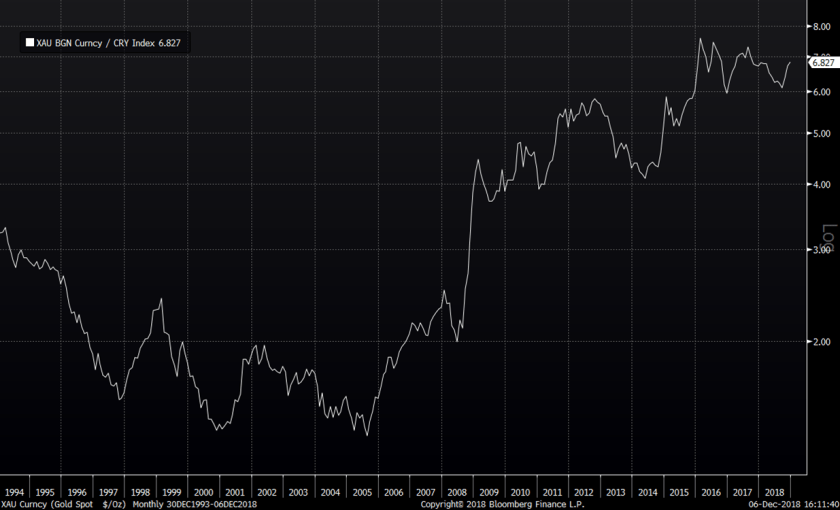
Gold has once again started out performing the broader commodity complex (the chart below is the price of gold divided by the CRB spot commodity index) after under performing during the first half of the year.


Over the longer-term, we can see the start of gold’s out performance over the commodity index dates back to late 2005 and the trend remains in favour of gold for now.


XAU CRB


2. The US dollar is losing momentum despite its strength

The dollar index $DXY is right above its 48-month moving average, having intermittently broken below it at the start of the year. The greenback, however, is losing momentum (second panel) with the 48-month rate of change making lower highs despite the continued strength in the dollar.


DXY ROC.png


3.  Emerging markets have been out performing the S&P 500 since early October

Emerging markets hit their recent lows at the end of October (top panel) but started outperforming the S&P 500 starting early October (bottom panel).


Coincidentally, emerging market out performance started soon after the deadline for tax-breaks for pension contributions by US corporations passed. Pension contributions made through mid-September of this year were deductible from income on tax returns being filed for 2017 — when the US corporate tax rate was still 35 per cent as compared to the 21 per cent in 2018. This one-time incentive encouraged US corporations to bring forward pension plan contributions and is likely to have had an out sized impact on US assets relative to non-US assets.


MXEF.png


Whilst not definitive by any means, the gold, US dollar and emerging markets charts, we think, appear to be sending the same message: weaker dollar, stronger commodities and non-US markets out performance relative to US markets.


4. Despite all the bad news, China too has stopped under performing the US

The signal from China is the weakest but follow through has the potential to be the strongest across emerging markets.


Chinese markets have remained above mid-October lows despite all the bad news in recent weeks. If the lows hold, we suspect China is likely to outperform the US in 2019.


SHCOMP.png


5. In the US, it is time to sell the rallies in growth to re-balance to value

The below chart shows the ratio of the S&P 500 Growth Index to the S&P 500 Value Index. Given the ratios distance from its 36-month moving average, portfolios should gradually be shifting away from growth to value over the course of 2019.


SPG.png


This post should not be considered as investment advice or a recommendation to purchase any particular security, strategy or investment product. References to specific securities and issuers are not intended to be, and should not be interpreted as, recommendations to purchase or sell such securities. Information contained herein has been obtained from sources believed to be reliable, but not guaranteed.

The Hawks Have Not Left the Building


“Difficulties are meant to rouse, not discourage. The human spirit is to grow strong by conflict.” – William Ellery Channing


“Very few negotiations are begun and concluded in the same sitting. It’s really rare. In fact, if you sit down and actually complete your negotiation in one sitting, you left stuff on the table.” – Christopher Voss


The Hawks Have Not Left the Building


A “typical feature of conflicts is that […] the intergroup conflict tends to be exacerbated and perpetuated by intragroup conflicts: by internal conflicts within each of the two contending parties. Even when there is growing interest on both sides in finding a way out of the conflict, movement toward negotiations is hampered by conflicts between the “doves” and the “hawks” –or the “moderates” and “extremists” –within each community”.  So wrote Herbert C. Kelman, the Richard Clarke Professor of Social Ethics, Emeritus at Harvard University, in Coalitions Across Conflict Lines: The Interplay of Conflicts and Between the Israeli and Palestinian Communities.


Kelman – renowned for his work in the Middle East and efforts to bring Israel and Palestine closer towards the goal of achieving peace in the Middle East – identifies, in the paper he authored in 1993, the “relationship between intergroup and intragroup conflict” as a key hurdle towards building coalitions across conflict lines. According to Kelman, “doves on the two sides and hawks on the two sides have common interests”. The hawks, unlike the doves, can pursue their interests without the need to coordinate with their counterparts on the opposing side. The hawks simply “by engaging in provocative actions or making threatening statements” reaffirm the enemy’s worst fears and embolden the hawks on the opposing side. The doves, on the other hand, “tend to be preoccupied with how their words will sound, and how their actions will look, at home, and with the immediate political consequences of what they say and do.” Therefore, the doves tend to take a more measured approach in communicating their views and underplay their side’s willingness to negotiate – the kind of behaviour that plays right into the hands of the hawks and reduces the effectiveness of the doves


Kelman’s recommendation to increase the chances of resolving a conflict by means of negotiation is to facilitate greater coordination between the doves on the opposing sides and minimise the involvement of the hawks.


The lessons from Professor Kelman’s work, we think, are highly relevant today. His insights provide a framework for determining the possibility of success in each round of negotiations between the US and China in resolving the on-going trade dispute.


Subsequent to the working dinner between President Trump and President Xi in Buenos Aires following the G20 summit, the headlines have focused on the temporary ceasefire in the trade dispute. President Trump has pledged to suspend the increase in tariffs on US dollars 200 billion of Chinese imports that was to go into effect on 1 January 2019 for a period of up to 90 days. In return President Xi has pledged that China will buy more US goods, ban exports of the opioid drug, and offered to reconsider the Qualcomm-NXP merger that failed to receive regulatory approval in China earlier in the year.


The three-month period, before the suspension of the tariff increase lapses, provides the two-sides a window of opportunity to initiate a new round of talks to tackle some of the more sensitive issues surrounding the trade dispute, including ownership and access to technology and intellectual property.


Despite the announcements lacking details, capital markets have reacted positively to the news of the temporary ceasefire and the Chinese yuan, on Monday, posted its largest single day gain since February 2016.


We are not surprised by the bare bones nature of the agreement following the meeting between President Trump and President Xi. The last minute inclusion of Peter Navarro, White House trade policy adviser and prominent China hawk, to the list of guests attending the working dinner was, at least to us, a clear signal that meaningful progress on trade relations during the meeting was unlikely. After all, Mr Navarro’s role in the Trump Administration, as The Atlantic puts it, is “to shepherd Trump’s more extreme ideas into reality, ensuring that the president’s convictions are not weakened as officials translate them from bully-pulpit shouts to negotiated legalese. He is the madman behind Trump’s “madman theory” approach to trade policy, there to make enemies and allies alike believe that the president can and will do anything to make America great again.”


Moreover, we do not expect a breakthrough in negotiations to materialise during the next round of talks between Washington and Beijing before the suspension of the increase in tariffs lapses. As long as hawks such as Peter Navarro and Robert E. Lighthizer continue to have President Trump’s ear our view is unlikely to change. If, however, the dovish members of the Trump Administration, such as Treasury Secretary Steve Mnuchin and Director of the National Economic Council Lawrence Kudlow, begin to take control of proceedings we would become much more hopeful of a positive resolution to the trade dispute.


For now, we see the temporary agreement between the two sides as providing much needed short-term respite for China. More importantly, we see President Trump’s offer of a temporary ceasefire without President Xi offering any concessions on sensitive issues, such as industrial policy, state funded subsidies and intellectual property rights, to be a symptom of the short-termism that seemingly besets democratically elected leaders without exception. Had the US equity capital markets not faltered recently and / or the Republicans not lost control of the House of Representatives, it is unlikely, we think, that President Trump would have been as acquiescent.


Liquidity Relief


In June in The Great Unwind and the Two Most Important Prices in the World we wrote:


“In the 362 months between end of May 1988 and today there have only been 81 months during which both the US 10-year treasury yield and the oil price have been above their respective 48-month moving averages – that is less than a quarter of the time.


Over the course of the last thirty years, the longest duration the two prices have concurrently been above their respective 48-month moving averages is the 25 month period between September 2005 and October 2007. Since May 1988, the two prices have only been above their respective 48-month moving averages for 5 or more consecutive months on only four other occasions: between (1) April and October 1996; (2) January and May 1995; (3) October 1999 and August 2000; and (4) July 2013 and August 2014.


Notably, annual global GDP growth has been negative on exactly five occasions since 1988 as well: 1997, 1998, 2001, 2009, and 2015. The squeeze due to sustainably high US interest rates and oil prices on the global economy is very real.”


We have updated the charts we presented alongside the above remarks and provide them below. (The periods during which both the US 10-year treasury yield and the oil price have been above their respective 48-month moving averages are shaded in grey in the two charts below.)


US 10-Year Treasury Yield10YSource: Bloomberg


West Texas Intermediate Crude (US dollars per barrel) WTISource: Bloomberg


The sharp drop in oil prices in recent weeks ended the 10 month streak of the 10-year Treasury yields and oil prices concurrently trading above their respective 48-month moving averages.


The recent drop in oil prices has coincided with the Fed weighing up the possibility of changing its policy guidance language. Several members of the Fed have suggested, according to the minutes of the FOMC’s November policy meeting, a “transition to statement language that [places] greater emphasis on the evaluation of incoming data in assessing the economic and policy outlook”. If the drop in oil prices sustains the data is likely soften and compel the Fed to dial back its hawkishness. With the base effects from the Trump Tax Cut also likely to recede in 2019, there is a distinct possibility that the Fed’s policy will be far less hawkish in 2019 than it has been over the course of 2018.


Lower (or range bound oil prices) and a more dovish Fed (even at the margin) are the conditions under which oil importing emerging markets tend to thrive. Although it is still too early to be sure, if oil prices fail to recover in the coming few months and the Fed is forced into a more dovish stance due to softer data, 2019 might just be the year to once again be long emerging markets.


This post should not be considered as investment advice or a recommendation to purchase any particular security, strategy or investment product. References to specific securities and issuers are not intended to be, and should not be interpreted as, recommendations to purchase or sell such securities. Information contained herein has been obtained from sources believed to be reliable, but not guaranteed.

US vs. Europe: A Closer Look at US Outperformance

 “Europe was created by history. America was created by philosophy.” – Margaret Thatcher

“In America everything goes and nothing matters, while in Europe nothing goes and everything matters.” – Philip Roth, American novelist and modern literary great

MSCI Europe Index vs. S&P 500 Index – Total Return in USD Indices TRSource: Bloomberg

In the ten years since the global financial crisis, European stocks have underperformed US stocks by a considerable margin.

In the first three years following the global financial crisis, the performance of the two markets were not too dissimilar. For the period commencing end of November 2008 through October 2011, the MSCI Europe and S&P 500 indices generated total returns of 46 and 53 per cent in US dollar terms, respectively.

Since late 2011, however, investors in European stocks have been left frustrated all the while investors in US stocks have enjoyed a long-running bull market. From 29 October 2011 through 20 November 2018, the MSCI Europe Index has generated a total return of 35.8 per cent in US dollar terms – 102.8 per cent less than the total return of the S&P 500 Index for the same period.

Despite, the strong outperformance of US equity markets relative to European equity markets, European stocks have been more expensive, on a trailing 12 month price-to-earnings basis, for the majority of the time since late 2011. Only since late 2017 have European equities become cheaper than US equities on a trailing 12 month price-to-earnings basis.

MSCI Europe vs. S&P500: Trailing 12 Month Price-to-Earnings RatioIndices PESource: Bloomberg

At an index level and since the global financial crisis, US companies have grown revenues and earnings at a faster clip than their European companies.

MSCI Europe vs. S&P500: Revenue Growth RevenueSource: Bloomberg

MSCI Europe vs. S&P500: Earnings Growth EarningsSource: Bloomberg

In terms of annual performance, European markets have outperformed US markets in three out of the nine calendar years since the global financial crisis: 2009, 2012, and 2017. Notably, in 2009 and 2017, European companies’ year-over-year earnings growth rates were far superior to those of American companies. While outperformance in 2012, can be attributed to Signor Draghi uttering those famous words that brought Europe back from the brink: “Whatever it takes”.

European earnings also outpaced US earnings during the years 2010 and 2013, yet US stocks outperformed European stocks. The year 2010 was, of course, when the sovereign debt crisis engulfed the peripheral members – Portugal, Italy, Ireland, Greece and Spain – of the European Monetary Union. While in 2013, although European equities underperformed US equities , it was still a very good year for Europe with the MSCI Europe Index generating a total return of around 23 per cent in US dollar terms versus around 28 per cent for the S&P 500 Index.

Digging a little deeper we compare the performance between US and European markets on a sector-by-sector basis, using the Global Investment Classification Standards (GICS) level 1 classifications.

US vs. Europe: 5- and 10-Year Sector Level Total Returns (USD) Sectors TR

Source: Bloomberg

Note: Periods ending 31 Oct 2018, calculated using monthly data, and excludes real estate

For both the 5- and 10-year periods for every sector except energy, US performance has been superior to European performance – we have excluded real estate as we were unable to gather clean data for the sector.

The US energy sector has lagged the European energy sector largely due to the much higher number of listed shale oil companies in the US. Shale oil plays witnessed significantly larger drawdowns as compared to blue chip oil producers following the sharp drop in oil prices in late 2014.

For the 10-year period ended 31 October 2018, the greatest difference in performance between the two markets comes from the consumer discretionary and information technology sectors. The consumer discretionary sector includes Amazon and used to include Netflix – a significant portion of US consumer discretionary outperformance can be attributed to Amazon and Netflix. While the outperformance of the American information technology sector has been broader than that of the consumer discretionary sector, a handful of stocks still have had an outsized impact on US outperformance. These stocks are namely Apple, Google, Facebook, Salesforce.com, Microsoft and Nvidia. (Note: In January 2018 the industry classification of Google, Facebook, and Netflix was changed to communication services).

The most comparable performance between the two markets, for the 10-year period, comes from the energy, materials, consumer staples and industrial sectors.

US vs. Europe: 5-Year Sector Level Revenue and Earnings Growth Sectors Rev Earnings

Source: Bloomberg

The above table details the 5 year (4-years for communication services) revenue and earnings growth by sector for US and European stocks.

Notably, in the US, net margins expanded from 2012 through 2017 across all sectors except energy. While in Europe, margins expanded for six sectors and declined for three – margins declined for the consumer discretionary, utilities and communication services sectors.

Median sector level revenue growth in the US for the five-year period was 20.96 per cent versus -2.26 per cent in Europe. (Earnings level comparisons are not meaningful in our opinion due to the artificially high earnings growth in certain sectors in Europe due to write-downs / exceptional circumstances in 2012 that understate earnings at the beginning of the period.)

Investment Perspective

The underperformance of European equities relative to US equities over the last five- and ten-years can predominantly be explained by fundamental factors. The challenge at this juncture, however, becomes that of identifying scenarios under which European stocks would arrest this trend of underperformance and begin outperforming the US stocks on a prolonged basis. We outline three such scenarios below.

  1. If the next ten years are not like the last ten years

If we assume, simplistically and without trying to predict how, that the next ten years will be unlike the last ten years then there should be a preference for non-US stocks over US stocks in general.

In capital markets dominated by passive allocations to market capitalisation weighted indices, the main drawback is that the allocation to ‘go-go’ stocks is at its highest when they are at their peak relative to other stocks in the indices.

With respect to the S&P 500 Index, the information technology, healthcare, financials, communication services and consumer discretionary sectors have gone from representing 58 per cent of the index at the start of 2009 to almost 70 per cent today. And within these sectors the increase in allocation to technology and technology related stocks has been even more pronounced.

S&P 500 Index Allocation by GICS Level 1SPXSource: Bloomberg

The change in sector allocation for US indices has been far more prominent than it has been for European indices – simply because the dispersion in performance between sectors has been much greater in the US. Over the last ten-years the top performing sector in the S&P 500 Index has outperformed the median sector by almost 260 per cent. In comparison, the total return differential between the best performing and median sectors is 63 per cent for the MSCI Europe Index.

MSCI Europe Index Allocation by GICS Level 1 MSCIESource: Bloomberg

  1. Labour not capital is rewarded

“The defining characteristic of economics in the 1950s is that the country got rich by making the poor less poor.

Average wages doubled from 1940 to 1948, then doubled again by 1963.

And those gains focused on those who had been left behind for decades before. The gap between rich and poor narrowed by an extraordinary amount.”

– Excerpt from Morgan Housel’s piece How This All Happened:

In the aftermath of the global financial crisis, unemployment levels shot up across the world. The global economy has spent the last ten-years healing from the damage wrought by the financial crisis. Slack in the labour market has been slow to dissipate and wages have remained stubbornly stagnant.

The corollary of the abundance of labour has been capital owners benefiting at the expense of labour.

As the global economy has healed, unemployment levels have gradually declined and wage pressures have slowly emerged. The European labour market, however, has much more slack than the US labour market – where unemployment levels are reaching twenty year lows and wage pressures are much more significant.

If demand for labour picks up globally, Europe has much more room to reduce unemployment levels before wages have to pick up meaningfully. Whereas the US has limited, if any, room for unemployment levels to drop lower without a meaningful increase in wage inflation. Therefore, Europe has greater flexibility to facilitate an improvement in household earnings without it impacting profit margins.

  1. Capital investment / infrastructure spending pick ups

US corporations have been far savvier capital allocators than their transatlantic counterparts – they have reduced equity, through share buy backs, and increased leverage during a time when servicing debt has never been easier. The behaviour of US corporations has been facilitated not only by record low interest rates but also by a limited need for capital investment – a deflationary environment incentivises the postponement of capital investment.

If capital investment picks up globally – motivated by inflation, infrastructure development led diplomacy, such as China’s Belt and Road Initiative, or a need to reconfigure global supply chains due to trade wars – European indices, with their much greater weighting to the industrial and materials sectors, are better placed to outperform the more technology leaning US indices in such a scenario.

Moreover, increasing capital investment may spur demand for credit in Europe and support the much maligned European financial services sector, which also happens to be the sector with the highest allocation in the MSCI Europe Index.

This post should not be considered as investment advice or a recommendation to purchase any particular security, strategy or investment product. References to specific securities and issuers are not intended to be, and should not be interpreted as, recommendations to purchase or sell such securities. Information contained herein has been obtained from sources believed to be reliable, but not guaranteed.

Humble Pie, US Credit Standards, General Electric and More


“I don’t enjoy eating humble pie; it never tastes good. But I do appreciate it when it happens.” – Simon Sinek

“I have more respect for a man who lets me know where he stands, even if he’s wrong, than the one who comes up like an angel and is nothing but a devil.” – Malcolm X


Humble Pie


Last week we wrote about our bullish view on oil prices. A few days later oil prices dropped by more than 7 per cent in one trading session, leaving us to eat a large portion of humble pie. Capital markets are tough and, on occasion, very cruel.

Following the sharp drop in oil prices this week, we were left scratching our heads and have since tried to understand what transpired. One of the best explanations we have found comes from the Macro Tourist blog. Rather than commenting on the piece, we provide the link here and urge you to read the analysis.

There is also an article from Bloomberg that presents Goldman Sachs’s reasoning for the recent drop in oil prices. We quote from the article:


Goldman analysts blamed the rout on a combination of momentum trading strategies, and selling from financial institutions which had helped arrange hedges on behalf of oil producers. Goldman is itself one of Wall Street’s top commodity banks.

“Increased selling of crude oil futures by swap dealers as they manage the risk incurred from existing producer hedging programs” was a key contributor to the rout, analysts including Jeff Currie said in a note.

Producers often lock in their price exposure by buying put options from banks. As prices fall toward the level where the options pay out, the banks are then forced to sell ever greater numbers of futures to hedge their own risk.”


Both articles point to technical as opposed to fundamental factors being behind the recent drop in oil prices. At the risk of becoming victims to confirmation bias, we tend to agree and continue to maintain our fundamental view.

As one of our former colleagues and dear friends often reminds us, market participants with an information advantage can only express themselves through the markets, ipso facto technicals, in such circumstances, front run fundamentals. If oil prices continue to drop from current levels we will have to accept that something that we do not know or understand is afoot in the oil market and close our long position in $XLE.


Fed’s Senior Loan Officer Opinion Survey on Bank Lending Practices


The Fed published the most recent edition of its quarterly “Senior Loan Officer Opinion Survey on Bank Lending Practices”. We quote from the Fed’s commentary on the key findings from the survey:


“Regarding loans to business borrowers, banks indicated that they eased their standards and terms for commercial and industrial (C&I) loans while experiencing weaker demand for such loans on balance. At the same time, banks reportedly left their standards unchanged on most categories of commercial real estate (CRE) loans, while demand reportedly weakened for most categories of such loans.

For loans to households, banks reported easing their standards on most categories of residential real estate (RRE) loans while experiencing weaker demand for such loans on balance. In contrast, banks reportedly left their standards on auto and credit card loans about unchanged, while demand for such loans also remained unchanged.”


The latest survey showed US banks continue to loosen lending standards for commercial and industrial loans as opposed to tightening them. Notably, the survey data suggests that banks are facing declining loan demand. Reasons for declining demand for credit include (i) increases in companies’ internally generated funds, (ii) reduced investment, and (iii) borrowers shifting their borrowing to new lenders.

One of the primary reasons we have remained bullish on the prospects of the US market, particularly since the ‘volmaggedon’ driven sell-off in February, is that we have seen little evidence of a meaningful tightening in either the availability of credit or credit standards in the US. The loan officer survey confirms as much.

Credit standards have been reliable leading indicators for commercial and industrial loan demand over the coming six to twelve months. It might well be that loosening credit standards stimulate demand for credit; or it may be that business prospects are bright enough to warrant a loosening of standards. With increases in companies’ internally generated funds being cited as one of the reasons for the softness in credit demand, it suggests strong business prospects are contributing to a loosening of standards.


General Electric Fears


Uneasiness around General Electric’s US dollars 114 billion in debt has been growing since October, when Standard & Poor’s downgraded the company’s credit rating to BBB+, just three notches above junk. In Novembers, Moody’s and Fitch Ratings followed suit, pushing the company’s bonds to new all-time lows. Making matters worse, newly appointed chief executive Larry Culp expressed in an interview that General Electric urgently needed to cut its debt and sell assets in order to do so – the company’s share price fell 10 per cent price drop in response.

With the Fed continuing to raise interest rates, we are not surprised to see a company with a weak balance sheet and poor business prospects suffering from the ills of excessive debt. General Electric is unlikely to be the last of such cases that we read about before the Fed is done raising rates.

For now, however, with credit standards remaining loose and corporate yields spreads remaining tight (despite the slight widening in recent weeks), we do not consider the fallout from the likes of General Electric to be systemic. Nonetheless, we would avoid allocating capital to high yield credit at this stage of the business cycle.


Paul Krugman on the Tax Cuts and Jobs Act and the Balance of Payments


In the Fed loan officer opinion survey one of the reasons highlighted for soft credit demand is reduced investment. This is somewhat perplexing when we consider the incentives provided by the Trump Tax Plan, or the Tax Cuts and Jobs Act (TCJA), for US corporations to repatriate capital back onshore and use it for capital investments.

Paul Krugman, the Nobel Prize winning economist, has an excellent piece titled “The Tax Cut and the Balance of Payments (Wonkish)” in the New York Times that provides some explanation and evidence for why the TCJA has not resulted in increased capital investment in the US. While urging you to go and read the piece yourself, we quote from the article to highlight some of the critical points Professor Krugman makes (emphasis added):


“What tax-cut advocates argued was that the rate of return in the U.S., net of taxes, is set by global forces. Suppose that there is a global rate of return r*; then the U.S. will have to offer r*/(1-t), where t is the corporate tax rate.

Now imagine cutting t; the figure shows a complete elimination of corporate taxes, but the logic is the same for simply reducing the rate. This should lead to inflows of capital from abroad, increasing the capital stock, which both raises GDP and reduces the rate of return. In the end the after-tax return on capital should be back where it started, with all of the tax cut passed through to wages instead.

The crucial point, however, is that for this to happen you have to have a large increase in the physical stock of capital – it’s not an immaculate financial transaction. This in turn means that those inflows of capital have to enable a massive wave of real investment in plant and equipment.”


[P]romoting capital inflows was at the heart of the halfway reasonable argument for the tax cut. So far, that argument appears to be not totally stupid, but also, as it happens, quite wrong.


“On its face, a corporate tax cut looks like a big giveaway to stockholders. Proponents of the TCJA claimed that this was misleading, because large capital inflows would ensure that the cut went to workers instead. But there’s no sign of those big inflows, so what looks like a big giveaway to stockholders is, in fact, a big giveaway to stockholders.

And about 35 percent of that giveaway is to foreigners, so the tax cut makes America as a whole poorer.”


What Professor Krugman presents invalidates one of the key strong US dollar / offshore US dollar shortage arguments out there: the repatriation of offshore US dollar holdings into the US by US corporations. As Professor Krugman puts it, repatriation by US corporations might just be an accounting gimmick that does not require cash to move between jurisdictions. If, in fact he is correct in his diagnosis, there are plenty of reasons to be optimistic about the prospects of non-US markets heading into 2019.


We have for several weeks been working on better understanding the offshore US dollar market, the monetary transmission mechanisms being utilised by the Fed in a post-QE world and what it means for the prospects of the US dollar and non-US markets. We hope to have our work completed to share with you in the coming few weeks.


This post should not be considered as investment advice or a recommendation to purchase any particular security, strategy or investment product. References to specific securities and issuers are not intended to be, and should not be interpreted as, recommendations to purchase or sell such securities. Information contained herein has been obtained from sources believed to be reliable, but not guaranteed.

Oil Market Misery | Amazon Ups Its Advertising Game


“This is a frightening statistic. More people vote in ‘American Idol’ than in any US election.” – Rush Limbaugh, American radio talk show host


“When luck plays a part in determining the consequences of your actions, you don’t want to study success to learn what strategy was used but rather study strategy to see whether it consistently led to success.” – The Success Equation: Untangling Skill and Luck in Business, Sports, and Investing by Michael J. Mauboussin


“Sometimes it is the people no one can imagine anything of who do the things no one can imagine.” – Alan Turing

Oil Market Misery


Since late September, when oil prices hit four year highs, Brent and WTI prices have slumped by more than 20 and 23 per cent, respectively. With economic sanctions fully re-imposed on Iran starting 5 November, the price action of oil market makes one wonder if it is yet another case of buying the rumour and selling news.

The drawdown in oil prices coming at a time when Chinese oil imports have surged to record levels makes it all the more glaring.


Brent.PNG


The sharp drop in oil prices over the last six weeks has attributed to a number of factors, including:


  • The growing conviction that the Trump Administration’s will take a soft-touch approach in policing adherence of the economic sanctions on Iran;


  • Rising US oil production;


  • Expected growth in production from OPEC member states after the easing of production quotas;


  • Global economic growth expectations for next year being revised downwards, in turn implying weaker oil demand growth next year; and


  • Higher than anticipated levels of crude inventory builds in the US.


On Monday, when the US administration announced granting waivers to eight of the largest importers of Iranian oil including China, India and Turkey, it was seen as confirmation that US’s enforcement of sanctions on Iran will be lukewarm at best. We do not agree with this view and see no reason for the Trump Administration to take anything except the most hard line approach towards Iran.

The waivers granted by the US have been on the cards ever since the Trump Administration first announced it would re-impose sanctions on Iran back in May. They are a means to avoid disruption in the oil market and to give importers ample time to shift away from Iranian oil.  The waivers have little to no impact on Iranian oil exports expectations for 2019 and beyond. Iranian oil exports are expected to drop from a peak of 2.5 million barrels per day in 2018 to less than 1 million barrels per day during the grace period afforded to the eight importers and drop off sharply once the waivers lapse.

We expect the Trump Administration to tighten the noose around the Iranian economy in 2019. We see no political or economic incentive for President Trump to act otherwise. Trump’s Middle Eastern allies – Saudi Arabia and Israel – are passionately in support of the sanctions and with mid-terms elections now out of the way Mr Trump is unlikely to agitate over a moderate rise in domestic gas prices at the cost of appearing to go easy on Iran.

Moreover, Mr Trump’s band of trade warriors and security hawks, with one eye on the on-going trade negotiations with China, are likely to be partial to higher oil prices and unlikely to want to see the Administration come across as being soft. Higher oil prices put a squeeze on the Chinese economy and increase its need for US dollars – factors that are likely to give the US an upper hand in trade related negotiations with China.

As it relates to rising US production capacity, nothing has changed since oil prices peaked in September to alleviate capacity constraints and infrastructure bottlenecks that would allow for an uninterrupted rise in US production. If anything, the recent drop in prices is bound to have a negative impact on future production growth.

We also think that worries about rising output from OPEC and Russia are misplaced. Although OPEC member states and Russia agreed in June to raise production by a combined 1 million barrels per day from May levels in order to offset expected losses from Iran and Venezuela, the Saudis and Russians are reportedly already contemplating production cuts for 2019 in response to the reason drop in prices. Our view is that oil exporting nations have little to no incentive to release their stronghold over the oil market.

High oil prices, a strong US dollar, rising interest rates and a slowing China certainly raise cause for concern for global economic prospects in 2019. Despite the concerns, OPEC still expects world oil demand to grow by 1.36 million barrels per day in 2019. Moreover, Chinese demand should continue to increase with at least two major refineries scheduled to start operations during the first half of 2019.

We consider the recent sell-off in oil to be largely sentiment driven and an unwinding of exceedingly bullish positioning by speculative accounts. Total net long exposure has declined by around 40 per cent in the last six weeks – representing almost 400 million barrels of crude.

Given that oil market supply-demand dynamics point to a probable supply deficit in 2019 and waivers for Iranian sanctions set to expire in six months, we expect oil prices to consolidate and move higher from current levels in the coming weeks and months – potentially even making a new cyclical high in the process.

Amazon Ups Its Advertising Game


Just a quick update on Amazon and another step the company has taken to increase its share of the advertising pie.

Amazon is shipping its first-ever printed holiday toy catalogue, titled “A Holiday of Play”, to millions of customers starting this month. Toys featured in the catalogue come with a QR code, allowing readers to instantly scan and shop for the products. Readers can also scan the product images in the catalogue with their Amazon App to get more information.

This is quite an interesting development in our view. We have a hunch that Amazon’s efforts have been heavily subsidised by advertising dollars from brands eager to feature their products and logos in the catalogue.

If Amazon’s efforts to blur the boundaries between offline and online prove successful in increasing consumer spending on its website, we can certainly envision a scenario where Amazon, the combination of the website and catalogues, becomes the go to destination for consumer brand advertising. Which half of the advertising pie Amazon gets its share from is likely to have far reaching implications for both digital incumbents (Google and Facebook) and traditional media.


This post should not be considered as investment advice or a recommendation to purchase any particular security, strategy or investment product. References to specific securities and issuers are not intended to be, and should not be interpreted as, recommendations to purchase or sell such securities. Information contained herein has been obtained from sources believed to be reliable, but not guaranteed.

The US Consumer is Not Immune and More


“Progress is impossible without change, and those who cannot change their minds cannot change anything.” – George Bernard Shaw


“The first rule of business is: Do other men for they would do you.” – Charles Dickens


“Globalization and trade liberalization were supposed to make us all better off through the mechanism of trickle-down economics. What we seemed to be seeing instead was trickle-up economics, accompanied by a destruction of democratic politics, as we moved ever closer to a system of ‘one dollar, one vote’ as opposed to ‘one person, one vote.’” – Joseph Stiglitz


The US Consumer is Not Immune from the Trade War


On 6 July 2018 the first tranche of tariffs imposed by the Trump Administration on China went into effect. The first tranche amounts to a 25 per cent import duty on 818 Chinese goods, representing US dollars 34 billion of China’s exports to the US in 2017. The first set of tariffs primarily target industrial goods such as aircraft engines and engine parts, cranes, nuclear reactors, electricity transformers and industrial magnets.


On 24 September 2018 the second tranche of tariffs on Chinese imports went into effect. Import duties on goods targeted in the second tranche started at 10 per cent and will rise to 25 per cent from 1 January 2019. All manner of Chinese goods, constituting roughly US dollars 200 billion of China’s exports to the US in 2017, have been hit in the second wave of tariffs. Targeted products include consumer goods such as furniture and luggage, agriculture products such as fruit and seafood, and industrial products such as chemicals and printed circuit boards.


The imposition of tariffs on Chinese goods has coincided with the gradual depreciation of the Chinese yuan. From its peak in April, the Chinese yuan has dropped by approximately 11 per cent. The drop in the currency is seen by many as a means by which China aims to counter the 10 per cent import duty imposed on its exports.


In reaction to the steady depreciation of the Chinese yuan this year, a narrative has started to take hold amongst those with a pro-tariff / anti-China disposition. That narrative being that the US consumer will be sheltered from the negative effects of a trade war as China will simply continue depreciating its currency in response to the tariffs. And a further 15 per cent decline in the value of the Chinese yuan relative to the US dollar is being anticipated ahead of the increase in import duties to 25 per cent on goods targeted in the second tranche of tariffs.


Chinese Yuan to US Dollar Exchange RateCNY.png

Source: Bloomberg


While the currency devaluation argument has merit, we do not agree with the view that the US consumer is immune to the effects of the trade war. A cheaper currency does not solve everything. Raw materials prices for Chinese exporters have increased in local currency terms and pushed up their costs, especially for producers with inputs comprising of commodities or imported products priced in US dollars.


Contrary to the view that the US consumer will not be impacted by trade wars, the recent decline of the Chinese yuan against the US dollar does not mean exporters can cut prices, in US dollar terms, to entirely offset the impact of the imposed tariffs, especially as most exporters operate with very thin profit margins.


In our estimation, under an optimistic scenario, the depreciation of the currency will only support to offset about 50 per cent of the import duties. Implying that, in most cases, the cost of tariffs will have to be shared by Chinese exporters and US consumers.


Prices for US consumers, however, should not start rising immediately.  US companies are preparing for the increased tariffs by purchasing higher levels of inventories from Chinese exporters. This also means that Chinese exporters are still to feel the pinch from tariffs. Based on anecdotal evidence we have gathered, Chinese exporters are inundated with orders and are operating at full capacity to ensure US bound orders are fulfilled in time to reach US ports ahead of the 1 January 2019 deadline.


A necessary corollary of the accelerated demand from US importers this year is that the first quarter of 2019 is going to be very tough for Chinese exporters. And US consumer prices are likely to start increasing in the second or third quarter of next year.


US consumer discretionary stocks have had a pretty good run in 2018; the time to start rotating out of the sector is approaching fast.


China Doubles Down on the Consumer


At last year’s 19th Annual Communist Party Congress Xi Jinping highlighted the need to tackle financial risks as one of the priorities for the Chinese leadership. Following the event, the government took steps to clampdown on the shadow banking sector. New regulations were introduced to close loopholes that were being exploited both by banks and asset management companies to funnel loans under the guise of investment. Consequently, credit growth in China has stalled – possibly even more so than the Chinese leadership may have anticipated.


China Money Supply M2 Year-over-YearM2.png

Source: Bloomberg


Facing the escalating trade dispute with the US and the marked slowdown in credit growth, China has been under pressure to use fiscal policy more aggressively to support the economy. The government has so far resisted the urge to ramp up fiscal spending – possibly wanting to hold on to the option to combat further economic challenges in 2019.


Instead of increasing fiscal spending the Chinese government has focused on reducing reserve requirements for banks and providing inducements to Chinese consumers to increase spending.


In our view, reserve requirements cuts are unlikely to change the trajectory of either credit or economic growth in the near term. The government still remains committed to its financial de-risking campaign, and while there have been noises about scaling it back, there is little sign of it happening.


China needs increased spending to spur its economy forward and if it is not going to come from the government, it has to come from the consumer. And this is where it seems the Chinese government is focusing its near terms economic policy.


A sharp rise in consumer and household debt is what drove China’s economic growth in recent years. The build-up in household debt has been quite rapid, and in some coastal areas of China debt levels are now quite high. Consequently, compelling Chinese consumers to borrow more does not appear to be a viable policy option. For this reason the Chinese government has instead opted for tax cuts.


In September, China implemented its first income tax cut in seven years. Moreover, the implementation date of the tax cut was brought forward to 1 October from 1 January. The major change in the new tax regime is an increase in the threshold for paying tax to Chinese yuan 60,000 in annual compensation, from Chinese yuan 42,000 – individuals will not pay tax on their first Chinese yuan 60,000 of income. This change delivers a tax cut at all levels of income.


Further cuts apply for the first four of China’s seven income-tax brackets. The benefits of the tax cuts are highest for those with monthly incomes of Chinese yuan 10,000 to 50,000, with the cuts representing approximately 6 per cent of their income.


In total, these changes, according to the Ministry of Finance, will reduce revenue from the personal income tax by about Chinese yuan 320 billion – equivalent to roughly 1 per cent of annual household income. Also according to the Ministry of Finance, the share of the population paying income tax will fall 44 per cent to 15 per cent as a result of the changes to the income tax law.


More recently, the Chinese government has introduced plans to let households deduct major expenses such as housing and education from their income taxes. An estimated 80 per cent of households stand to benefit from the change and the tax burden on lower and middle class households is expected to be reduced by as much as 25 to 30 per cent


There has also has been news that China is considering a tax cut to revive its flagging automotive market.


There is little reason to doubt that the Chinese government will do more to support growth as and when it becomes necessary. For now, however, it may be time to go bottom fishing in beaten down Chinese consumer plays.


This post should not be considered as investment advice or a recommendation to purchase any particular security, strategy or investment product. References to specific securities and issuers are not intended to be, and should not be interpreted as, recommendations to purchase or sell such securities. Information contained herein has been obtained from sources believed to be reliable, but not guaranteed.